
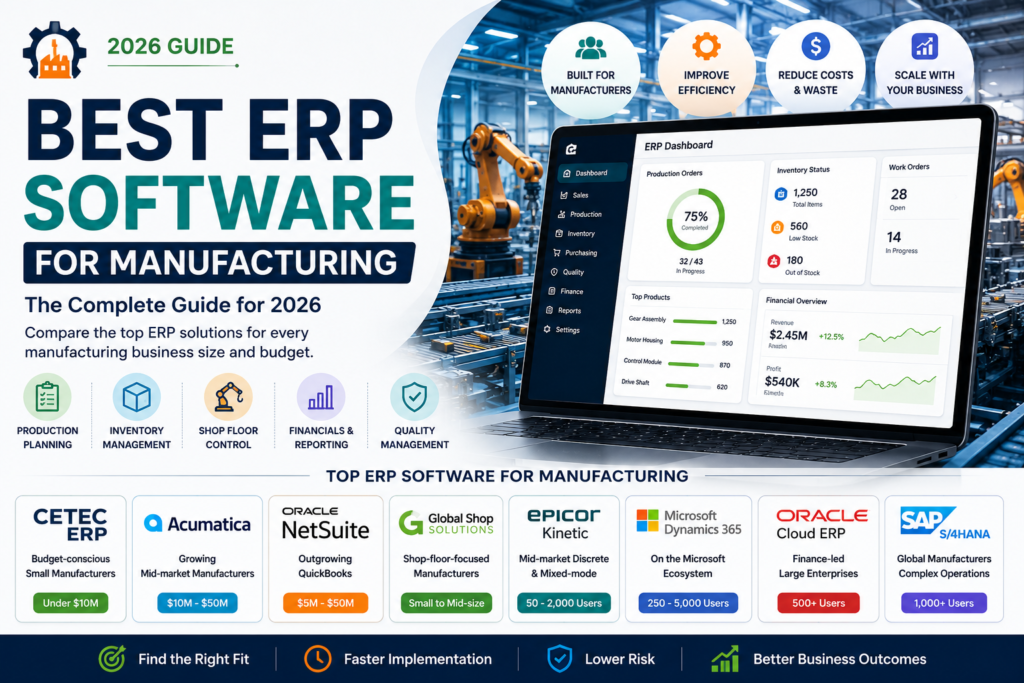
Most guides ranking the best ERP software for manufacturing fall into one of two traps: they either list ten vendors with nothing but praise for each one, or they give you an honest look at four enterprise systems while ignoring everything a small or mid-sized manufacturer could actually afford. This guide avoids both. It covers real options across every company size, gives you genuine strengths and weaknesses for each one instead of marketing copy, and explains how manufacturing ERP selection actually goes wrong in practice. You’ll get real pricing ranges, implementation timelines, and a framework for matching a system to your specific type of manufacturing. By the end, you’ll know exactly where to start your shortlist instead of drowning in a hundred-vendor directory.
What Manufacturing ERP Actually Does
Enterprise Resource Planning software for manufacturers connects the functions that used to live in separate spreadsheets and disconnected systems: production scheduling, inventory, purchasing, quality control, and financials, all updating from a single shared database. When a purchase order arrives, inventory updates automatically, accounts payable adjusts, and any production orders waiting on that component can move forward, all without someone manually re-entering the same data three times.
Manufacturing ERP specifically differs from general business ERP in a few important ways: it tracks bills of materials and production routings, manages work-in-progress inventory that regular retail ERP systems don’t need to handle, and supports either discrete manufacturing (built from a bill of materials, like an assembly line) or process manufacturing (built from a formula or recipe, like food and chemicals).
Why This Decision Is Harder Than It Looks
Manufacturing ERP implementations fail more often than most buyers expect. Industry research consistently shows a majority of ERP implementations run over budget, and the average cost of a failed manufacturing ERP implementation runs into seven figures once you count lost productivity, extended timelines, and remediation work. That risk doesn’t come primarily from bad software. It comes from mismatched software, a system sized for a company three times your revenue, or one that’s outgrown by your operations within two years.
This is also where a lot of manufacturing engineers and operations staff end up frustrated after the fact. A common pattern across manufacturing forums and practitioner discussions is regret over choosing a system based on a slick sales demo rather than an honest fit assessment, only to discover months into implementation that the system didn’t actually match how their shop floor really operates. Keeping that risk in mind while reading vendor descriptions, including the ones below, is worth doing deliberately rather than getting swept up in feature lists.
How We Evaluated These Systems
- Manufacturing depth: bill of materials, routing, shop floor control, and quality management, not just generic inventory tracking
- Total cost of ownership: licensing plus implementation, not just the advertised per-user price
- Implementation timeline and risk: how long it realistically takes to go live, and what commonly derails it
- Fit by company size: whether the system is genuinely designed for your revenue range or being stretched to fit
- Discrete vs. process manufacturing fit: since these are functionally different problems
Best ERP Software for Manufacturing: Quick Comparison
| System | Best For | Company Size | 3-Year TCO | Implementation |
| Cetec ERP | Budget-conscious small manufacturers | Under $10M revenue | Low ($3K-$40K total) | Weeks to a few months |
| Acumatica | Growing mid-market manufacturers | $10M-$50M revenue | Moderate | 3-6 months |
| NetSuite | Small-to-mid manufacturers outgrowing QuickBooks | $5M-$50M revenue | Moderate | 3-6 months |
| Global Shop Solutions | Shop-floor-focused discrete manufacturers | Small to mid-size | Moderate | 3-6 months |
| Epicor Kinetic | Mid-market discrete and mixed-mode manufacturers | 50-2,000 users | $250K-$800K | 4-9 months |
| Microsoft Dynamics 365 | Manufacturers on the Microsoft ecosystem | 250-5,000 users | $300K-$1.5M | 6-14 months |
| Oracle Cloud ERP | Finance-led large enterprises | 500+ users | $500K-$2M | 6-12 months |
| SAP S/4HANA | Global manufacturers, complex operations | 1,000+ users | $1M-$5M+ | 6-18 months |
Best ERP Software for Manufacturing, Reviewed
1. Cetec ERP
Cetec is a fully web-native manufacturing ERP built specifically to remove the high barriers to entry that keep small manufacturers stuck on spreadsheets. It covers CRM, quoting, inventory, mobile warehousing, and quality assurance at around $40 per user per month, with no minimum implementation fee in many cases.
Strengths: Extremely accessible pricing, fast setup, genuinely built for small manufacturers rather than a scaled-down enterprise product.
Weaknesses: Lighter reporting and analytics than larger competitors, smaller partner and integration ecosystem, less depth for complex multi-plant operations.
Best for: First-time ERP buyers under $10 million in revenue who need real manufacturing functionality without enterprise pricing.
2. Acumatica Cloud ERP
Acumatica uses consumption-based licensing rather than a strict per-user model, which lets manufacturers scale the system as they grow without renegotiating every time they add staff. It offers private, public, and hybrid cloud deployment options and integrates AI and IoT capabilities for mid-market manufacturers.
Strengths: Flexible licensing that scales with usage rather than headcount, strong technology investment, good fit for manufacturers between $10-50 million in revenue.
Weaknesses: Requires more implementation planning than the smallest ERP options, and manufacturing-specific depth trails purpose-built manufacturing systems like Epicor or Global Shop.
Best for: Growing manufacturers that expect significant headcount changes and want licensing that doesn’t punish growth.
3. NetSuite ERP
Owned by Oracle, NetSuite is frequently the first true ERP system smaller manufacturers adopt after outgrowing QuickBooks. It combines financial management, inventory, and supply chain visibility with straightforward cloud implementation and serves a large existing customer base.
Strengths: Smooth transition path from basic accounting software, strong financial management core, large support and partner ecosystem.
Weaknesses: Manufacturing-specific functionality (shop floor control, advanced scheduling) is less deep than purpose-built manufacturing ERP systems, and costs can climb quickly as modules are added.
Best for: Small-to-mid manufacturers whose next step is genuinely leaving spreadsheet-based or entry-level accounting software behind.
4. Global Shop Solutions
A family-owned company operating since 1976, Global Shop Solutions built its reputation specifically on shop-floor control and real-time inventory tracking for small-to-mid-sized manufacturers. It offers both cloud and on-premise deployment and is genuinely designed around discrete, blueprint-based manufacturing rather than adapted from a general business system.
Strengths: Deep shop-floor and scheduling functionality, personalized vendor support uncommon at this price point, purpose-built for discrete manufacturing.
Weaknesses: Less suited to process or formula-based manufacturing, and its smaller company size means a narrower long-term technology roadmap than larger competitors.
Best for: Discrete manufacturers, like machine shops and assembly-line operations, that prioritize shop-floor control above all else.
5. Epicor Kinetic
Epicor Kinetic, formerly Epicor ERP, is considered the gold-standard comparison point for mid-market discrete manufacturers. It offers both cloud and on-premises deployment, strong quality management, and increasingly, agentic AI features through its Prism module aimed at shop-floor productivity.
Strengths: Manufacturing-first design rather than general ERP adapted for manufacturing, native MES and advanced planning and scheduling integration, faster implementation than Tier 1 enterprise systems.
Weaknesses: Financial and CRM functionality trails Tier 1 systems like SAP or Oracle, and its global partner network is smaller, which can matter for multinational operations.
Best for: Mid-market discrete and engineer-to-order manufacturers between roughly 50 and 2,000 users who want deep manufacturing functionality without enterprise-level cost or timelines.
6. Microsoft Dynamics 365
Dynamics 365 Finance and Supply Chain Management is the natural choice for manufacturers already invested in Microsoft 365 and Azure. It’s modular, meaning companies can start with core financials and add manufacturing-specific modules as needed, and it integrates tightly with Power BI for reporting.
Strengths: Best-in-class fit for organizations already on the Microsoft stack, modular adoption path, strong business intelligence through Power BI.
Weaknesses: Manufacturing depth trails SAP in complex process manufacturing environments, and heavy customization often requires the separate Power Platform, adding cost and complexity.
Best for: Mid-to-large manufacturers already standardized on Microsoft tools that want ERP and CRM from a single vendor.
7. Oracle Cloud ERP
Oracle Cloud ERP is built around best-in-class financial management, with manufacturing modules layered on top rather than manufacturing being the system’s original core. It updates quarterly in the cloud and integrates strongly with Oracle’s broader database and cloud ecosystem.
Strengths: Excellent financial consolidation for multi-subsidiary organizations, strong embedded AI and machine learning, frequent cloud updates with minimal manual maintenance.
Weaknesses: Manufacturing-specific depth is good but not best-in-class compared to SAP or Epicor, and the implementation partner pool for manufacturing specifically is smaller than for finance-led deployments.
Best for: Large enterprises where finance-led consolidation across subsidiaries matters as much as manufacturing functionality.
8. SAP S/4HANA
SAP remains the deepest manufacturing ERP available, particularly for complex process manufacturing in pharmaceuticals, chemicals, and food, alongside large-scale discrete manufacturing. Its in-memory HANA database supports real-time analytics across multi-plant, multi-currency, multi-GAAP operations.
Strengths: The deepest manufacturing functionality of any system on this list, the largest implementation partner network globally, genuine real-time analytics at scale.
Weaknesses: The highest total cost of ownership by a wide margin, a genuinely steep learning curve, and it’s overkill for any manufacturer under roughly 1,000 users.
Best for: Global manufacturers with complex regulatory requirements and the budget and timeline to match SAP’s depth.
Discrete vs. Process Manufacturing: Match the System to Your Production Type
This distinction matters more than most buying guides acknowledge, and it applies across every vendor on this list, not just one or two examples.
Discrete manufacturing builds finished products from a bill of materials, think machine shops, electronics assembly, or automotive parts. Global Shop Solutions and Epicor Kinetic both lean strongly toward this model, with routing, CNC integration, and CAD connectivity as core strengths.
Process manufacturing builds products from a formula or recipe, think food, beverage, chemicals, and pharmaceuticals. This requires lot traceability, recipe management, and batch-level compliance documentation that discrete-focused systems often handle poorly. SAP S/4HANA has genuine depth here, and specialist systems like BatchMaster exist specifically for this use case if none of the systems above fit well.
If you’re not sure which category you fall into, or if you’re a mixed-mode manufacturer doing both, say so explicitly to any vendor during a demo, since a system’s marketing rarely volunteers where its weaknesses actually are.
What Manufacturers Actually Get Wrong During Selection
A recurring pattern shows up across manufacturing operations discussions and post-implementation reviews: the system gets picked based on what a CIO or IT lead already knows, or what looked most impressive in a demo, rather than what the actual production floor needs day to day. A few specific mistakes come up repeatedly:
- Skipping input from shop-floor staff during selection, then discovering after go-live that the system doesn’t match how work actually happens on the floor
- Underestimating data migration effort, particularly when moving off older, heavily customized legacy systems
- Choosing based on brand recognition rather than genuine fit for company size and manufacturing type
- Not budgeting realistic contingency, given that a majority of ERP implementations run over their original budget
Involving people who actually work the production floor, not just finance and IT, before signing a contract is one of the simplest ways to avoid a mismatch that only becomes obvious months into implementation.
Cloud vs. On-Premise: Which Fits Manufacturing Better
Most systems on this list now offer cloud deployment, and several still offer on-premise as an option.
Cloud ERP means lower upfront costs, automatic updates handled by the vendor, and typically faster deployment. It suits manufacturers without a large internal IT department.
On-premise ERP keeps data in-house and allows deeper customization, but requires more internal IT capacity to maintain and typically costs more upfront.
For most small and mid-sized manufacturers, cloud deployment is now the more practical default. Larger manufacturers with existing data center infrastructure and strict data residency requirements sometimes still prefer on-premise or hybrid deployment.
Frequently Asked Questions
What is the best ERP software for manufacturing overall?
There’s no single best system, it depends heavily on your company size and manufacturing type. Cetec ERP and NetSuite suit small manufacturers, Epicor Kinetic and Acumatica fit the mid-market well, and SAP S/4HANA leads for large, complex global operations.
What is the best ERP software for small manufacturing businesses specifically?
Cetec ERP offers the most accessible entry point given its low pricing and minimal implementation barriers. NetSuite and Global Shop Solutions are also strong options for small manufacturers ready to move beyond basic accounting software.
How long does manufacturing ERP implementation take?
This varies significantly by system and complexity. Smaller cloud-native systems can go live in weeks to a few months, while enterprise systems like SAP typically take 6 to 18 months depending on deployment scope and customization.
Why do manufacturing ERP implementations fail?
Most failures stem from mismatched software rather than defective software, choosing a system sized for a different company profile, skipping shop-floor input during selection, underestimating data migration, and inadequate budget contingency all contribute significantly.
Should I choose cloud or on-premise ERP for manufacturing?
Cloud deployment is the more practical default for most small and mid-sized manufacturers today, given lower upfront costs and vendor-managed updates. On-premise remains relevant mainly for larger manufacturers with existing IT infrastructure and strict data residency needs.
Conclusion
The best ERP software for manufacturing depends entirely on matching system complexity to your actual company size and production type, not on picking whichever name appears most often in search results. Cetec ERP and NetSuite offer real, accessible starting points for small manufacturers, Epicor Kinetic and Acumatica handle the mid-market well, and SAP S/4HANA remains the deepest option for global, complex operations that can support its cost and timeline. Whatever you choose, involve the people who’ll actually use the system daily before signing anything, budget real contingency beyond the vendor’s quoted price, and be honest with yourself about whether you’re a discrete or process manufacturer before comparing feature lists that don’t always disclose where a system’s real weaknesses sit.