
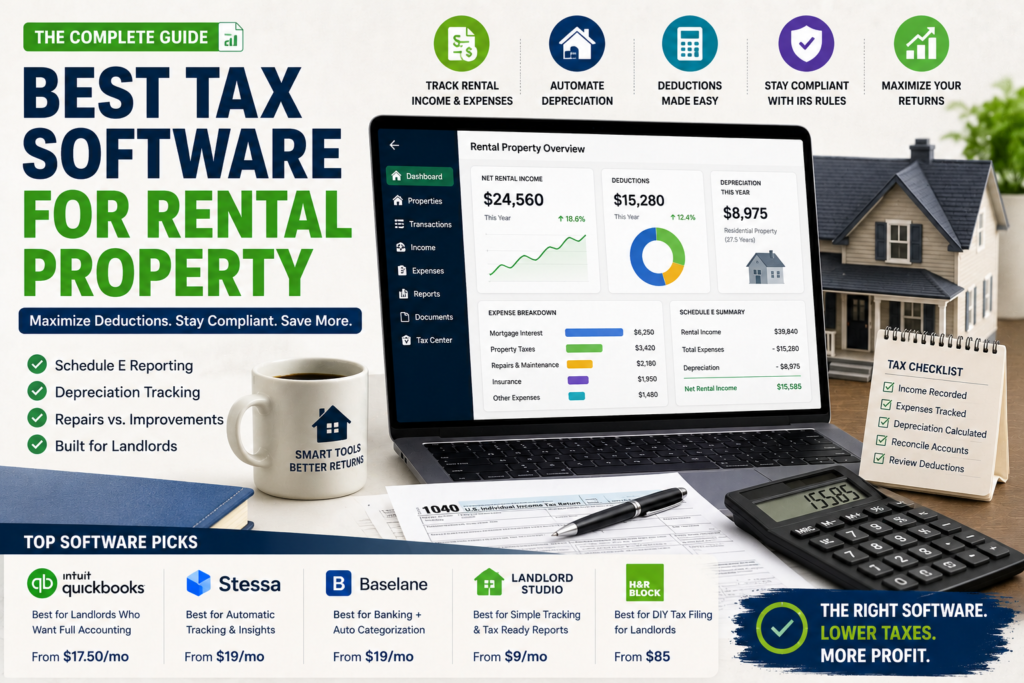
Tax season looks completely different depending on whether you own one rental unit or a growing portfolio. A single condo with a straightforward mortgage barely needs more than a guided filing tool. A portfolio spread across several properties, with mixed personal and rental use, depreciation schedules, and maybe a property manager involved, needs something closer to real accounting software with tax reporting built in. Most roundups treat every landlord as the same buyer and hand everyone the same three names. They are not the same buyer, and the best tax software for rental property depends heavily on how many doors you own and how hands on you want to be. This guide breaks the decision down by situation, explains what each tool actually does with your numbers, and flags the tax rules that trip people up regardless of which software you pick.
What Rental Property Tax Software Actually Needs to Do
Before comparing tools by name, it helps to know what separates software built for landlords from generic tax prep. Good rental property tax software should handle four things well.
Schedule E reporting. Rental income and expenses get reported on Schedule E, not the same place as W2 income, and the categories matter. Software built for landlords maps your transactions to these categories automatically instead of leaving you to guess.
Depreciation tracking. Residential rental property depreciates over 27.5 years under IRS rules. Missing this calculation, or getting it wrong, either costs you a real deduction or creates a mess when you eventually sell. Strong tax software for rental property calculates this for you and carries it forward every year without you having to remember the schedule.
Repairs versus improvements. A repair is deductible immediately. A capital improvement gets depreciated over time. Landlords misclassify this constantly, and it is one of the more common audit triggers on a rental return. The better tools prompt you to make this distinction as you enter each expense rather than sorting it out once a year under deadline pressure.
A path to your CPA or your own filing. Some platforms file your return directly. Others exist purely to organize your numbers and hand off a clean package to an accountant. Knowing which one you are buying matters, since they solve different problems.
If You Self File and Own One or Two Properties
This is the simplest case, and it is also the one existing guides already cover fairly well. TurboTax Premier remains the standard DIY choice here. It walks you through Schedule E line by line, calculates depreciation automatically, and separates repairs from capital improvements as part of its guided questions. If you sold a property this year or ran a 1031 exchange to defer capital gains, Premier also handles that reporting, which cheaper general filing tools often do not. Pricing for the Premier tier runs around $105 for federal filing as of this year, plus state fees, and you can add TurboTax Live if you want a CPA to review your return before you submit it.
The tradeoff is that TurboTax is fundamentally a once a year tool. It has no memory of your expenses in July, no bank feed quietly categorizing transactions in the background, and no ongoing bookkeeping between filing seasons. For exactly one or two units with simple, well kept records, that is a fair tradeoff and there is no reason to pay for more software than you need. Once you own more than a couple of properties, the lack of a year round system starts costing you more time chasing receipts than the software saves you at filing time.
If You Own Several Properties and Want the Bookkeeping Done Automatically
This is where most landlords who have been at it for a few years actually land, and it is the segment general tax filing software genuinely does not serve well. Baselane and Stessa both target this gap, though they approach it from different angles, and it is worth checking both before picking one.
Baselane pairs landlord banking with automatic transaction categorization, so income and expenses land in the correct Schedule E category as they happen instead of getting sorted in a rush every March. Because it is tied to your actual banking, it tends to appeal to landlords who want one system rather than a bank account plus a separate tracking spreadsheet.
Stessa leans more toward portfolio performance tracking, with dashboards that show which properties are actually profitable and which are dragging on returns, plus receipt scanning and a tax package it can hand directly to your CPA at year end. It does not require you to move your banking, which makes it a lighter lift if you already have a banking setup you like.
Neither Baselane nor Stessa files your return directly. What they do is remove the manual data entry that makes DIY filing painful once you are past two or three units, and hand your CPA, or TurboTax, a clean set of numbers instead of a shoebox of receipts every April. A related option worth knowing about here is Landlord Studio, which covers similar ground with automatic expense tracking and document storage, and tends to suit landlords who want something a bit lighter than a full accounting platform.
If You Need Real Double Entry Accounting, Not Just Tracking
Once a portfolio grows past a handful of units, or once multiple entities, partners, or lenders are involved, tools built purely for landlord convenience start to strain. REI Hub was built specifically for this tier. It runs on proper double entry accounting rather than simplified expense tracking, supports entity level reporting when properties sit inside different LLCs, and produces the kind of financial statements a lender or partner will actually accept, not just a tax summary.
QuickBooks is the other common answer at this level, mainly because bookkeepers and CPAs already know how to use it. The honest tradeoff is that QuickBooks was not built for real estate specifically, so property level tracking and Schedule E alignment require more manual setup than a purpose built tool would need. If your accountant already runs your business finances on QuickBooks, staying there usually beats switching platforms. If you are choosing fresh with no existing setup, a real estate specific option like REI Hub usually gets you to accurate numbers with less configuration.
If You Manage Properties for Other Owners, Not Just Yourself
This is a different job entirely, and it is where property management platforms like Buildium come in rather than landlord tax software. Beyond expense tracking, this tier needs trust accounting to keep owner funds separate from operating funds, itemized owner statements, management fee tracking, and in some states, compliance with specific trust account regulations. If you are only managing your own properties, this is more capability than you need and the pricing reflects that gap. If you are managing on behalf of clients, proper trust accounting is close to non negotiable, both for your own protection and for state licensing requirements in many places.
Quick Comparison
| Tool | Best Fit | Files Your Return | Ongoing Bookkeeping | Starting Cost |
| TurboTax Premier | One or two properties, DIY filers | Yes | No | Around $105 federal |
| Baselane | Several properties, wants banking and categorization combined | No | Yes | Free tier available |
| Stessa | Portfolio performance tracking, hands off to a CPA | No | Yes | Free tier available |
| Landlord Studio | Lighter expense tracking and document storage | No | Yes | Free tier available |
| REI Hub | Multiple entities, needs real financial statements | No | Yes, full accounting | Paid, no free tier |
| QuickBooks | Already used by your accountant | No | Yes, general purpose | Paid, no free tier |
| Buildium | Managing properties for other owners | No | Yes, with trust accounting | Around $62/month entry tier |
Checking each platform’s current pricing page before committing is worth doing, since landlord software plans change fairly often as these companies add features.
The Passive Loss Rule That Trips People Up Regardless of Software
This is worth flagging no matter which tool you choose, since no software fixes a misunderstanding of the underlying rule. Rental losses are generally treated as passive income and cannot offset W2 wages. There is a limited exception, up to $25,000, for landlords who actively participate in managing their properties, and that exception phases out between $100,000 and $150,000 in adjusted gross income. Software that tracks rental accounting year over year will carry forward any losses you cannot use yet, so they are not simply lost, just deferred until you have passive income to offset or you sell the property. A tool that only sees your numbers once a year at filing time is far more likely to miss this carryforward than one that tracks your position continuously.
A Few Questions Worth Answering Before You Pick One
Do I need software that files my return, or software that organizes my books? These are different products. TurboTax files. Baselane, Stessa, Landlord Studio, and REI Hub organize your numbers so filing, whether DIY or through a CPA, goes faster and more accurately.
How many properties justify paying for a dedicated platform? There is no strict cutoff, but most landlords feel the pain of manual tracking somewhere around three or four units, especially if they span more than one bank account or lender.
Will my CPA accept exports from this software? Worth confirming directly with your accountant before committing, since most CPAs have a strong preference and switching formats mid relationship creates extra work for everyone.
What This Actually Means for You
If you are still self managing a small handful of doors, start with whichever tracking tool matches how hands on you want to be. Choose Baselane if you want banking and categorization combined into one system, or Stessa if performance data across properties matters more to you than banking. Either way, feed clean numbers into TurboTax Premier or your CPA at year end rather than trying to reconstruct a year of transactions in April. Once you are dealing with multiple entities or outside partners, move to REI Hub or QuickBooks with a bookkeeper who genuinely understands real estate. And if the properties are not all yours, stop evaluating landlord software altogether and look at a property management platform like Buildium instead, since trust accounting is not optional once you are managing money on someone else’s behalf.
The mistake worth avoiding when choosing tax software for rental property is picking a tool sized for the portfolio you hope to have in five years instead of the one you actually have this April. Start where you are, and upgrade when the manual work actually starts costing you more time than the software would.