
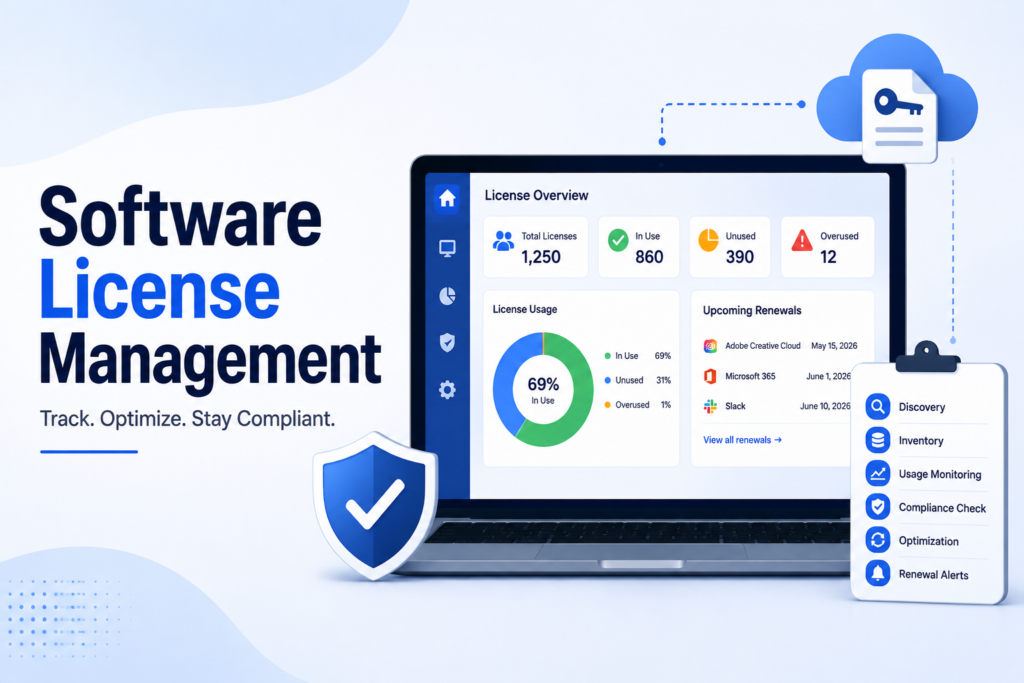
If your company holds more than a handful of business licenses, permits, or registrations across different cities, states, or countries, you already know how easy it is to lose track of a renewal date until a fine shows up. Business license management software exists specifically to solve that problem, and this guide covers how it actually works, which real tools are worth considering, and how to choose based on your company’s size and complexity. We’ll ground every category in real, named software rather than vague descriptions, and cover the compliance risks and security questions most guides skip. Whether you’re managing five licenses or five hundred across multiple jurisdictions, you’ll leave this guide knowing exactly what to look for. Let’s start with what this software actually does.
What Is Business License Management Software?
Business license management software is a centralized system that tracks, organizes, and manages the licenses, permits, and registrations a company needs to legally operate. This includes things like business operating licenses, professional certifications, sales tax permits, health department permits, liquor licenses, and industry-specific registrations, depending on what your business does and where it operates.
Instead of tracking renewal dates in a shared spreadsheet or relying on individual employees to remember deadlines, the software centralizes everything: what you hold, where it’s filed, when it expires, and what’s required to renew it.
Why Businesses Need Business License Tracking
Companies that operate in a single location with one or two licenses can often manage fine with a manual system. The complexity increases sharply once a business crosses a few thresholds:
- Multiple physical locations, each potentially requiring its own local business license
- Multi-state or multi-country operations, where licensing rules vary significantly by jurisdiction
- Regulated industries, like healthcare, financial services, food service, or cannabis, that carry additional layers of required permits
- Franchise or multi-entity structures, where each entity may need separate registrations
Missing a renewal isn’t just an inconvenience. Depending on the jurisdiction and license type, operating with a lapsed license can result in fines, forced closure, or in some regulated industries, loss of the ability to legally operate at all until the license is reinstated.
A Quick Note on How This Guide Was Built
We’re not selling a licensing platform, so nothing here is written to funnel you toward one specific vendor. Every tool named below is a real, established player in this space, and pricing information reflects what’s publicly available; several of these vendors, particularly at the enterprise tier, only provide custom quotes based on license volume and complexity.
How Business License Management Software Works
Most platforms in this category follow a similar core process, regardless of which specific vendor you choose.
- License inventory and data collection: Every existing license, permit, and registration gets logged into the system, including issue date, expiration date, renewal requirements, and the responsible jurisdiction.
- Centralized document storage: Actual license documents and supporting paperwork are stored digitally, so you’re not searching through filing cabinets or scattered email threads when a document is needed.
- Automated renewal alerts: The system flags upcoming expirations with enough lead time to complete renewal paperwork, rather than discovering a lapse after the fact.
- Jurisdiction requirement tracking: Since renewal requirements and fees vary by city, county, state, and country, better platforms maintain updated requirement data so you’re not researching each jurisdiction manually every renewal cycle.
- Compliance reporting: Dashboards and reports give a real-time view of your compliance status across every location and entity, useful both internally and during audits.
- Workflow and approval routing: Larger organizations often need renewal tasks routed to the right internal owner or external filing service, with approval steps before submission.
This cycle runs continuously rather than as a one-time setup, since licenses expire on an ongoing basis and new locations or registrations get added over time.
Business License Management Software: Real Tools Compared
Rather than describing this category abstractly, here’s how the established players actually differ.
| Tool | Best For | Standout Strength | Pricing |
| Avalara License Management | Mid-size to large multi-location businesses | Deep jurisdiction database, filing service option | Custom, based on license volume |
| CT Corporation (Wolters Kluwer) | Large enterprises and law firms managing entity compliance | Established filing network across all US jurisdictions | Custom |
| Harbor Compliance | Small to mid-size businesses wanting managed filing support | Combines software with actual filing assistance | Custom, per-license and subscription options |
| Symphia LM (CSC) | Large multinational corporations | Global registration and licensing coverage | Custom, enterprise-focused |
| LicenseSuite | Small businesses needing a straightforward research and tracking tool | Simple license research tool for new business setup | Per-report and subscription pricing |
None of these is universally best. Avalara and CT Corporation both suit organizations with genuine multi-jurisdiction complexity and often bundle filing services alongside tracking software. Harbor Compliance leans toward smaller and mid-size businesses that want some hands-on filing help rather than pure self-service software. LicenseSuite is a lighter-weight option, more useful for researching what licenses a new business needs than for ongoing enterprise-scale tracking.
Business License Tracking: Manual vs. Software-Based
It’s worth being honest about when a manual system is actually still reasonable, since not every business needs dedicated software.
A spreadsheet can work if:
- You hold fewer than five to ten licenses total
- You operate in a single jurisdiction
- One person is clearly responsible for tracking renewals
Dedicated software becomes worth it once:
- You’re managing licenses across multiple jurisdictions with different renewal cycles
- More than one person needs visibility into compliance status
- You’ve already missed a renewal deadline once and felt the cost of that mistake
- Your industry carries meaningful regulatory risk if a license lapses
If you’re genuinely unsure which category you fall into, the cost of a missed renewal is usually a more useful comparison point than the cost of the software itself.
Industries With the Highest License Management Complexity
Some industries carry meaningfully more licensing complexity than others, which affects how much value dedicated software actually adds.
Food service and hospitality often require health permits, liquor licenses, and food handler certifications, each with different renewal cycles and inspection requirements depending on the jurisdiction.
Healthcare involves both facility licenses and individual practitioner licenses, often requiring continuing education tracking alongside straightforward renewal dates.
Financial services carry state-by-state licensing requirements for many activities, including lending and money transmission, with some of the strictest compliance consequences for lapses.
Cannabis businesses face some of the most complex licensing environments currently in existence, with requirements that shift frequently as regulations continue to evolve state by state.
Multi-location retail and franchise operations need a local business license in nearly every jurisdiction where they operate, which becomes genuinely difficult to track manually once a company passes a handful of locations.
Security and Data Considerations
This is a topic most guides in this category skip, despite these platforms holding sensitive business registration data, tax identification numbers, and in some cases, individual professional license details.
- Data encryption, both in transit and at rest, is a baseline expectation for any platform storing license and registration documents
- Role-based access control matters particularly for larger organizations, since not every employee needs visibility into every entity’s licensing data
- Audit trail capability, so changes to license records and renewal actions are logged and traceable
- Data retention policy after contract termination, confirm what happens to your license history and documents if you switch vendors later
Given that license data often includes tax identification and registration details tied directly to your legal entities, it’s reasonable to ask any vendor directly about their security certifications rather than assuming.
How to Choose the Right Business License Management Software
- License volume and jurisdiction spread: A business with licenses in three states has very different needs than one with licenses in thirty
- Filing support needs: Decide whether you want pure tracking software or a vendor that also handles actual filing and renewal submission
- Integration requirements: Confirm compatibility with your existing entity management, accounting, or compliance systems
- Industry-specific requirements: Regulated industries like healthcare or cannabis may need a vendor with specific experience in that regulatory space
- Internal ownership: Decide who within your organization will own renewal workflows before selecting a tool, since software alone won’t fix an unclear ownership structure
Testing a shortlist against your actual license portfolio, rather than a generic demo, is the most reliable way to know whether a platform genuinely fits your complexity level.
Common Mistakes in Business License Management
A few recurring problems show up across organizations regardless of size:
- Relying on a single person’s memory or calendar for renewal tracking, creating a single point of failure if that person leaves or is out during a critical window
- Underestimating local jurisdiction requirements, since city and county rules can differ meaningfully even within the same state
- Treating license management as a one-time setup project rather than an ongoing operational process
- Failing to track licenses tied to individual employees, like professional certifications, separately from entity-level business licenses
Frequently Asked Questions
What is business license management software used for?
It’s used to track, organize, and manage the renewal and compliance status of business licenses, permits, and registrations, helping companies avoid fines and operational disruptions from lapsed licenses.
Do small businesses need business license management software?
Not always. A business with a small number of licenses in one jurisdiction can often manage with a well-maintained spreadsheet. Software becomes more valuable once you’re managing multiple jurisdictions or multiple people need visibility into compliance status.
What’s the difference between business license tracking and entity management?
Business license tracking focuses specifically on operational licenses and permits, while entity management covers the broader legal structure of a company, including corporate filings, registered agents, and governance records. Some vendors, like CT Corporation, offer both.
How much does business license management software cost?
Pricing varies significantly and is often custom-quoted based on license volume and the number of jurisdictions involved. Smaller, lighter-weight tools may offer per-report or straightforward subscription pricing instead.
Can business license management software file renewals automatically?
Some platforms, like Avalara and Harbor Compliance, offer optional filing services alongside their tracking software, while others provide tracking and alerts only, leaving the actual filing to your team.
Conclusion
Business license management software solves a genuinely operational problem: keeping track of renewal dates and compliance requirements across every jurisdiction your business touches, without relying on memory or a spreadsheet that nobody consistently updates. Avalara and CT Corporation suit organizations with real multi-jurisdiction complexity, Harbor Compliance offers a middle ground with hands-on filing support, and lighter tools like LicenseSuite work well for simpler, smaller-scale needs. Whatever you choose, weigh the software’s cost against the real cost of a missed renewal in your specific industry, confirm the vendor’s security practices directly, and make sure someone within your organization clearly owns the renewal process, since even the best software still needs a responsible person behind it.