
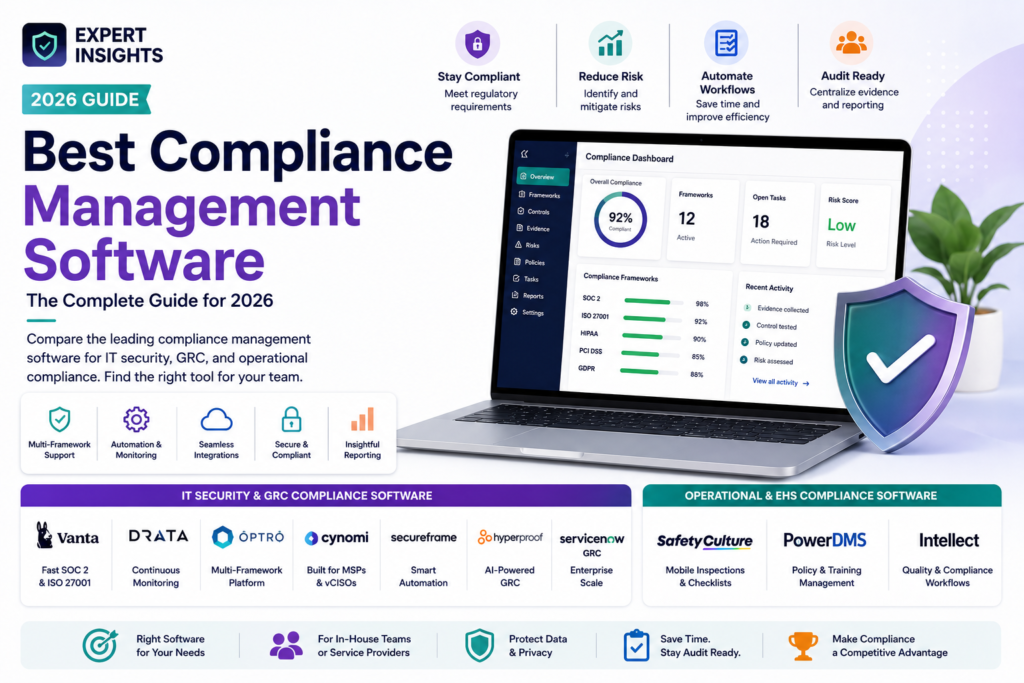
Searching for the best compliance management software usually starts with a frustrating discovery: half the results are enterprise GRC platforms built for SOC 2 and ISO 27001, and the other half are inspection and checklist apps built for workplace safety audits. They’re both called “compliance software,” and they solve completely different problems. This guide clears up that confusion first, then compares the leading platforms in each category honestly, without pretending our own product belongs at the top of the list, because we don’t have one to sell. You’ll get real pricing where it exists, a framework for figuring out which category you actually need, and guidance for two very different buyer types: teams managing their own compliance, and service providers managing compliance for multiple clients. By the end, you’ll know exactly which compliance management software fits your situation, not just which one has the flashiest homepage.
Table of Contents
Two Very Different Things Are Both Called “Compliance Software”
This is the first thing most buying guides skip, and it causes real confusion. There are two distinct categories hiding under the same search term.
IT security and GRC compliance software helps organizations achieve and maintain certifications like SOC 2, ISO 27001, HIPAA, PCI DSS, and GDPR. It automates evidence collection from cloud infrastructure, monitors technical controls continuously, and prepares you for security audits. Vanta, Drata, Optro, and Cynomi all live here.
Operational and EHS compliance software helps organizations manage physical safety, workplace inspections, policy training, and regulatory checklists across environmental, health, and safety standards. SafetyCulture, PowerDMS, and Intellect live here.
A handful of platforms, like Netwrix, sit closer to the technical side but with a broader operational reach. If you’re not sure which one you need, ask yourself one question: are you trying to prove your data and systems are secure to an auditor, or are you trying to keep physical operations, staff, and facilities compliant with safety regulations? The answer determines which half of this guide actually applies to you.
A Quick Note on How This Guide Was Built
We have no compliance product to sell, and no vendor here was allowed to rank itself. That matters, because several existing guides in this space are published directly by one of the platforms being reviewed, and that platform’s own product conveniently comes out on top using a rating scale it invented itself. We researched pricing, features, and buyer fit independently and applied the same criteria to every platform.
How We Evaluated These Platforms
- Framework coverage and how many regulatory or security standards are natively supported
- Automation depth for evidence collection, control testing, and continuous monitoring
- Pricing transparency rather than “contact sales” for every tier
- Buyer fit for in-house teams versus service providers managing multiple clients
- Integration breadth with cloud, identity, HR, and IT systems
- Implementation effort required to get a program running
Best IT Security and GRC Compliance Software
1. Vanta
Vanta focuses on continuous monitoring and automated evidence collection, with over 1,200 automated tests across infrastructure, identity, and endpoint tools, plus pre-mapped controls across 35+ frameworks including SOC 2 and ISO 27001. It’s a strong fit for cloud-first teams pursuing their first certification with minimal manual effort.
2. Drata
Drata offers always-on monitoring of technical controls with alerts when configurations drift, along with automatic evidence collection through cloud, identity, and source-control integrations. It supports 20+ frameworks and is commonly chosen by fast-growing SaaS companies that want continuous compliance without heavy manual upkeep.
3. Optro (formerly AuditBoard)
Optro is a connected risk platform supporting 40+ frameworks, built for organizations managing multiple frameworks and business units simultaneously. Its standout strength is cross-framework control mapping, meaning a single tested control can satisfy requirements across several standards at once, reducing duplicate audit work. It suits mid-market and enterprise teams that have outgrown spreadsheets and single-framework tools.
4. Cynomi
Cynomi is a channel-only platform built specifically for managed service providers and vCISO firms managing compliance across many client accounts from one dashboard. Its multi-tenant design and automated multi-framework assessments make it a distinct fit if you’re delivering compliance as a service rather than managing it for a single organization.
5. Secureframe
Secureframe combines automated monitoring and evidence collection with policy templates and AI-assisted remediation support, covering SOC 2, ISO 27001, HIPAA, PCI DSS, and GDPR. It’s frequently chosen by tech, SaaS, and eCommerce companies wanting fast onboarding.
6. Hyperproof
Hyperproof is an AI-powered GRC platform supporting over 100 frameworks, with stronger vendor risk management and reporting than most compliance-only tools. It fits mid-market and enterprise organizations with GRC needs that extend beyond a single certification.
7. ServiceNow GRC
ServiceNow GRC extends the Now Platform to unify compliance, risk, and ITSM workflows, and is typically chosen by large enterprises already standardized on ServiceNow for other operations.
Best Operational and EHS Compliance Software
1. SafetyCulture (formerly iAuditor)
SafetyCulture centers on customizable digital checklists, issue reporting, and mobile-first inspections, with a free tier for teams up to 10 people and a Premium plan around $24/month. It’s a strong entry point for physical operations, safety walkthroughs, and frontline compliance tracking.
2. PowerDMS
PowerDMS focuses on policy management and accreditation support, commonly used by public safety and healthcare organizations that need structured training alongside document control. Pricing depends on organization size.
3. Intellect
Intellect combines quality management with compliance workflows aligned to FDA and ISO standards, useful for organizations that need compliance and product quality managed together rather than separately.
Best Compliance Software at a Glance
| Platform | Category | Best For | Pricing |
| Vanta | IT security/GRC | Fast SOC 2/ISO 27001 certification | Tiered, contact sales |
| Drata | IT security/GRC | Continuous technical monitoring | Contact sales |
| Optro | IT security/GRC | Multi-framework, cross-mapping | Contact sales |
| Cynomi | IT security/GRC | MSPs and vCISO firms | Contact sales |
| Secureframe | IT security/GRC | Fast onboarding, tech/SaaS teams | Contact sales |
| Hyperproof | IT security/GRC | Broader GRC beyond certification | Contact sales |
| ServiceNow GRC | IT security/GRC | Enterprises standardized on ServiceNow | Custom |
| SafetyCulture | Operational/EHS | Mobile inspections, frontline safety | Free (10 users), $24/mo Premium |
| PowerDMS | Operational/EHS | Policy and accreditation management | Custom |
| Intellect | Operational/EHS | Quality and compliance combined | Custom |
Pricing for most enterprise-focused platforms remains behind a sales conversation, so it’s worth requesting quotes from two or three finalists to compare real numbers rather than relying on published starting prices alone.
In-House Compliance Teams vs. Service Providers: A Distinction That Changes Everything
Almost no buying guide separates these two use cases clearly, and the right software genuinely differs between them.
If you’re managing compliance for your own organization, prioritize framework coverage for your specific certifications, automation that reduces your team’s manual workload, and integrations with the specific cloud and identity tools you already run. Vanta, Drata, Secureframe, and Optro are built primarily for this.
If you’re managing compliance on behalf of multiple client organizations, as an MSP, MSSP, or vCISO firm, multi-tenancy is non-negotiable. You need one dashboard covering many clients, client-specific reporting, and the ability to standardize a process across accounts with different frameworks and maturity levels. Cynomi is purpose-built for this; a handful of other platforms offer it as an add-on rather than a core design principle, so confirm multi-tenant support directly before assuming it’s included.
Regulatory Compliance and Data Privacy: What to Check Regardless of Category
Whichever category you’re evaluating, a few checks apply universally, since compliance software itself handles sensitive regulatory and data privacy information:
- Does the platform itself hold relevant certifications? A tool helping you achieve SOC 2 should ideally maintain its own security certifications.
- How is evidence and audit data stored and encrypted? Ask about encryption at rest and in transit, not just marketing claims.
- Does it support your data residency requirements? Relevant if you operate under GDPR or other regional data privacy rules.
- What happens to your data if you switch platforms? Confirm export rights before signing a contract, not after.
Getting Started Without a Big Budget
Most guides in this space skip early-stage and budget-conscious buyers entirely, so it’s worth addressing directly. If you’re a small team pursuing your first SOC 2 or ISO 27001 certification, Vanta and Drata both offer tiered plans that scale with company size rather than requiring an enterprise-level commitment upfront, and SafetyCulture’s free plan for teams up to 10 covers basic operational compliance without any cost at all. Rather than jumping straight to a platform built for complex, multi-framework enterprise programs, matching the tool to your current stage avoids paying for capability you won’t use for another year or two.
Frequently Asked Questions
What is the best compliance management software overall?
It depends on which category you need. For IT security and GRC certifications like SOC 2 or ISO 27001, Vanta and Drata lead for fast-moving teams, while Optro and Hyperproof suit multi-framework enterprise programs. For operational and safety compliance, SafetyCulture is the most accessible starting point.
What’s the difference between compliance software and GRC software?
Compliance software typically focuses narrowly on meeting specific regulatory or certification requirements. GRC (governance, risk, and compliance) software extends further, connecting compliance to broader risk management and governance reporting, often across multiple business units.
Which frameworks should compliance management software support?
At minimum, look for support for the frameworks directly relevant to your industry, commonly SOC 2, ISO 27001, HIPAA, PCI DSS, and GDPR for technology companies. Confirm the platform can add new frameworks as regulations evolve, rather than requiring a full re-implementation.
How long does it take to implement compliance management software?
This varies significantly by platform and framework complexity. Cloud-native automated platforms like Vanta or Drata can often show initial results within weeks, while enterprise GRC suites with complex, multi-framework requirements may take several months to fully configure.
Do small businesses need compliance management software?
Not always immediately. If you’re managing a single framework with a small team, spreadsheets can work temporarily. Software becomes worthwhile once manual evidence collection and control tracking start consuming significant time, or once you’re managing more than one framework at once.
Conlcusion
The best compliance management software depends entirely on which category you actually need and who you’re managing compliance for. If you’re chasing a security certification, Vanta, Drata, and Secureframe offer the fastest path for smaller teams, while Optro and Hyperproof better suit complex, multi-framework enterprise programs. If your compliance work is operational or safety-focused, SafetyCulture and PowerDMS are built for that world instead, and mixing the two categories up is the single most common mistake in this search. Whatever you choose, confirm real pricing directly with vendors rather than relying on published starting rates, check the platform’s own data privacy and security practices before trusting it with your evidence, and match the tool’s complexity to your current stage rather than your eventual scale.