
Table of Contents
Add a header to begin generating the table of contents
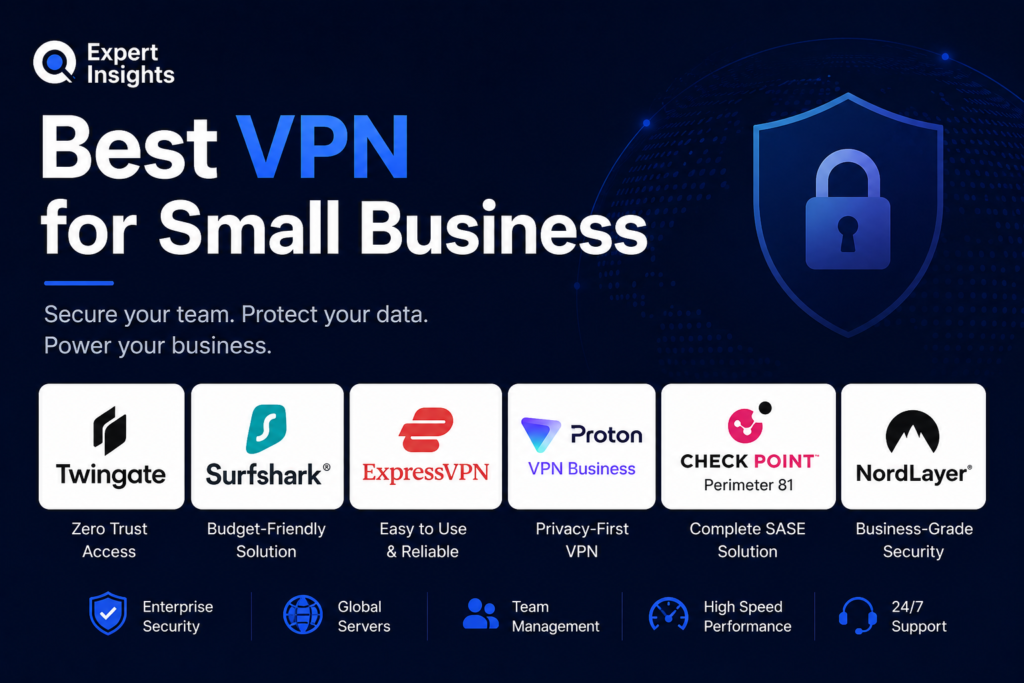
Choosing the best VPN for small business isn’t the same as picking a VPN for streaming or personal browsing. Your business needs centralized user management, dedicated IPs, compliance support, and a way to protect an entire team not just one device. In this guide, we tested and compared the top VPN for business options available right now, broke down real pricing, and mapped each pick to the type of company it actually fits. By the end, you’ll know exactly which service matches your team size, budget, and security needs — no guesswork required.
Table of Contents
Why Your Business Needs a VPN (Not Just a Personal One)
A VPN creates an encrypted internet connection between your employees’ devices and the internet, hiding their IP addresses and scrambling their traffic so outsiders can’t read it. For an individual, that mostly means privacy. For a business, it means something bigger: protecting client data, financial records, and internal communications from theft on public Wi-Fi, compromised networks, and man-in-the-middle attacks.
Cybersecurity threats aimed at small businesses have grown sharply, and attackers increasingly target smaller companies precisely because they assume the security is weaker than at large enterprises. A single leaked customer database or intercepted login can cost far more than a VPN subscription ever would in fines, lost trust, and downtime.
A VPN for office use does a few things a consumer VPN typically can’t:
- Lets an admin manage every employee’s access from one dashboard
- Assigns dedicated IP addresses so your team always connects from a recognized, trusted address
- Supports site-to-site connections between multiple office locations
- Integrates with tools like Okta, Google Workspace, or Azure AD for single sign-on
- Logs connection activity so IT can spot unusual behavior early
If your team is still relying on a free VPN or no VPN at all, that’s the first gap worth closing.
VPN vs. ZTNA vs. SASE: What’s Actually Different
Before comparing providers, it helps to understand that “business VPN” now covers a few different technologies, and picking the wrong category can leave gaps in your security:
- Traditional VPN encrypts traffic and puts users on a shared network, similar to a personal VPN but with business controls layered on top. Good for smaller teams that mainly need encrypted remote access.
- ZTNA (Zero Trust Network Access) authenticates users per-application instead of per-network, so an employee only sees the specific tool or file server they’re approved for, not the entire company network. Better for businesses handling sensitive data or working with contractors.
- SASE (Secure Access Service Edge) bundles VPN/ZTNA with a cloud firewall, secure web gateway, and DNS filtering into one platform, aimed at growing companies that want several security tools working together instead of managed separately.
Most small businesses do fine starting with a traditional business VPN and moving toward ZTNA or SASE as the team and its security needs grow.
How We Evaluated These VPNs
To identify genuinely useful picks, each provider was assessed on:
- Security protocols: encryption strength, kill switch reliability, no-logs practices
- Team management: how easy it is to add, remove, or restrict users
- Compliance support: whether the provider helps meet standards like HIPAA or GDPR
- Pricing transparency: real per-user costs, not just promotional teaser rates
- Deployment time: how quickly a non-technical team can get set up
- Server network and speed: enough coverage and bandwidth for daily business use
Best VPN for Small Business: Quick Comparison
| Provider | Best For | Starting Price | Min. Users | Dedicated IP | SSO Support |
| NordLayer | Overall balance of price and features | $8/user/month | 5 | Yes | Yes |
| Perimeter 81 (Check Point SASE) | Growing teams needing full SASE | $8/user/month + $50/gateway | 10 | Yes | Yes |
| Proton VPN Business | Privacy-first teams, EU compliance | Custom (tiered) | 1 | Yes | Yes |
| ExpressVPN | Very small teams / freelancers | ~$5-8/user/month | 1 | No | No |
| Surfshark | Budget teams with many devices | ~$5/user/month | 1 | No | No |
| Twingate | Teams wanting ZTNA over classic VPN | $6/user/month | 1 | N/A (ZTNA) | Yes |
Pricing changes often, so it’s worth checking each provider’s current plans before committing to annual billing.
The Best VPN for Business, Reviewed
1. NordLayer — Best Overall for Small Businesses
NordLayer is built by Nord Security, the team behind NordVPN, but designed specifically for company use. It runs on the NordLynx protocol (a WireGuard-based tunnel built for speed) and includes a centralized control panel where IT can create network segments, assign dedicated IPs, and monitor connection activity.
What makes it a strong starting point is the low user minimum — just 5 seats — so it doesn’t force very small teams into enterprise-sized contracts. Plans run from around $8 to $18 per user per month depending on features, with all infrastructure costs bundled into that price rather than billed separately.
Good for: Teams of 5-50 that want strong security without hiring a dedicated network engineer to manage it.
2. Perimeter 81 (Check Point SASE) — Best for Full Cloud Security
Perimeter 81 goes beyond a standard VPN by bundling Zero Trust access, a cloud firewall, and a secure web gateway into one product. That’s genuinely useful if you’re currently juggling several separate security tools and want one dashboard instead. The tradeoff is a separate $50/month gateway fee on top of per-user pricing, and a 10-user minimum, which makes it a better fit once a company has outgrown the basics.
Good for: Growing businesses ready to consolidate multiple security tools into one platform.
3. Proton VPN Business — Best for Compliance-Conscious Teams
Proton VPN’s business plans stand out for privacy credentials open-source apps, a no-logs policy backed by Swiss privacy law, and strong support for teams that need to stay aligned with GDPR. It offers three tiers (Essentials, Professional, and Business Suite), plus MDM support so IT can manage devices remotely. Each user can connect up to 10 devices at once, which is generous compared to most competitors.
Good for: EU-based businesses, healthcare, legal, or any company where regulatory compliance is non-negotiable.
4. ExpressVPN — Best for Freelancers and Very Small Teams
ExpressVPN isn’t purpose-built for business, but its strong encryption, reliable kill switch, and simultaneous device support make it workable for freelancers, consultants, or teams of two or three who don’t need centralized admin controls yet. It lacks dedicated IPs and SSO, so it’s a starting point rather than a long-term scalable solution.
Good for: Solopreneurs and very small teams that want strong security without a business-specific setup process.
5. Surfshark — Best Budget Pick for Multi-Device Teams
Surfshark doesn’t offer a dedicated business plan, but its unlimited simultaneous connections mean one account can realistically cover a small team’s laptops, phones, and tablets without paying per seat. It’s a reasonable budget option, though it lacks the centralized management and compliance features larger teams eventually need.
Good for: Cash-conscious startups where every employee uses multiple devices.
6. Twingate — Best for Zero Trust Access
Twingate skips the traditional VPN model entirely in favor of ZTNA, authenticating each user for specific applications rather than the whole network. Setup takes a bit more configuration than a plug-and-play VPN, but it’s a strong fit for businesses working with contractors or remote staff who shouldn’t have blanket network access.
Good for: Businesses that want to limit exposure by giving employees access only to what they specifically need.
Compliance: Matching a VPN to Your Regulatory Needs
If your business handles sensitive data, the right VPN for business should support the compliance standards relevant to your industry:
- HIPAA (healthcare): Look for providers offering signed business associate agreements and audit logging NordLayer and Proton VPN Business both support HIPAA-aligned setups.
- GDPR (EU data protection): Proton VPN’s Swiss/EU legal base makes it a natural fit for companies handling EU customer data.
- SOC 2 / ISO 27001: Most established business VPNs, including NordLayer and Perimeter 81, maintain these certifications worth confirming directly before signing a contract.
- PCI-DSS (payment processing): Ensure the provider supports network segmentation, since isolating payment systems from general traffic is often a requirement.
It’s worth checking a provider’s current compliance documentation directly, since certifications and legal frameworks are updated periodically.
How to Choose the Right VPN for Your Business Size
2-10 employees: Prioritize simplicity and low minimums. NordLayer’s 5-user minimum or a flexible option like Surfshark keeps costs predictable without unnecessary complexity.
11-50 employees: This is where centralized management starts to matter. NordLayer and Perimeter 81 both scale well here, offering role-based access and activity monitoring.
50+ employees: Consider a full SASE platform like Perimeter 81 or explore ZTNA with Twingate, especially if you have multiple office locations, remote contractors, or strict compliance requirements.
If you’re not sure which category your business falls into yet, it’s worth reviewing your current setup number of devices, remote staff, and sensitive data handled before comparing specific plans.
Frequently Asked Questions
Do small businesses really need a VPN?
Yes. Even a two-person team handling client data or financial information benefits from encrypting that traffic, especially when working from cafes, co-working spaces, or home networks that aren’t secured to business standards.
What’s the difference between a VPN for business and a personal VPN?
A personal VPN protects one user’s privacy. A business VPN adds centralized management, dedicated IPs, team billing, and often compliance support features an individual consumer plan doesn’t include.
Is a free VPN safe for business use?
Generally not. Free VPNs often log and sell user data, lack dedicated business support, and don’t offer the admin controls needed to manage a team securely.
Can a VPN replace a firewall?
No. A VPN encrypts your connection; a firewall controls what traffic is allowed in and out of your network. Larger businesses typically need both, which is why SASE platforms bundle them together.
How much does a business VPN cost?
Most providers charge between $5 and $18 per user per month, depending on features like dedicated IPs, SSO, and compliance support. Some, like Perimeter 81, add separate infrastructure fees on top.
Conclusion
The best VPN for small business ultimately depends on your team size, budget, and how much regulatory weight your industry carries. NordLayer offers the strongest all-around balance for most growing teams, Proton VPN Business is the smarter pick if compliance is a priority, and Perimeter 81 makes sense once you’re ready to consolidate multiple security tools into one. Whichever you choose, moving off consumer-grade or free VPNs is one of the simplest security upgrades a small business can make take the time to compare current pricing and features before you commit to a plan.