
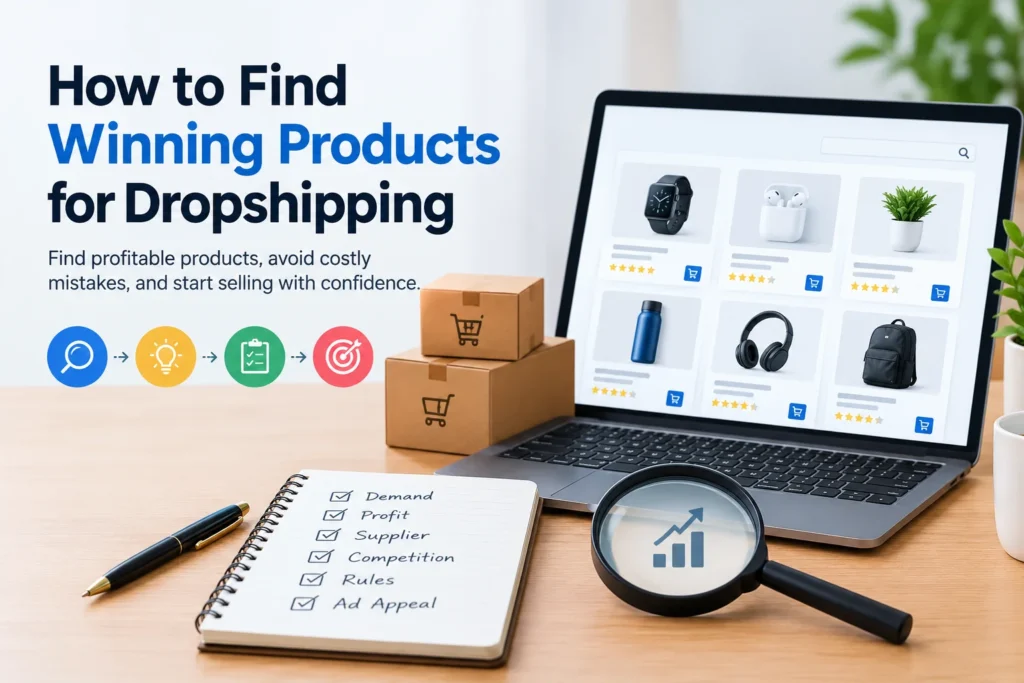
To find winning products for dropshipping, look for items that still make a profit after every cost, that a reliable supplier can deliver on time, and that give shoppers a reason to buy from you. Finding ideas is easy. Rejecting weak ones is the real skill, and it saves you the most money.
This guide on how to find winning products for dropshipping gives you a scorecard to judge any product, shows where to look for ideas, and explains how to validate a dropshipping product on paper before you spend on ads. It includes a worked example of a good product and a bad one. Examples use US dollars, and rules differ by country.
Table of Contents
What Makes a Product Winning?
A winning product is not a viral item or a bestseller. It is a product where the profit on each order is larger than the cost of getting that order. Popularity helps only if the numbers work.
That means three things must be true together. Shoppers want it, so there is real product demand. You can sell it for more than it costs you in total. And a supplier can ship it reliably, without damage, delays or safety problems.
Many guides describe winning products by their features, such as wow factor or low competition. Those are guesses until you check the maths, so this guide starts with the numbers.
The Product Scorecard
Score every idea against these seven checks before you contact a supplier. This is general guidance based on how dropshipping costs work, not a formula proven by data.
| Check | Good sign | Red flag |
| Demand | Steady interest across the year, or a clear seasonal peak you can plan for | Interest that spiked once and fell, or no search interest at all |
| Profit per order | Profit before ads is well above what a sale will cost you to win | Profit before ads is smaller than a realistic ad cost per sale |
| Size and weight | Small, light and easy to pack | Bulky, heavy or fragile, which raises shipping cost and damage |
| Supplier | Clear shipping times, tracking and a returns process | Slow replies, no tracking, unclear stock |
| Difference | You can offer a better bundle, clearer details or a stronger niche message | Identical to hundreds of stores, competing only on price |
| Rules and rights | No safety certification needed, and no brand or design you do not own | Branded goods, copied designs, children’s products or regulated items |
| Ad friendly | Easy to show and explain in a short photo or video | Needs long explanation or looks the same as cheaper items |
My recommendation is to treat profit, supplier and rules as pass or fail. If any of those three fails, drop the product, even if the other four checks look strong. Demand, difference and ad appeal can be improved, but a bad margin or an unsafe product cannot.
Where to Find Product Ideas
No single source reveals a winner. Use several, then run each idea through the scorecard.
Marketplace bestseller lists
Large marketplaces show best seller and trending lists by category. They tell you what already sells, so demand is proven. They also show how many sellers compete and how low prices have fallen. A product at the top of a list is often a crowded one.
Search trends and product demand
Google Trends shows how interest in a search term changes over time. It shows relative popularity on a scale up to 100, not the number of searches, so a score of 100 only marks the peak for that term in the chosen place and period. Use it to see whether interest is rising, steady or seasonal, and compare two products side by side.
Social media
Short video apps and image sites show what people are talking about and buying. They are good at spotting trends early. They are poor at telling you whether those viewers actually buy, so treat a viral clip as a prompt to research, not as proof.
Competitor stores and ads
Look at stores that sell in your niche and the ads they run. A store that keeps advertising the same product for weeks may be making sales, but this is a hint, not data. Note the price, the offer and what the product page promises, then ask how you could present it better.
Reviews and everyday problems
One of the most reliable ways to identify products that solve everyday problems is to read reviews. Look at three star and one star reviews of existing products and note repeated complaints, such as a weak strap or a missing feature. A complaint that appears again and again is a gap in the market.
Also think about daily frustrations in a narrow group, such as pet owners, new parents or home cooks. Products that fix a clear problem are easier to explain and often easier to sell than gadgets with vague benefits.
How to Validate a Dropshipping Product on Paper
Before any ad runs, compare the most you can afford to pay for one sale against what a sale usually costs. The first number is your profit before advertising. Here is an illustrative comparison of two products. Every figure is an assumption, not market data.
| Per order (illustration) | Product A | Product B |
| Selling price | $45.00 | $18.00 |
| Less: supplier price | $15.00 | $9.00 |
| Less: supplier shipping | $4.00 | $3.00 |
| Less: payment fee, 2.9 percent plus $0.30 | $1.61 | $0.82 |
| Less: refunds, 5 percent and 8 percent of price | $2.25 | $1.44 |
| Profit before ads (the most you can spend per sale) | $22.14 | $3.74 |
| Ad cost per sale at $0.40 per click and 2.5 percent conversion | $16.00 | $16.00 |
| Profit per order | $6.14 | Loss of $12.26 |
Both products attract the same traffic at the same cost, yet the results are opposite. Product A leaves $6.14 per order, or about 13.6 percent of its price. Product B cannot cover even its own ad cost, because its profit before ads is only $3.74.
You can also work out the break even conversion rate. Divide the click cost by the profit before ads. For Product A that is $0.40 divided by $22.14, about 1.8 percent. For Product B it is $0.40 divided by $3.74, about 10.7 percent, which is unrealistic for most stores. If your break even rate is far above what stores normally convert, reject the product.
Before you search for a supplier, build this table for your own product idea. It takes ten minutes and prevents most bad launches.
Check the Supplier and Shipping Before You Commit
A product is only winning if it arrives. Ask each supplier for shipping times, tracking, stock updates and their returns process, and compare answers from more than one. Order a sample and check the quality, packaging and delivery time. Then keep a backup supplier for any product that starts to sell.
In the US, the FTC also expects you to have a reasonable basis for any delivery time you promise, so ask for real shipping times before you publish them.
Run a Small Test
Validation on paper tells you whether a product could work. A small test tells you whether it does. Decide your budget before you start, and decide when you will stop.
Here is an illustrative stop rule using Product A. The most you can spend per sale is $22.14, so set a test budget of about twice that, which is $44. At $0.40 per click, that buys around 110 clicks. If your true conversion rate were 2.5 percent, you would expect about three sales. Seeing none after 110 clicks would happen only about 6 percent of the time, so it is a reasonable sign to pause and review the page, the price or the audience.
A small test shows direction, not proof. A few orders cannot tell you the real conversion rate, so keep tracking cost per sale, refunds and delivery complaints as the numbers grow. Scale only when many orders support the result.
Products to Avoid at the Start
- Fragile items such as glass or ceramics. They break in transit, and returns erase the profit.
- Heavy or bulky items such as furniture. Shipping costs eat the margin, and returns are expensive.
- Regulated products. Products for children, cosmetics, supplements and electronics can need testing, labeling or certification. In the US, the Consumer Product Safety Commission’s guide for online sellers says importers must issue a Children’s Product Certificate for children’s products and that selling a recalled product is illegal.
- Branded or copied products. Using logos, characters or copied designs can get listings removed and accounts closed.
- Commodity items. Anything you cannot differentiate from hundreds of other stores.
Read the CPSC’s Online Sellers Safety Guide if you sell into the United States, and check the equivalent rules for your own country.
Do You Need Paid Research Tools?
Not at the beginning. Free tools and manual research can answer most early questions: trend charts for demand, marketplace lists for competition and reviews for problems. Paid tools can save time by collecting sales estimates and ad data in one place.
Estimates from any tool are modelled guesses, not the seller’s real sales. Use them to compare ideas against each other, not to promise yourself a result. Whatever you use, finish with the profit table above, because no tool knows your supplier costs.
Common Mistakes
- Copying viral products without checking the numbers. A trending video says nothing about margin.
- Counting only the supplier price. Reading only the highest price and ignoring shipping, fees and refunds.
- Forgetting advertising. Ads are often the largest cost per order.
- Skipping samples. Test products with a real order before you sell them.
- Judging a product too early. A handful of clicks cannot tell you much.
- Falling in love with one idea. Many ideas fail, and that is normal.
Quick Answers
How many products should I start with?
There is no proven number. Start with a few products that pass the scorecard, so you can test each one properly and give customers good service.
Are trending products worth selling?
Sometimes, but trends fade quickly and many sellers rush in. A trend is worth testing only if the profit, supplier and rules checks pass and you can move fast.
Can I find winning products for free?
You can find ideas for free through trend charts, marketplace lists, social media and reviews. You still need small amounts of money for samples and a test, so plan for those.
Conclusion
Finding a winning product comes down to a repeatable process: collect ideas from several sources, score them, prove the profit on paper and then run a small test. Start by building the profit table for three ideas and keep the one that passes. Trends, fees and rules change, so recheck your numbers before each new launch.