
Table of Contents
How to Market a New Product: A Launch Plan That Fits Your Budget
To market a new product, work out exactly who it is for, test whether they want it, explain why it is better than what they use today, and then put your effort into the two or three channels where those people already pay attention. Measure what happens and adjust. A launch is easier when the work starts before the product is finished.
This guide follows that order in time. It covers market research, positioning, pricing, channel choice, budgeting, a launch timeline, working with creators, and what to do when results are weak. It uses a made up product as an example, so the steps are easy to picture, and it avoids numbers that nobody can back up.
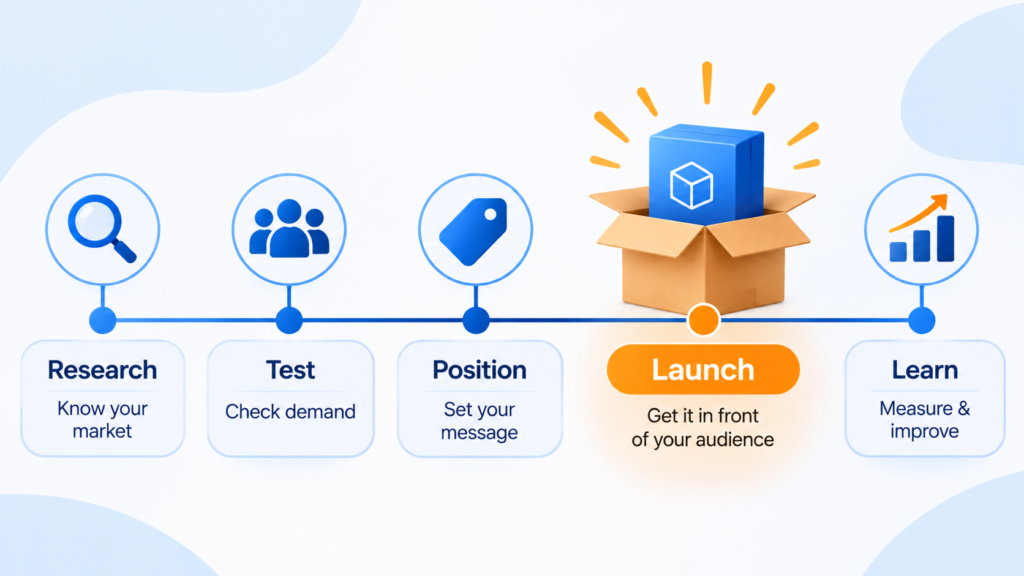
The short answer: five moves in order
- Define the buyer. Identify the ideal customers for a new product before you choose a single channel.
- Test demand. Use interviews, a waitlist or pre orders to find out whether people will act.
- Sharpen the message and price. Say who it is for, what problem it solves and why it is different.
- Pick a few channels. Match them to your product type, not to what is fashionable.
- Measure and adjust. Track a small set of numbers and change one thing at a time.
Identify the ideal customers for a new product
Most weak launches start with a vague audience such as everyone who likes fitness. The US Small Business Administration advises describing your audience in detail, including market size, demographics, unique traits and trends that affect demand. Treat that as the starting point for your market research.
A useful way to do it is to write an ideal customer profile. This is a short description of the person or business most likely to buy and keep using your product. Cover these points:
- Who they are: role or situation, location and income range if it matters.
- The problem: what they are trying to get done and what frustrates them now.
- Current alternative: what they use today, including doing nothing.
- Where they look: the search terms, platforms, communities and shops they use.
- What stops them buying: price, trust, effort to switch or lack of awareness.
You do not need an expensive study. Talk to 10 to 15 people who fit the profile, read reviews of competing products, and look at the questions people ask in forums and search results. Write down the exact words they use, because those words belong in your messaging.
A good first step is to book short calls with five people who fit your profile and ask what they use today and what annoys them.
Test demand before you spend on marketing
Marketing a product nobody wants only costs more. Before a big spend, look for evidence that people will act. These signals are in rough order of strength:
| Signal | What it tells you | Limit |
| Interview comments | The problem is real | People are polite and often say yes |
| Waitlist sign ups | Interest exists | Sign ups cost nothing, so they overstate demand |
| Pre orders or deposits | People will pay | Harder to collect, but much more reliable |
| Early users coming back | The product delivers | Needs a working version |
Decide in advance what result would convince you to continue, such as a number of pre orders or a share of interview subjects who ask when they can buy. That threshold is your own judgment, and no source defines a universal good result, but writing it down stops you from reading every signal as success.
Position and price your product
Positioning is the short statement of who the product is for, what it does and why it is different from the alternative. A simple template is: for [customer] who [problem], our [product] provides [main benefit], unlike [current alternative]. If you cannot fill it in with specifics, the message is not ready.
On price, set it from value and costs, not from the lowest competitor. Deep launch discounts can attract buyers who only come back for discounts, and they make later price rises harder. A limited early access offer for your waitlist is often a safer way to reward early interest.
Be careful with claims. The Federal Trade Commission says in its small business guidance that advertising must be truthful and not deceptive, and that advertisers must have evidence for their claims before the ad runs, including implied claims. That is US guidance, so check the rules where you sell.
Choose channels that fit your product
A long list of tactics is less useful than a short list that fits. Start with the product type. The table below is a practical starting point based on common logic, not a ranking from any study.
| Product type | Good first channels | Why |
| Physical consumer product | Short video, search and marketplace listings, email list, creators | Buyers discover visually and compare prices |
| Software or app | Search content, product demos, communities, partner listings | Buyers research before trying |
| Local product or service | Google Business Profile, local search, referrals, local partnerships | Buyers look near them |
| Business to business product | Search, LinkedIn, direct outreach, webinars, case studies | Buying takes longer and involves more people |
Pick two or three. It is better to do a few well than to spread a small budget across many. Your customer research should tell you where your buyers already spend time. If you are choosing among ways to promote a new product, ask a simple question: where would my ideal customer see this and trust it?
Set a marketing budget without guessing
You will see rules such as spending a fixed share of revenue on marketing. They are rules of thumb, and the sources I checked do not agree on a standard. The SBA, for example, asks business owners to include a complete breakdown of marketing costs and to track them, but it does not give a percentage.
A more honest method is to build the budget from the goal backward:
- Set a goal, for example a number of first customers.
- Estimate how many people you need to reach and how many will buy. Use your waitlist and test results, not hope.
- Add the cost of reaching them, including ads, creator fees, samples, tools and your own time.
- Add a reserve for testing, since your first estimates will be wrong.
If the number is more than you can afford, narrow the goal or the audience instead of stretching the budget across everything. Marketing a new product with no budget is possible, but it trades money for time: you rely on interviews, communities, search content, email and your own outreach.
A product launch strategy timeline
The timing below is a suggested routine, not a documented standard. Adjust it to your sales cycle.
| When | Focus | Key actions |
| 8 to 6 weeks before | Research and validation | Ideal customer profile, interviews, positioning draft, waitlist page |
| 6 to 3 weeks before | Build interest | Publish useful content, share behind the scenes, invite early testers, agree creator terms |
| 2 weeks before | Prepare | Final price, support ready, tracking links set, launch emails written, claims checked |
| Launch week | Announce | Email the waitlist first, publish on chosen channels, reply to every question quickly |
| First 30 days | Learn | Collect reviews and feedback, fix confusing points, compare results to your goal |
| Days 30 to 90 | Improve | Double down on what worked, stop what did not, plan the next release or offer |
Support deserves attention before launch week. Questions in the first days are a chance to win trust, and slow replies lose it.
Work with creators and the press
Creators and journalists give you borrowed attention, but only when the fit is right. Choose people whose audience matches your ideal customer, send a clear and short pitch, and make it easy to try the product.
Put the terms in writing. The Federal Trade Commission’s guidance for influencers says to disclose any financial, employment, personal or family relationship with a brand, and to place the disclosure where it is hard to miss. For video, it says to put the disclosure in the video itself, not only in the description. Agree these rules before anything is posted, and recheck the current guidance.
Measure the launch with a few numbers
Choose a handful of figures that connect to your goal. Too many numbers create confusion.
| Measure | What it means | Why it matters |
| Waitlist to purchase rate | Share of sign ups who buy | Shows the quality of your interest |
| Conversion rate | Share of visitors who buy or sign up | Shows whether the page and offer work |
| Customer acquisition cost | Total marketing spend divided by new customers | Shows whether growth is affordable |
| Repeat purchase or retention | Share of buyers who return | Shows whether the product satisfies |
| Review and feedback themes | What buyers praise or dislike | Guides messaging and product fixes |
The SBA says marketing plans should be maintained at least once a year. During a launch it makes sense to look weekly at first, then monthly. Use tracking links so you can tell which channel produced each visit or sale.
What to do when the launch is slow
| What you see | Likely cause | What to try |
| Few visitors | The audience cannot find you | Change channels or sharpen targeting, and ask customers where they look |
| Visitors but few sales | The message or price does not convince | Test a clearer headline, add proof and compare with the alternative |
| Sign ups but no purchases | Interest was casual | Ask why they have not bought and offer a small early access reason to act |
| Sales but few repeats | The product or onboarding disappoints | Read reviews, fix the first use experience and follow up with buyers |
This table is a practical guide, not a diagnosis. Change one thing at a time so you can tell what made the difference.
A worked example: Tidewell water bottle
Here is a made up example to show the steps together. Tidewell is not a real product, and the figures are illustrations.
- Ideal customer: commuters in a city who carry a bottle daily and dislike the taste of tap water. Alternative: disposable bottles and cheap filter jugs at home.
- Demand test: interviews with 12 commuters and a waitlist page. A target of 100 refundable pre orders, set by the founder, decides whether to proceed.
- Positioning: for commuters who want better tasting water on the go, Tidewell is a bottle with a replaceable filter, unlike bulky filter jugs.
- Channels: short videos of the daily commute, search content about water taste, and an email list. A few commuter creators receive free bottles with written disclosure terms.
- Budget: built from the goal of 300 first customers, not from a percentage.
- After launch: reviews show the filter is hard to replace, so the team films a short guide and changes the instructions.
Common mistakes
- Starting marketing only after the product is finished.
- Describing the audience as everyone.
- Counting waitlist sign ups as sales.
- Using many channels with a tiny budget.
- Making claims in ads that you cannot support.
- Ignoring early customer feedback.
Frequently asked questions
How early should marketing start?
There is no fixed rule. Starting research and a waitlist several weeks before launch gives you time to learn and build interest, as the timeline above suggests.
How much should I spend on marketing a new product?
There is no single correct percentage. Build a budget from your goal, track the costs and review them as results arrive.
Can I market a new product with no budget?
Yes, but expect to spend time instead of money. Use interviews, communities, search content, email and direct outreach.
Which channel should I try first?
Start where your ideal customer already looks, using the product type table as a guide, and test two or three channels.
How long until I see results?
No source gives a reliable timeline. Treat the first 30 days as learning and judge results against your own goal.
Conclusion
Marketing a new product works best as a sequence: know the buyer, test demand, say something specific, choose a few fitting channels, and measure honestly. Your numbers will be rough at first, and that is normal. This week, write your ideal customer profile and book five conversations. What you hear will shape every later decision.