
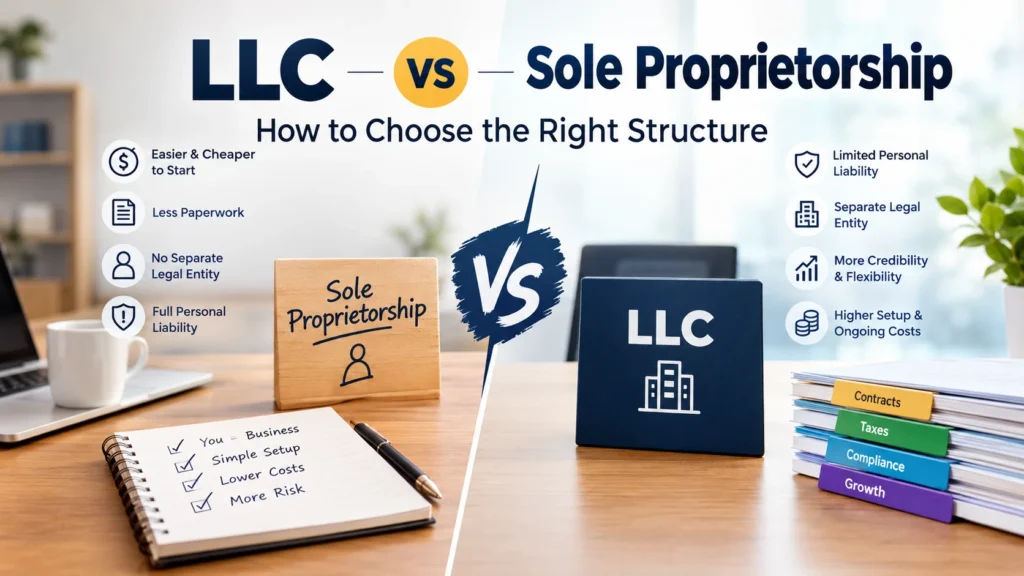
The main difference in LLC vs sole proprietorship is that a sole proprietorship is you, running a business with no legal separation, while a limited liability company is a separate legal entity that can limit how far business debts and claims reach your personal assets. A sole proprietorship is simpler and cheaper to start. An LLC costs more to set up and maintain, and it does not protect you from everything. This guide explains the difference in plain English, with worked examples for liability, cost and tax, and shows when each structure tends to make sense. It is written for the United States, and the rules differ in other countries.
General information only, not legal, tax or financial advice. Tax rules, state fees and filing requirements change and vary by state and situation. Talk to a licensed accountant or attorney before you choose or change a business structure.
Table of Contents
LLC vs Sole Proprietorship at a Glance
| Factor | Sole proprietorship | LLC |
| Legal status | No separate entity from you | Separate legal entity created by state filing |
| Setup | Often automatic when you start selling, though local licenses may apply | File formation documents with your state and pay a fee |
| Personal liability | You are personally responsible for business debts and claims | Generally limited to what you put in, with important exceptions |
| Default tax | Profit reported on your personal return | A single member LLC is usually taxed the same way by default |
| Ongoing costs | Few or none | Annual reports or fees in many states, plus a registered agent |
| Paperwork | Light | More formal records and separate finances expected |
| Owners | One person | One or more members |
| Credibility | Basic | Often seen as more established by banks and clients |
LLC vs Sole Proprietorship for Beginners: Five Plain Answers
- Do I need an LLC to start? You can start as a sole proprietor and form an LLC later, once your risk, income or plans grow. Check whether your trade needs a local license from day one.
- Do I need an EIN as a sole proprietor? Often not. Many sole proprietors use their Social Security number, but you generally need an EIN if you hire employees or meet certain tax filing situations, and many people get one anyway to avoid sharing their number. Confirm on the IRS website.
- Does an LLC lower my taxes? Not by default. A single member LLC is usually taxed like a sole proprietorship. Savings, if any, come from an S corporation election at higher profits.
- Should I open a separate bank account? Yes in practice, and for an LLC it is essential. A separate account makes records easier and helps protect the LLC’s separation from you.
- Can I switch later? Usually yes, but the process takes steps, and you must move contracts, licenses and accounts. See the conversion steps below.
What Is a Sole Proprietorship?
A sole proprietorship is the default form of business for one person who sells goods or services without forming a company. There is no filing to create it. You and the business are the same legal person. A freelancer, a tutor or a market stall owner is usually a sole proprietor unless they have formed something else.
You can trade under your own name or a business name. A business name, often called a DBA, short for doing business as, is only a trade name. Registering one does not change your legal structure or give you any liability protection.
What Is a Limited Liability Company?
A limited liability company, or LLC, is a business structure created by filing documents with a state. The owners are called members. The LLC can sign contracts, own property, open bank accounts and sue or be sued in its own name.
An LLC is a legal structure, not a tax category. By default, the IRS treats a single member LLC like a sole proprietorship for income tax, and a multi member LLC like a partnership. An LLC can also choose to be taxed as an S corporation or a C corporation. This is why many people say an LLC offers more tax flexibility.
How Much Protection Does an LLC Give Your Personal Assets?
Personal assets are things you own outside the business, such as your home, savings and car. As a sole proprietor, a court can generally reach them to pay business debts or a judgment. An LLC creates a legal wall between the business and its owner, so creditors of the company normally look to the company’s assets first.
This illustration shows the idea. A customer wins a $60,000 judgment against a business. The business has $20,000 in assets, and the owner has $150,000 in home equity and savings.
| Situation (illustrative) | Sole proprietorship | LLC |
| Business assets available | $20,000 | $20,000 |
| Personal assets exposed | Yes, for the remaining $40,000 and more | Generally no |
| Possible outcome | Business assets and some personal assets | Mostly limited to business assets |
An LLC does not protect you in every case.
- Your own actions. If you personally cause harm, you can be held responsible even if you work through an LLC.
- Personal guarantees. Banks and landlords often ask owners to guarantee loans and leases, which makes you personally liable.
- Mixing money. Using the business account for personal costs, or skipping formal records, can lead a court to ignore the LLC and reach your assets. This is called piercing the veil.
- Certain debts. Tax debts, unpaid payroll taxes and some other obligations can still reach you.
Insurance is a separate tool. A general liability or professional liability policy can protect a sole proprietor or an LLC owner. Many small owners use both an LLC and insurance.
Compare LLC and Sole Proprietorship Ownership
Ownership works differently in each structure. A sole proprietorship has one owner, and the business ends or changes when that person dies, sells or stops. If you bring in a partner without forming an LLC, you may create a general partnership by default, with shared personal liability.
An LLC can have one member or many. Members agree on profit shares, voting and what happens if someone leaves, usually in a written operating agreement. An LLC can continue after a member leaves or dies, depending on its rules and state law. It is also easier to sell part of an LLC or add an investor, though investors may prefer other structures.
What Each Structure Costs
A sole proprietorship has almost no formation cost, though you may need a local business license, permits or a DBA filing. An LLC adds filing fees and ongoing costs. State charges range from tens of dollars to several hundred, and a few states add an annual tax or fee on top. Check your state’s website for current amounts.
Here is an illustrative yearly budget. These are assumptions, not typical or current state fees.
| LLC cost (illustrative) | First year | Later years |
| State filing fee | $150 | $0 |
| Annual report or state fee | $100 | $100 |
| Registered agent | $125 | $125 |
| Extra accounting or bookkeeping | $500 | $500 |
| Total | $875 | $725 |
The question is whether the protection and flexibility are worth that extra spending for your business. For a small, low risk side business, the answer is often no. For a business with larger risks, contracts or employees, it is more often yes.
Next step: Look up your state’s LLC filing fee and annual requirements on the official secretary of state website, and write down the true yearly cost.
Taxes Compared: A Worked Example
Both a sole proprietor and a default single member LLC owner report business profit on the personal tax return, using Schedule C, and pay income tax on it. Both also pay self employment tax, which covers Social Security and Medicare. The base rate is 15.3 percent, applied to 92.35 percent of net earnings, subject to annual limits that change. Many owners are surprised by this.
An LLC can choose to be taxed as an S corporation. Then the owner takes a reasonable salary, which is taxed for payroll, and the remaining profit passes through without self employment tax. The rules are strict, including the reasonable salary requirement. Here is a simplified illustration of the self employment and payroll tax effect only, with an assumed profit of $100,000 and an assumed salary of $60,000.
| Item (illustrative) | Sole proprietor or default LLC | LLC taxed as S corporation |
| Business profit | $100,000 | $100,000 |
| Salary paid to owner | Not applicable | $60,000 |
| Self employment or payroll tax | $14,130 | $9,180 |
| Difference | About $4,950 lower | |
| Assumed extra costs (payroll, return, fees) | $0 | $2,000 |
| Net difference | About $2,950 |
The sole proprietor figure is $100,000 times 92.35 percent times 15.3 percent, which is $14,129.55. The S corporation figure is $60,000 times 15.3 percent, which is $9,180. The result ignores income tax, state taxes, the qualified business income deduction and the effect of retirement contributions. It also ignores the risk that a salary the IRS considers too low can lead to penalties. Savings are smaller or zero at lower profits, so many owners wait until profit is steady and meaningful before they consider it.
When Each Structure Makes Sense
| Situation | Often leans toward |
| Testing a low risk side business with small income | Sole proprietorship |
| You work alone, have little risk and want minimal paperwork | Sole proprietorship |
| You hire employees or sign larger contracts | LLC, plus insurance |
| Your work could injure people or damage property | LLC, plus insurance |
| You are adding a partner or investor | LLC, with a written operating agreement |
| Profit is rising and you want tax options | LLC, then discuss an S election with an accountant |
| You have significant personal assets to protect | LLC and insurance, after professional advice |
This table is a guide to your thinking, not a rule. Your state, your industry and your finances can change the answer.
How to Switch From a Sole Proprietorship to an LLC
If you decide to convert, these are the usual steps. Details vary by state.
Choose Your State and Check the Name
Most small owners form in the state where they operate. Search the state’s business registry to confirm that your name is available and follows the naming rules.
File the Formation Documents
File articles of organization, sometimes called a certificate of formation, with the state and pay the fee. Processing times vary.
Appoint a Registered Agent
A registered agent receives legal papers for the LLC at a physical address in the state. You can serve as your own agent in many states, or hire a service.
Write an Operating Agreement
Even a single member LLC benefits from a written agreement that states ownership, how decisions are made and how money is handled.
Get an EIN and Open a Business Bank Account
Apply for an employer identification number through the IRS and open an account in the LLC’s name. Keep personal and business money apart from day one.
Update Licenses, Contracts and Insurance
Move permits, tax registrations, customer contracts, vendor accounts and insurance into the LLC’s name. Tell clients about the change.
Keep the Records and Meet Annual Requirements
Track filing deadlines, pay any annual fee or tax, and keep your records current. Missing these can put the LLC in poor standing or lead to administrative dissolution.
Next step: If you plan to switch, ask an accountant how to handle the transition year, including your tax return and any assets you transfer.
Mistakes to Avoid
- Assuming total protection. Believing an LLC makes you immune from all claims, and dropping your insurance.
- Mixing finances. Paying personal bills from the business account.
- Ignoring where you operate. Forming an LLC in one state and operating in another without checking whether you must register there too.
- Skipping filings. Missing annual reports, fees or franchise taxes.
- Chasing a tax saving. Electing S corporation status because someone said it saves tax, without a full calculation.
- Ignoring reporting rules. Using an LLC as a shortcut to hide your identity, then ignoring reporting rules. Rules on ownership reporting have changed in recent years, so check current guidance.
Conclusion
There is no single winner in LLC vs sole proprietorship. A sole proprietorship fits a small, low risk business that you want to start quickly and cheaply. An LLC fits a business where personal assets, contracts, employees or partners raise the stakes. Run the cost and tax numbers with your own figures, add insurance where it makes sense, and ask an accountant or attorney for advice on your state before you commit.