
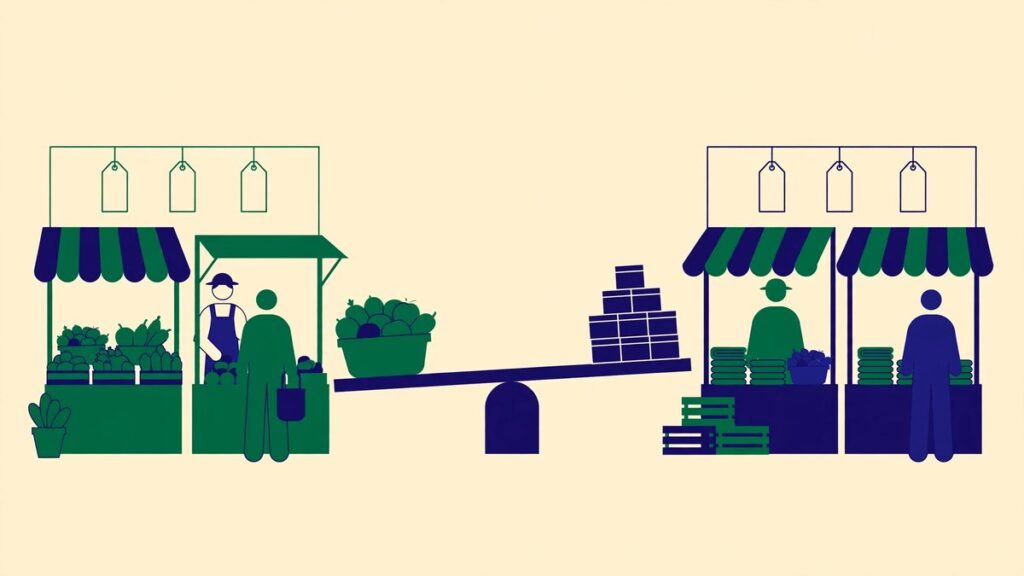
A market economy is an economic system in which most decisions about what to make, how much to make and what to charge are shaped by buyers and sellers trading with each other, with prices acting as the signals. Private people and businesses own and run most of the resources, and no central authority tells them what to produce.
That is the short answer. The longer answer has a catch worth knowing from the start: no real country runs a pure market economy. Most combine markets with some government rules and services. This guide explains how prices are set, what producers and consumers do, how a market economy differs from other systems, and where it works well and where it struggles.
Table of Contents
How prices are determined in a market economy
Prices are the heart of the system. In a market, a price tells sellers how much buyers want something and tells buyers how scarce it is. The price moves until the amount buyers want roughly matches the amount sellers offer.
Here is an invented example. Imagine a town where bakers sell loaves of bread. The table shows how many loaves buyers want and how many bakers are willing to make at different prices on a given day.
| Price per loaf | Loaves buyers want | Loaves bakers offer | What happens |
|---|---|---|---|
| $2 | 120 | 40 | Shortage of 80. Buyers compete, so the price rises. |
| $3 | 90 | 60 | Shortage of 30. The price still rises. |
| $4 | 70 | 70 | Balance. Everything offered is bought. |
| $5 | 50 | 90 | Surplus of 40. Bakers cut prices to sell. |
At $2 there are not enough loaves, so people bid up the price and more bakers are tempted to bake. At $5 there are too many loaves, so unsold bread pushes the price down. The price settles near $4, where the amount wanted equals the amount offered. Economists call this the equilibrium price. In real life the numbers keep shifting, because tastes, costs and incomes change, so prices keep moving too.
Nobody in this story told the bakers how much to bake. The price did that job. This is why people describe prices as signals that coordinate millions of separate decisions.
The roles of producers and consumers
A market economy depends on two groups making choices for their own reasons.
- Producers are businesses and individuals who make goods or provide services. They decide what to offer and at what price, and they hope to earn a profit. If they guess wrong, they lose money, which pushes them to adjust.
- Consumers are the people who buy. Their spending is a kind of vote. When many consumers choose a product, producers see the demand and make more of it.
Competition links the two. When several sellers chase the same buyers, they have a reason to improve quality, lower costs or cut prices. Buyers can walk away from a seller they dislike, which keeps the pressure on.
Key features of a market economy
- Private ownership. People and firms can own property and the resources used to produce goods.
- Prices set by supply and demand. The interaction of buyers and sellers, not a central plan, drives prices.
- Voluntary exchange. People choose whether to trade and on what terms.
- Competition. Many sellers compete for customers.
- Limited central control. The government does not direct what each firm produces.
Britannica makes a related point about market systems: coordination happens through exchange, and managers respond to supply and demand instead of central direction. It also notes that no market society has been purely market based, since matters such as defense and law and order still need public action.
Market economy compared with other systems
Economists often compare a market economy with a command economy, a mixed economy and a traditional economy. The table below gives the basic differences.
| System | Who decides what is produced | How prices are set | Example or note |
|---|---|---|---|
| Market economy | Private people and firms, responding to buyers | Mostly by supply and demand | A stated ideal that no country fully reaches |
| Command economy | The state sets targets and plans | Often set or heavily influenced by the state | Britannica describes the Soviet Gosplan, which turned political goals into industry targets |
| Mixed economy | A blend of private choice and government action | Markets mostly, with government rules, taxes or subsidies | Britannica describes it as a market system where free markets coexist with government intervention |
| Traditional economy | Custom and long standing practice | Often by custom, barter or local agreement | Found in small or remote communities |
Is any economy purely a market economy?
In practice, no. Governments almost everywhere set rules for contracts and property, collect taxes and provide some services. Britannica’s explanation of the mixed economy says the term covers cases where free markets coexist with government intervention. It points to examples such as public education and health systems, tariffs, mandatory social security and the United States New Deal.
The difference between countries is one of degree. Some leave more decisions to markets, others give government a bigger role. Britannica also says economies such as those of China and Russia formerly had centrally planned and socialist economies and later moved toward mixed systems. If you need to label a specific country, check a current source, since classifications differ and change over time.
Advantages of a market economy
- Choice. Producers can offer many products, and buyers can pick among them.
- Incentives to improve. Firms that make better or cheaper products can win more customers.
- Information carried by prices. Prices spread information about scarcity and demand without a central planner needing to know everything.
- Flexibility. Producers can respond quickly when what people want changes.
These are the arguments commonly made in favor of markets. Whether they hold in a given case depends on competition, rules and how well information flows.
Disadvantages and market failure
Markets also have well known weak spots. Economists use the term market failure for situations in which markets do not produce a good outcome on their own. Three examples are easy to understand.
Externalities. According to the Library of Economics and Liberty, an externality is a benefit or cost that spills over to people outside a transaction and is not reflected in market prices. Air pollution from a factory is a negative example. Research that helps others is a positive one.
Public goods. The Library of Economics and Liberty describes them as goods where it is prohibitively costly to exclude non payers and where one person’s use does not reduce what remains for others. National defense is a standard example. Private firms struggle to charge for such goods, so they are often provided by government.
Market power and inequality. When one seller dominates, competition weakens. Markets can also leave people with very different incomes, which is why many countries add taxes and social programs.
These problems are a main reason most countries run mixed economies and not purely market ones. People disagree about how much government action is right, and that disagreement is a matter of politics and values as well as economics.
Market economy, free market and capitalism
These terms overlap but are not identical.
| Term | What it mainly describes |
|---|---|
| Market economy | How decisions and prices are coordinated: through exchange between buyers and sellers |
| Free market | A market with little government interference, which is more of an ideal than a description of any country |
| Capitalism | A system built on private ownership of capital and the pursuit of profit, usually working through markets |
A free market economy is the version of a market economy with the least government involvement. In everyday use, people often swap the terms, but separating them helps when you read news or textbooks.
To go deeper, you can read about supply and demand in a separate guide and compare how different countries mix markets and government. A good next step is to pick one price you see this week, such as fuel or fruit, and ask what might be pushing it up or down.
Frequently asked questions
What’s a market economy in simple words?
It is an economic system where buyers and sellers decide what is made and at what price, mostly through trade and competition, with little central planning.
What is the market economy definition in economics?
It is a system of resource allocation coordinated through prices set by supply and demand, with private ownership of most resources.
What is the difference between a market economy and a command economy?
In a market economy, private people and firms decide what to produce. In a command economy, the state sets targets and plans.
Is the United States a market economy?
It is usually described as a mixed economy, because markets operate alongside government rules, taxes and programs. Britannica lists the New Deal among its examples of mixed economy policies.
What is market failure?
It is a situation where markets on their own do not deliver a good outcome, for example when pollution harms people who are not part of the transaction.
Who sets prices in a market economy?
No single person does. Prices emerge from the choices of many buyers and sellers, which is why they change as demand and supply change.
Conclusion
A market economy is a system where prices, competition and voluntary trade guide what gets made. It tends to offer choice and incentives to improve, but it also has gaps that rules and public services try to fill, so real economies are usually mixed. Next time you see a price change, try to name the supply or demand shift behind it, and you will have used the idea in practice.