
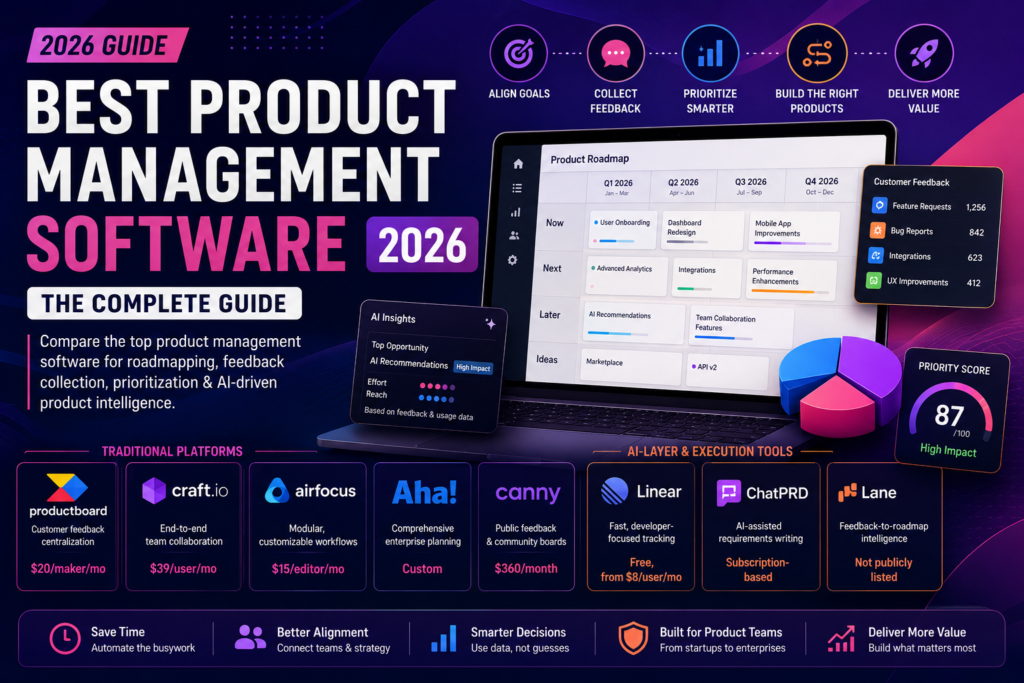
Searching for the best product management software 2026 usually turns up lists where the publisher happens to rank their own product first, or AI tool roundups that stretch the category to include general apps like Canva and ChatGPT. This guide skips both problems. We compare genuine product management platforms honestly, split them into the two categories that actually matter today, traditional roadmapping tools and newer AI-layer tools, and give you real, complete pricing instead of gaps in the comparison table. You’ll also learn how to avoid the tool fragmentation that quietly wastes hours of every product manager’s week. By the end, you’ll know exactly which type of product management software fits your team, not just which one has the flashiest homepage.
A Quick Note on How This Guide Was Built
We don’t sell product management software, and no tool here was allowed to rank itself. That matters, because several existing guides in this category are published directly by one of the vendors being reviewed, and unsurprisingly, that vendor’s product comes out on top. Pricing was checked against each vendor’s current published rates, and every tool included is genuine product management software, not a general design or productivity app being stretched to fit the category.
Two Different Things Get Called “Product Management Software”
This is the first thing worth clearing up, since most comparison guides blend two genuinely different categories together without saying so.
Traditional product management platforms center on roadmapping, feedback collection, and feature prioritization. You manually connect customer insights to what gets built, and the software gives you the structure to do that clearly. Productboard, Craft.io, airfocus, Aha!, and Canny all live here.
AI-layer intelligence tools are a newer category that tries to automatically connect requirements, roadmaps, and execution data using AI, reducing the manual work of syncing tickets, PRDs, and progress updates across separate tools. ChatPRD, Linear, and Lane fall into this group, each solving a different piece of that automation.
Knowing which category actually solves your problem will save you from comparing tools that aren’t built for the same job.
What Makes Product Management Software Different From Project Management Tools
Product management software focuses on deciding what to build and why, connecting customer feedback, business goals, and a product roadmap into one coherent strategy. Project management tools, by contrast, focus on how work gets done: tasks, deadlines, and team coordination. Many teams need both, and some of the tools below (Linear especially) blur the line between the two.
How We Evaluated These Tools
- Core functionality: roadmapping, feedback collection, and feature prioritization as genuine, built-in capabilities
- Pricing transparency: real, current costs rather than tools with no published pricing at all
- Category fit: whether a tool genuinely belongs in product management software, not a stretched inclusion
- Integration depth: connections to feedback sources, engineering tools, and analytics platforms
- Team fit: whether the tool suits small teams, mid-market, or enterprise product organizations
Best Product Management Software: Quick Comparison
| Software | Category | Best For | Starting Price |
| Productboard | Traditional | Customer feedback centralization | $20/maker/month |
| Craft.io | Traditional | End-to-end team collaboration | $39/user/month |
| airfocus | Traditional | Modular, customizable workflows | $15/editor/month |
| Aha! | Traditional | Comprehensive enterprise planning | Custom |
| Canny | Traditional | Public feedback and community boards | $360/month |
| Linear | AI-layer/execution | Fast, developer-focused issue tracking | Free, paid from $8/user/month |
| ChatPRD | AI-layer | AI-assisted requirements writing | Subscription-based |
| Lane | AI-layer | Feedback-to-roadmap intelligence | Not publicly listed |
Best Product Management Software, Reviewed
1. Productboard
Productboard centralizes customer feedback from support tickets, sales calls, and user interviews into a single view, then uses that data to help prioritize what gets built next. Its drag-and-drop roadmap builder supports tailored views for teams, stakeholders, and customers.
Pricing starts at $20 per maker per month, though the jump to the Pro plan (around $60/month) triples the cost, and the most useful AI-assisted feedback insights are reserved for higher tiers.
Good for: Teams with heavy customer feedback volume who want feedback and roadmapping in one connected system.
2. Craft.io
Craft.io is built for the whole product team, not just the product manager, with a Strategic Inputs dashboard that centralizes OKRs, customer personas, and product strategy alongside roadmapping and prioritization tools like RICE and MoSCoW scoring.
Pricing starts at $39 per user per month, and the interface has a real learning curve given how much functionality is packed in.
Good for: Teams that want stakeholders, not just the product team, actively involved in the planning process.
3. airfocus
airfocus takes a modular approach, letting you assemble only the features your team actually needs, which keeps the interface simpler than more comprehensive competitors. Its Priority Poker feature turns feature scoring into a collaborative, game-like session across stakeholders.
Pricing starts at $15 per editor per month, though advanced collaboration features like Priority Poker are reserved for higher tiers.
Good for: Teams that want essential product management functionality without a steep learning curve.
4. Aha!
Aha! is the most comprehensive traditional platform available, covering strategy, whiteboarding, roadmapping, and development tracking in one system, with AI assistance for roadmap generation and release notes.
Pricing is custom, and implementation typically takes four to eight weeks, reflecting how much the platform tries to cover.
Good for: Larger product organizations ready to commit fully to one comprehensive, opinionated platform.
5. Canny
Canny centers on public feedback boards where users can submit and vote on feature requests, paired with a changelog for closing the loop once features ship. It’s less of a full roadmapping suite and more a transparency-focused feedback tool.
Pricing starts at $360 per month for the Growth plan, which is a notably higher entry point than most competitors on this list.
Good for: Products with an engaged user community that want public, transparent feedback collection.
6. Linear
Linear started as a fast issue-tracking tool for developers and has evolved into a genuine product development platform, with AI now auto-triaging issues, suggesting labels, and estimating completion timelines. It’s exceptionally fast, with almost no lag even under heavy use.
The free plan covers unlimited users with some usage limits; paid plans start at $8 per user per month.
Good for: Engineering-led teams that want product tracking to stay close to actual development work, without heavy strategic planning overhead.
7. ChatPRD
ChatPRD is an AI tool purpose-built for writing product requirement documents, turning a rough idea or piece of feedback into a structured PRD with user stories and acceptance criteria in minutes.
It doesn’t connect those documents to a roadmap or execution tracking, so it works best paired with another tool rather than as a standalone system.
Good for: Product managers writing multiple PRDs per week who want to cut documentation time significantly.
8. Lane
Lane positions itself as an intelligence layer that connects customer feedback, revenue data, and business goals to help teams decide what to build next, aiming to reduce the manual work of pulling insights from scattered tools.
Pricing isn’t publicly listed, so you’ll need to request a demo to get real numbers, which is worth knowing upfront if transparent pricing matters to your evaluation process.
Good for: Teams frustrated by feedback and data living in disconnected tools who want a single decision layer on top.
The Real Cost of Tool Fragmentation
Most product teams don’t run into trouble because their tools are bad. They run into trouble because they’re running four or five disconnected tools that don’t talk to each other: one for writing requirements, one for roadmaps, one for execution tracking, and one for customer feedback.
That fragmentation is a real, well-documented pain point, and it’s worth taking seriously without assuming any single tool magically eliminates it. In practice, most teams reduce friction not by finding one tool that replaces everything, but by choosing two or three tools with strong integrations between them, and being disciplined about which tool owns which type of information.
Before adding a new product management software to your stack, ask whether it genuinely reduces the number of places information lives, or just adds another login to check.
Traditional vs. AI-Layer Tools: Which Do You Actually Need
If your team’s main challenge is organizing feedback and building shareable roadmaps, a traditional platform like Productboard, Craft.io, or airfocus solves that directly. If your bigger problem is that planning and execution constantly drift apart, or that writing requirements eats too much of your week, an AI-layer tool like ChatPRD or Lane addresses a narrower, more specific pain point.
Many mature product teams end up using one from each category rather than expecting either type to cover everything on its own.
Frequently Asked Questions
What is the best product management software 2026 overall?
It depends on your team’s core challenge. Productboard leads for feedback-heavy teams, Aha! suits large organizations wanting one comprehensive platform, and Linear is the strongest choice for engineering-led teams that want execution tracking to stay fast and simple.
What is the best product roadmap software specifically?
Productboard and Craft.io both offer strong, flexible roadmap builders with tailored views for different audiences. airfocus is the better choice if you want roadmapping without a steep learning curve.
Do I need both a traditional and an AI-layer product management tool?
Not always, but many teams benefit from pairing one of each: a traditional platform for roadmapping and feedback, plus an AI-layer tool like ChatPRD for faster requirements writing or Lane for connecting feedback to revenue data.
Is free product management software good enough for small teams?
Linear’s free plan is genuinely capable for issue tracking and lightweight roadmapping. Most other tools on this list don’t offer a meaningful free tier, so budget-conscious small teams often start with Linear and add a dedicated roadmapping tool later.
How much does product management software typically cost?
Pricing ranges widely, from Linear’s free tier and airfocus starting around $15 per editor per month, up to Canny’s $360 per month Growth plan and custom enterprise pricing from Aha!. Confirm current rates directly, since pricing structures change.
Conclusion
The best product management software 2026 depends on which specific problem you’re trying to solve, not which vendor has the loudest marketing. Productboard and Craft.io lead for feedback-driven roadmapping, Aha! suits large teams wanting one comprehensive system, Linear covers fast execution tracking for engineering-led teams, and newer AI-layer tools like ChatPRD and Lane address narrower automation problems rather than replacing your whole stack. Whatever you choose, confirm real pricing directly before committing, be honest about whether you’re solving a roadmapping problem or a tool-fragmentation problem, and resist the pitch that any single tool eliminates the need for everything else.