
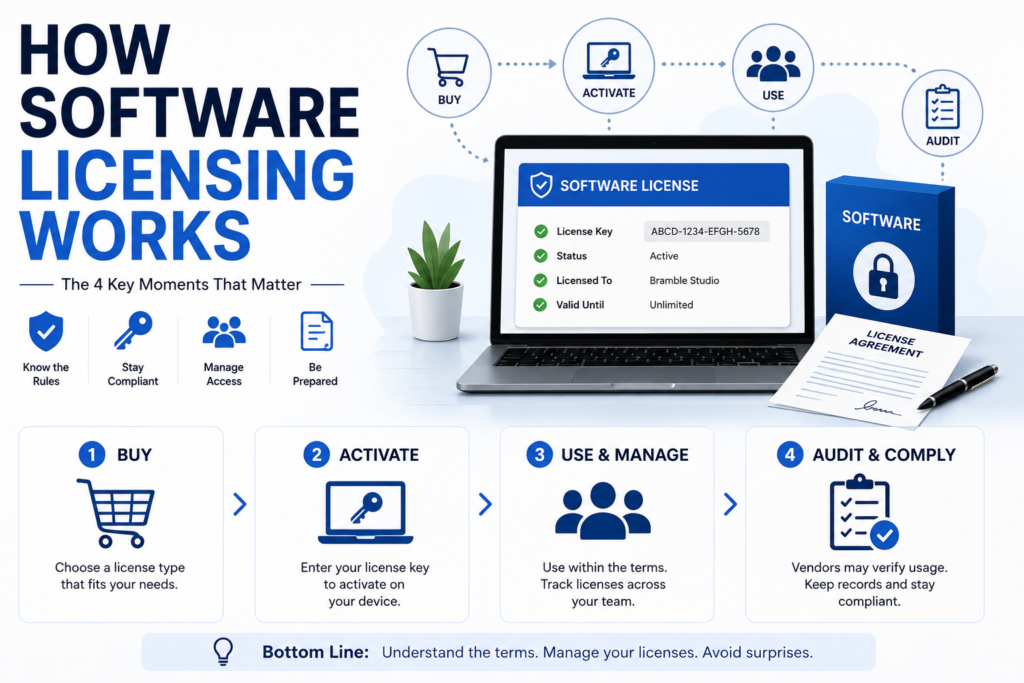
Nobody reads a license agreement until something goes wrong, and by then the terms that would have saved you money or spared you an awkward email were sitting in a document you clicked past months earlier. Understanding how software licensing works is less about memorizing legal language and more about knowing what you are actually agreeing to at four specific moments, when you buy it, when you activate it, when you scale it across a team, and when someone eventually checks whether you followed the rules. Rather than listing definitions at you, this guide follows one small company through all four of those moments, since licensing makes a lot more sense once you see where it actually bites. By the end, you will understand not just the terminology but the situations where it actually matters.
How Software Licensing Works, Told Through One Company
Bramble Studio is a 40 person design agency, the kind of business that exists everywhere and rarely thinks about software licensing until it has to. Early on, their lead designer needed a serious upgrade from a free tool, and the studio’s founder was staring at two very different price tags for essentially the same software: one large number paid once, and one smaller number paid every month. That decision, more than any definition, is where understanding software licensing actually begins.
The Choice Nobody Explains Well
The larger, one time number was a perpetual license. Paying it meant Bramble Studio would own the right to use that specific version of the software indefinitely, with no further payment required to keep it running. The smaller, recurring number was a subscription, and it meant continuous access to the latest version for as long as the studio kept paying, but nothing at all the moment they stopped.
The founder’s instinct was to treat the subscription as obviously cheaper, since the monthly number looked so much smaller. But a perpetual license versus subscription decision is really a bet on time. Run the subscription price out three or four years and it often overtakes what the perpetual license would have cost upfront, especially for software the studio planned to keep using without needing every new feature the moment it shipped. What tipped the decision in the end was updates. The perpetual version they were quoted would require a separate paid upgrade for major new features, while the subscription bundled every update automatically. For a design studio whose clients expected them to work in the newest file formats, that ongoing access mattered more than the raw math, so they went with the subscription. A studio doing highly specialized work on a stable, rarely updated tool might have made the opposite call, and both would have been reasonable.
What Actually Happens When Priya Types In a License Key
Priya, the lead designer, installed the software and reached the screen asking for a license key. That string of characters is not decorative, it is a coded value the software checks against the vendor’s own servers before unlocking anything. When Priya entered hers, the software quietly generated an identifier tied to her specific machine, sent that identifier along with the key to the vendor’s activation server, and waited for a response confirming the key was valid and had not already been used up on other devices.
Once approved, the server returned an activation token that got stored locally on Priya’s laptop, which is why the software kept working even on days her internet connection was spotty. What Priya did not realize was that her software would periodically recheck that activation quietly in the background. Two years later, when she got a new laptop and forgot to deactivate the license on her old one first, the software flagged the mismatch almost immediately, since the vendor’s system was still tracking that identifier as active. A quick call to support fixed it, but it was a real reminder that a license key is being watched, not just typed in once and forgotten.
Six Months Later, Why the IT Lead Started Keeping a Spreadsheet
As Bramble Studio grew past 30 employees, their IT lead, Marcus, started losing track of which software was licensed to which laptop. A few designers were running the design subscription on both a work laptop and a personal one, technically outside what a single seat allowed. Marcus began keeping a simple spreadsheet, one row per employee, listing every piece of licensed software they used and which specific entitlement it was tied to.
What Marcus was doing, without necessarily calling it this, was a basic form of software asset management. Larger organizations formalize this practice around an international standard called ISO IEC 19770, which is really three related ideas rather than one. The first part of that standard covers how an organization should manage software through its entire lifecycle, from purchase through retirement. The second part covers how installed software gets tagged so it can actually be identified consistently across a whole company rather than guessed at by file name. The third part covers how entitlement records, meaning proof of what you are actually allowed to use, get structured so they can be checked against real usage later. Marcus’s spreadsheet was a homemade version of exactly that third piece, and it turned out to matter more than he expected.
The Email Bramble Studio Did Not Want to Get
Eighteen months in, Marcus opened an email from the software vendor’s compliance team, citing a clause buried in the original subscription agreement that gave the vendor the right to verify how the software was actually being used across the studio. This is what a real software audit looks like in practice, not a surprise inspection, but a formal notice pointing to language everyone had agreed to and never read closely.
The vendor asked Bramble Studio to run a discovery tool that would report every installed copy and its usage pattern back to them. Marcus already had most of this in his spreadsheet, which meant he could cross check the vendor’s automated report against his own records before responding, rather than scrambling to reconstruct eighteen months of installs from memory. The vendor’s tool found two extra installations beyond what the studio had actually paid for, both leftover from the early days before Marcus started tracking anything. Because Bramble Studio responded quickly with accurate records and simply purchased the two additional seats at the standard rate, the whole process closed within a couple of weeks. A studio with no internal records at all often faces a slower, more expensive version of this same process, sometimes settling at a less favorable rate than what a normal purchase would have cost, simply because they have no way to push back on the vendor’s own numbers.
What Bramble Studio Would Do Differently
Looking back, Marcus’s biggest regret was not starting the spreadsheet on day one. A few habits would have saved real stress along the way.
- Read the actual terms before assuming a personal or single user license covers a whole team’s usage
- Deactivate a license on an old device before activating it on a replacement, rather than leaving both technically active
- Keep even a simple running record of what is installed where, since that record is exactly what protects you if an audit notice ever arrives
- Reassess a perpetual license versus subscription decision periodically, since a choice that made sense at 10 employees does not always make sense at 40
None of this required Bramble Studio to become a licensing expert. It required someone to read the terms once, keep a basic record, and treat a license key as something the vendor is actively watching rather than a one time password. That is really what understanding how software licensing works comes down to in practice, not the legal language itself, but knowing which four moments in a license’s life actually matter, and being ready for each one before it arrives instead of after.