
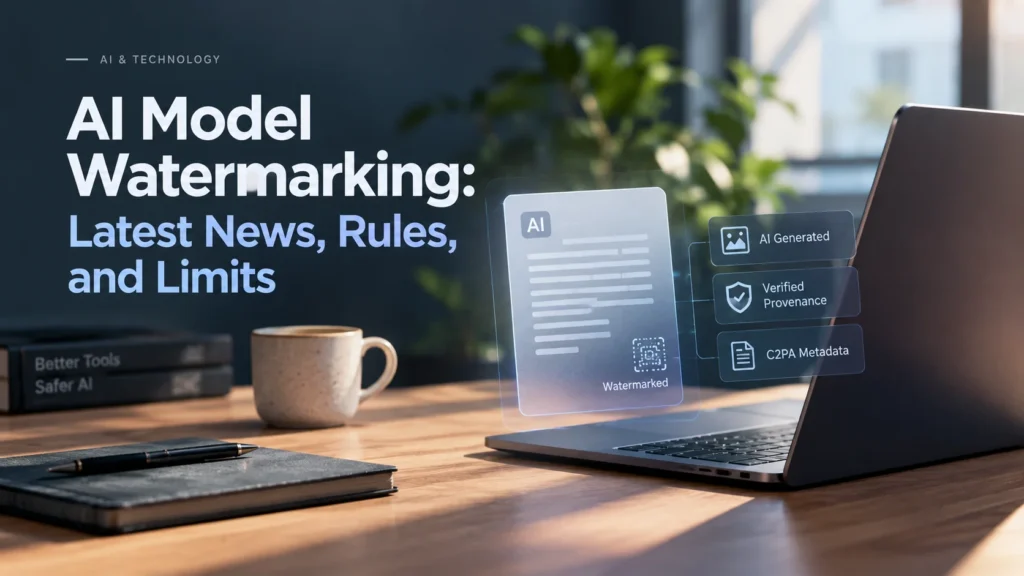
AI generated text and images are now being quietly marked, and most people have no idea how that works or who can read the marks. This guide covers the AI model watermarking latest news in plain English, from the EU rules that started applying in August to what Anthropic, Google, and OpenAI are actually doing. You will also learn how SynthID works, where watermarks fail, and what recent security research says about side effects. If you write, publish, teach, or build with AI, this touches your work. Read on to see what changed and what to do about it.
Table of Contents
What AI Model Watermarking Actually Means
The phrase gets used for three different things, and mixing them up causes most of the confusion in news coverage.
| Type | What It Marks | Purpose | Example |
| Model watermarking | The AI model itself | Prove ownership and catch theft or copying | A hidden signature in a model’s behavior that only its owner can test for |
| Content watermarking | What a model produces: text, images, audio, video | Show that content was AI generated | SynthID |
| Provenance metadata | The data record attached to a file | Record where a file came from and how it changed | C2PA Content Credentials |
Most AI watermarking news right now is about the second and third types, driven by the EU AI Act. Market research firms use the first meaning. One paid estimate puts the model watermarking market at about $0.55 billion in 2026, growing to $1.51 billion by 2030 at roughly 29 percent a year. Treat that as an analyst estimate rather than a hard number.
AI Model Watermarking Latest News at a Glance
These are the developments that matter most, in the order they happened or will happen.
- 2 August 2026: The transparency rules in Article 50 of the EU AI Act began to apply. Providers must make AI output machine readable and detectable, and deployers must disclose deepfakes.
- Code of Practice: The voluntary EU Code of Practice on AI generated content had 234 signatories by late September, including Anthropic, Google, Meta, Microsoft, Mistral, and OpenAI, according to law firm Stephenson Harwood.
- Anthropic: Claude models launched on or after 2 August 2026 carry an invisible text watermark based on SynthID Text, plus signed C2PA metadata on generated files. Anthropic says this applies worldwide, not only in the EU.
- Google and OpenAI: Google has marked Gemini text with SynthID since 2024. OpenAI embeds SynthID and C2PA signals in supported images and audio and runs a public verification page.
- 17 September: The Register reported that Lasso Security found watermarking can change how AI agents call tools and how they refuse harmful requests.
- 2 December 2026: Deadline for generative AI systems already on the EU market before August to add watermarking or similar marking.
No single technique satisfies every requirement yet, so the interim approach is layered: watermarks, metadata, and provenance records used together. Because the AI model watermarking latest news changes almost weekly, check each provider’s help pages before you rely on any detector.
How SynthID Style Text Watermarking Works
When a language model writes, it picks one word at a time from a list of likely options. Often several options fit equally well, such as cold and overcast versus cold and gray. A text watermark steers those low stakes choices using a secret key. No single word gives it away. Across a few hundred words, though, the pattern of choices leans in a way a keyed detector can measure.
Google DeepMind published SynthID Text in Nature in 2024, and Anthropic says Claude’s method is a version of it. Detection works like a statistical test. Someone with the key checks whether the word choices match the pattern more often than chance would allow. Anthropic compares it to playing Monopoly with the digits of pi instead of dice. The game looks random to the players, but anyone who knows the trick can check afterward.
- Nothing is added to the text. There are no hidden characters, so the mark travels with the words when they are copied.
- Anthropic says the mark carries no identifying information and cannot be traced to a person, organization, or chat.
- A detection result is a probability that a model helped write the text, not a yes or no verdict.
Who Marks What: Provider Comparison
| Provider | Text | Images, Audio, Files | How to Check |
| Anthropic | Yes, SynthID Text based, for models launched from 2 August 2026 | C2PA signed metadata on generated files | Detector in private preview, by access request form |
| Yes, Gemini text since 2024 | SynthID in images, audio, and video | Ask Gemini, according to Stephenson Harwood | |
| OpenAI | Reported to use SynthID Text; no public text detector, and its 2023 classifier was retired | SynthID and C2PA in supported images and audio | Public verification page and API |
| Microsoft | Method not publicly detailed | Optional visible watermarks | Not specified |
This table reflects public statements at the time of writing. If you publish AI assisted work in the EU, read the European Commission’s Article 50 guidelines and the Code of Practice for the exact wording of your obligations.
Images, Audio, and Video: Watermarks Versus Metadata
For visual and audio content, providers usually stack several protections, and they behave very differently.
- C2PA metadata: A signed record attached to the file that says where it came from and how it was edited. It is easy to read, but it can be lost when a file is stripped, converted, or screenshotted.
- Embedded watermarks: A signal built into the pixels or sound itself. Google designed SynthID for images to stay detectable after edits such as resizing or screenshots, and OpenAI says its embedded signal can point to its tools even after metadata is removed.
- Visible labels: A mark viewers can see. OpenAI lets users request a visible watermark on generated images, though it is separate from the machine readable signals.
None of these is a guarantee. OpenAI’s own documentation says provenance signals do not prove that content is accurate, unedited, or correctly presented. That is why regulators and providers describe a layered approach rather than a single fix.
Where AI Watermarking Falls Short
Watermarks are useful, but they are far from airtight. These are the main limits.
- Short text. Detection needs enough word choices to measure. Anthropic says short samples do not carry enough signal.
- Factual and code heavy writing. When only one answer is correct, the model has little freedom to leave a pattern. Anthropic notes code carries less of a watermark than other text.
- Anthropic says light editing probably will not remove the mark, while a complete rewrite will.
- Mixing models. The authors of a 2026 ICML research paper report that averaging the outputs of three to five models cancels text watermarks and pushes detection scores below the usual threshold.
- Who holds the key. Only the provider can check its own mark, so outsiders cannot independently verify a claim.
- Not proof of anything. Anthropic’s own help page says a hit only means content may have been processed by Claude. Some people worry about false accusations, much like earlier problems with AI text detectors in schools.
Tools that claim to strip watermarks have already appeared, and some users have pushed back on being marked at all. Expect this to become an ongoing contest.
Side Effects: What Recent Research Found
Among the latest AI watermarking developments, this one is easy to miss. Lasso Security tested SynthID Text on seven open source models and reported several effects, as covered by The Register.
- Tool calling: Accuracy fell on six of seven models, so agents picked the wrong tool or the wrong arguments more often. Lasso adds that flat averages can hide individual calls that improved while others broke.
- Refusals: The effect on plain harmful requests was small, but it grew under prompt injection, where attack success rose noticeably.
- Spillover: Agents built by other companies that consume a watermarked model’s output could see the same effects.
Keep the context in mind. This is one security vendor’s study on open models, not on commercial systems, and Lasso does not argue against watermarking. Anthropic separately reports no measurable effect on the quality or readability of Claude’s text, citing internal testing and a Gemini traffic experiment from the SynthID Text paper. The practical takeaway from Lasso is to include watermarked output when red teaming agents.
What the Latest News Means for Creators and Businesses
For most people the rules land on AI providers first, but deployers have duties too.
- Label AI generated or manipulated video, audio, and images of real people clearly. In July, Italy’s data protection authority warned a broadcaster over deepfakes that were not adequately marked. A spoken disclaimer was not enough, since viewers may tune in after it was said.
- Do not treat a detector hit as a verdict. It is a probability from one vendor’s key.
- Keep your own records of which AI tools touched which content. That is more reliable than any detector.
- Be careful with tools that promise to remove watermarks or metadata. Results are unreliable, and removal may conflict with your obligations or platform rules.
- If you build agents, test them with watermarked model output, not only clean text.
A good next step is a one page list of the AI tools your team uses and the marks each one adds.
What to Watch Next
- Wider access to Claude’s watermark detector, which is still in private preview.
- The rollout of text watermarking for Claude Opus 5 on cloud partner surfaces, which Anthropic said began on 14 September and would be complete within about a week.
- Details of Microsoft’s watermarking method, which it has not yet described publicly.
- Independent replication of the Lasso findings on commercial models, not only open ones.
- The 2 December 2026 deadline for systems already on the EU market.
Set a reminder to revisit provider documentation after that deadline, since most of the practical detail will land then.
Frequently Asked Questions
Does watermarking change how AI text reads?
Anthropic and Google report no noticeable effect on quality or readability. The Lasso research suggests effects can show up in how agents behave, which is a different question.
Can I check whether text came from Claude?
Anthropic’s detector is in private preview and available by access request. General AI detectors cannot read the watermark. They only guess from writing style.
Is AI watermarking legally required?
In the EU, Article 50 has applied since 2 August 2026, with a 2 December 2026 deadline for systems already on the market. The Code of Practice is voluntary, and rules in other regions differ.
Will watermarks catch all AI content?
No. Unmarked tools and open models produce unmarked text, short or heavily edited passages are hard to detect, and mixing several models can wash the signal out.
Conclusion
The AI model watermarking latest news comes down to a simple picture. Marking is now normal for major providers, the EU has set the timeline, and detection is still limited, controlled by whoever holds the key, and not proof of who wrote what. The newest research adds a reminder that watermarking is not free of side effects for agents. Use these tools as one signal among several, keep your own records, and revisit provider documentation as detector access opens up and the December deadline approaches.