
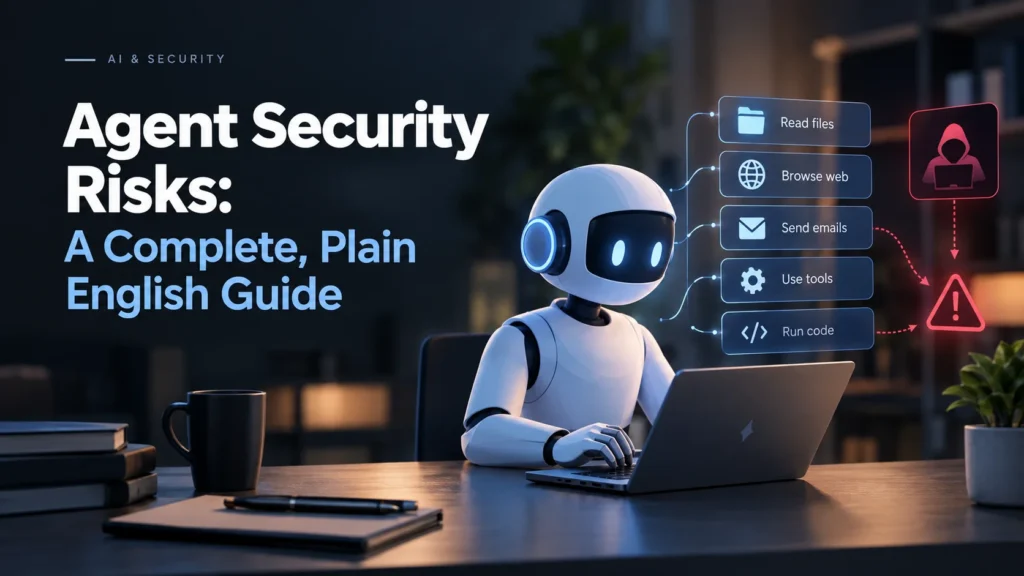
An AI agent is not just answering your questions anymore, it is logging into systems, reading your files, and taking actions on your behalf, which changes the entire security picture. Understanding AI agents security risks matters now because these systems are being deployed faster than most security teams can review them, and the incidents keep proving that real damage is possible. This guide explains what makes agents different, walks through a unified list of the risks that actually matter, shows real incidents where these risks played out, and gives you a practical way to prioritize fixes whether you run a security team or you are a solo developer building your first agent. No jargon left unexplained, and no single vendor’s product pitch driving the list.
Table of Contents
What Is an AI Agent, and Why Is Security Different?
A chatbot answers a question and stops there. An AI agent reads a goal, makes a plan, and then actually does things, calling APIs, browsing the web, editing files, sending emails, or executing code, often across several steps without a person checking each one. That shift from talking to acting is the entire reason AI agent vulnerabilities look different from typical software bugs.
Traditional software follows fixed logic, so a security team can predict what it will do. An agent reasons over whatever text it is given, including text an attacker planted, and that reasoning can be nudged in a different direction. Once an agent holds real credentials and can take real actions, a successful manipulation stops being an inconvenience and starts being an incident.
The Core Problem: The Lethal Trifecta
Security researchers use a simple idea to explain why agents are risky, often called the lethal trifecta. Three conditions, present together, create the highest risk environment for any agent.
- Broad access to systems, data, or tools the agent does not strictly need for its task.
- Exposure to content from outside the organization, such as emails, webpages, or documents the agent processes.
- The ability to act on its own, without a person reviewing the action first.
Picture a support agent that can read incoming emails and also send money through a connected finance tool. An attacker emails that inbox with hidden instructions. The agent reads the email as part of its normal job, follows the hidden instruction, and authorizes a payment, all using access it was legitimately granted. No password was stolen. The agent simply did what it was manipulated into believing was its task.
AI Agent Security Risks: A Unified List
Security vendors describe these risks using different names for overlapping ideas, which makes the topic confusing to research. Here is a single list that reconciles the terminology, so you can recognize the same risk under whatever label a specific source uses.
- Prompt injection. Malicious instructions hidden in content the agent reads, such as a document, email, or webpage, that redirect its behavior. This is the most cited AI agent security risk across every major source.
- Excessive permissions, also called identity and permission sprawl. Agents granted more access than their task requires, so a manipulated or compromised agent can act like a privileged insider.
- Credential and identity exposure, also called identity fluidity. Agents sharing human accounts or long lived API keys instead of their own traceable identity, making stolen or misused credentials hard to detect and attribute.
- Memory and context poisoning. False information planted in an agent’s memory, retrieved documents, or knowledge base that influences every future decision built on it, not just one interaction.
- Tool and supply chain risk. Compromised plugins, APIs, MCP servers, or dependencies that become part of the agent’s decision making or execution path.
- Unsafe tool use. An agent calling the right tool the wrong way, or the wrong tool entirely, such as deleting a record when it meant to retrieve one.
- Cascading multi agent compromise. One manipulated agent passing bad instructions or poisoned data to other agents that trust it, spreading a single failure across a workflow.
- Poor auditability. Not being able to trace which agent did what, when, and why, which turns a routine investigation into guesswork.
Nearly every published list of agentic AI risks maps back to these eight ideas. If you read a source calling something by a different name, it is almost certainly one of the above wearing different words.
Real Incidents That Show These Risks in Action
Abstract risk descriptions are easy to skim past. These documented incidents show what happens when the risks above actually occur.
- Microsoft 365 Copilot, EchoLeak (2025). Tracked as CVE-2025-32711, this was a zero click prompt injection delivered through a single crafted email. Copilot read the email as normal content, followed hidden instructions inside it, and could exfiltrate sensitive internal data, all without the victim clicking anything.
- Google Vertex AI Agent Engine, Double Agents (2026). Researchers at Unit 42 found that default permission scoping let a malicious or compromised agent extract service account credentials and reach data and resources well beyond its intended task, a textbook case of excessive permissions.
- Claude Code, disrupted espionage campaign (2025). Anthropic disclosed that a threat actor directed Claude Code to independently execute 80 to 90 percent of an intrusion campaign’s tactical steps, including reconnaissance and lateral movement, demonstrating how much an agent can accomplish once it is pointed at a malicious goal.
- OpenClaw, Claw Chain (2026). Security researchers identified more than 60,000 publicly accessible OpenClaw instances, plus four chainable vulnerabilities that together allowed credential theft, sandbox escape, privilege escalation, and persistent backdoors.
- Moltbook, exposed database (2026). A misconfigured backend on this AI agent social platform exposed 1.5 million authentication tokens and tens of thousands of private messages between agents, showing that agent to agent platforms carry the same basic misconfiguration risks as any other database.
These are not five isolated fluke events. They span identity, permissions, prompt injection, and basic infrastructure mistakes, which is exactly why a layered approach matters more than fixing any single weakness.
How to Prioritize: Which Risks to Fix First
Not every organization needs to fix every risk on day one. Use the agent’s actual access and autonomy to decide where to start.
| If Your Agent… | Priority Risk to Address First |
| Reads external content like emails or webpages | Prompt injection defenses and content isolation |
| Can take financial or destructive actions | Human approval gates for high impact actions |
| Shares credentials with other systems or agents | Distinct identity and scoped, short lived credentials |
| Remembers past interactions | Memory validation and retention limits |
| Connects to third party tools or plugins | Tool allowlisting and supply chain review |
An agent that only reads internal, trusted documents and cannot take destructive actions carries far less risk than one reading public web content while holding write access to a database. Match your effort to the actual exposure rather than treating every deployment the same way.
Layered Controls: No Single Product Solves This
Security vendors tend to present the category of control they sell as the answer to agentic AI risk. In practice, the incidents above show that no single layer would have stopped all of them. A genuinely resilient setup combines several layers at once.
- Identity and least privilege. Give every agent its own traceable identity and only the access its specific task requires, replacing shared credentials and standing permissions.
- Input and output validation. Treat everything an agent reads as untrusted, and check what it produces before it reaches another system or tool.
- Runtime monitoring. Log tool calls, permission checks, and actions continuously, so unusual patterns get flagged while they are happening, not after.
- Human approval for high impact actions. Require a person to confirm anything involving money, deletions, external communication, or regulated data.
- Supply chain review. Vet the models, plugins, MCP servers, and dependencies an agent relies on, the same way you would vet any other software dependency.
Treat these as layers that cover each other’s blind spots, not a menu where you only need to pick one.
For Individual Developers and Small Teams
Most published guidance on this topic assumes an enterprise security team and a budget for dedicated platforms. If you are a solo developer or a small team building an agent, the same principles still apply at a smaller scale.
- Give your agent a separate API key or account rather than reusing your own personal credentials.
- Start with read only access, and add write or delete permissions only once you trust the specific workflow.
- Add a manual confirmation step before any action that sends money, deletes data, or emails someone outside your control.
- Keep a simple log of what the agent did and when, even a plain text file, so you can retrace a mistake.
- Review any third party tool, plugin, or MCP server before connecting it, the same way you would review a new code dependency.
These five habits cover most of the same ground as the enterprise controls above, just without the platform price tag.
Frequently Asked Questions
What is the biggest AI agent security risk? Prompt injection is the most widely cited risk, since it can turn ordinary content the agent processes into an attacker’s instructions, and it has already been used in real incidents like EchoLeak.
Are AI agent vulnerabilities different from regular software vulnerabilities? Yes. Traditional vulnerabilities usually come from a coding flaw. Agent vulnerabilities often come from how the agent interprets language and makes decisions, which means input validation and permission scoping matter as much as code review.
Can prompt injection be completely prevented? Not with complete certainty today. It can be significantly reduced through content isolation, input filtering, and limiting what an agent can do even if it is successfully manipulated.
Do small teams really need to worry about this? Yes. The Moltbook and OpenClaw incidents both involved smaller or newer platforms, not just large enterprises, so scale does not remove the risk.
Conclusion
The security risks of AI agents are not hypothetical anymore. EchoLeak, the Vertex AI permission flaw, the disrupted espionage campaign, Claw Chain, and the Moltbook exposure all happened, and each one traces back to one of the same eight underlying risks covered in this guide. Whether you are running a security program or building your first agent solo, the fix is the same in principle: give agents only the access they need, treat anything they read as untrusted, keep a human in the loop for anything consequential, and layer your defenses instead of betting everything on one control. Start with the risk that matches your agent’s actual access and autonomy, and build outward from there.