
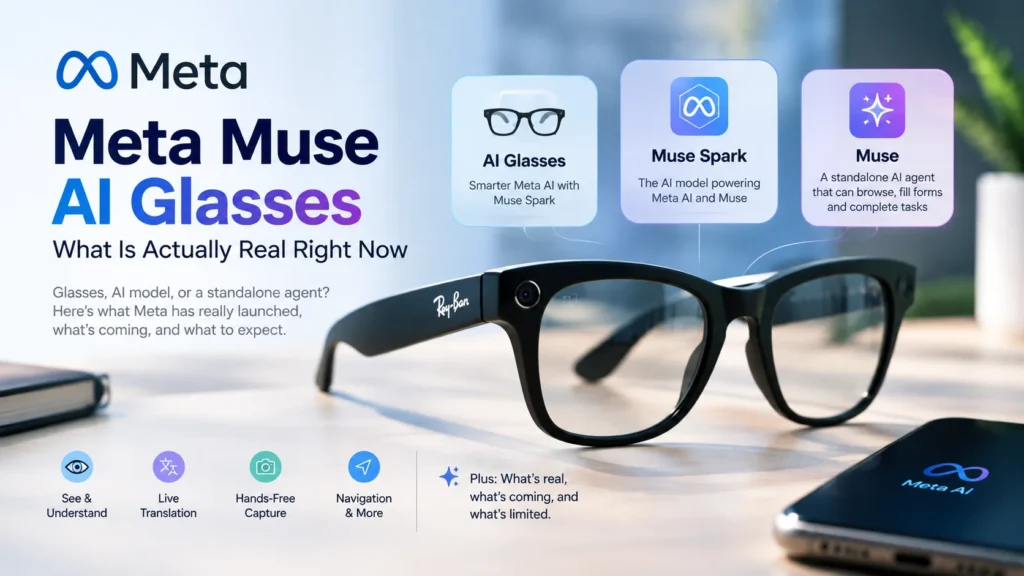
Meta has made so many overlapping announcements about Muse this year that even people following tech news closely are mixing up three different things: a new line of AI glasses, the model powering them, and a separate AI agent that shares the same name. Meta Muse AI glasses is not one single product launch, it is the collision of several related announcements spread across months, and most coverage picks up the story midway without explaining how the pieces connect. This guide sorts out the actual timeline, draws a clear line between what Meta has confirmed versus what was only demonstrated on stage, and covers the real world limitations, including one major retailer blocking the agent entirely, that the excitement around this launch tends to skip over.
Quick clarification: Muse Spark is the AI model. Meta AI is the assistant built into Meta’s apps and glasses. Muse is a separate, standalone AI agent product that can browse, fill forms, and complete tasks on its own. All three are related, but they are not the same thing.
Table of Contents
Muse, Muse Spark, and Meta AI: Three Different Things
This confusion is the single biggest reason coverage of Meta Muse AI glasses feels contradictory depending on which article you read.
| Name | What it actually is |
| Muse Spark | The underlying AI model, developed by Meta Superintelligence Labs, that powers both Meta AI and Muse |
| Meta AI | The broad assistant built into Meta’s apps and glasses, answering questions and helping with everyday tasks |
| Muse | A separate, standalone personal AI agent that can browse the web, fill out forms, and complete multi step tasks on its own, with a persistent virtual machine behind it |
Once this distinction is clear, the rest of the timeline makes far more sense. The glasses got a smarter assistant first. A genuinely different, more autonomous product arrived under a related name months later.
The Actual Timeline
- New AI glasses hardware, developed with EssilorLuxottica, launched with Meta AI powered by Muse Spark from day one, bringing stronger multimodal understanding to existing glasses features like hands free photo capture, live translation, and voice control
- Muse, the standalone AI agent, launched separately as its own product, available through a mobile app, the web, and WhatsApp, with a free tier and paid tiers for heavier use
- At a later Meta Connect event, the company announced that Muse the agent would extend to AI glasses in the coming months, alongside a separate pocket sized hardware device for talking to Muse directly
Treat that middle and final point separately from the first. The glasses already had a smarter Meta AI assistant from day one. Muse as a fully agentic feature on glasses was announced, not shipped, at the time of the Connect event.
What Muse Spark Actually Added to the Glasses
The original glasses launch focused on giving Meta AI a meaningfully better understanding of what the wearer is actually seeing, not on turning the glasses into an autonomous agent.
- Stronger multimodal understanding, meaning the assistant reads visual context more accurately
- Dynamic photo capture and pedestrian navigation on displayless glasses
- Live translation support expanded to additional languages
- More than eight hours of battery life, with a charging case adding up to 40 additional hours
None of this required the separate Muse agent to exist yet. It was Meta AI, running on the new Muse Spark model, doing a better job of the same kind of assistant tasks glasses wearers already expected.
What the Standalone Muse Agent Can Actually Do
This is the more ambitious product, and it works differently from a typical chatbot. Muse runs on a dedicated virtual machine with its own built in browser, letting it complete multi step tasks rather than just answering a question.
- Research, compare, and fill out forms for tasks like travel booking, pausing for your approval before finalizing anything sensitive
- Read and draft messages, manage schedules, and track longer running goals across time
- Browse retail sites and attempt purchases with permission, using credentials Meta says are stored separately from what the agent itself can see
- Continue working on a task in the background after you close the app, returning when a decision is needed
A separate system called Sentinel is designed to check outbound actions and require your approval before anything sensitive, like sending a message or completing a purchase, actually happens.
A Real Limitation Worth Knowing: Amazon Blocked Muse
This is genuinely important context that gets left out of most coverage focused purely on the announcement excitement. Shortly after launch, Amazon blocked Muse from shopping on its platform, citing unauthorized agent access and security concerns. This is a useful reality check on the whole category of AI agents, not just Muse specifically: an agent can be technically capable of completing a task and still get stopped by the service on the other end, since not every website or retailer wants an AI agent browsing and buying on a user’s behalf.
Security and Trust Issues Worth Knowing About
A responsible look at Meta Muse AI glasses and the Muse agent should include a couple of real incidents that surfaced quickly after launch, rather than only repeating Meta’s own claims.
- A security researcher found that local software on a Mac could alter an undocumented Muse setting and expose part of the agent’s authentication path. Meta pushed a fix quickly, and the issue required a local compromise first rather than being remotely exploitable, but it illustrates that an agent with broad permissions carries more risk if something does go wrong compared to a simple chatbot
- Reporting also surfaced that human contractors handled some phone calls users had delegated to Muse during internal testing, rather than the calls being fully automated as some users may have assumed. Meta said this was part of improving the calling feature before a public rollout and that proper disclosure would accompany any real launch
Neither issue means the product is unsafe to use. Both are worth knowing before assuming an AI agent’s actions are entirely automated and entirely risk free.
Confirmed, Demonstrated, or Just Reported: A Clear Breakdown
Separating what Meta has actually committed to from what was only shown on stage or reported by outside journalists matters a lot here, since these get blended together in most coverage.
| Status | What falls here |
| Confirmed and available now | Meta AI powered by Muse Spark on current AI glasses, and the standalone Muse agent app on phones, web, and WhatsApp |
| Confirmed but not yet available | Muse arriving as a feature on AI glasses, announced but described as coming in the following months |
| Demonstrated, not finalized | Muse Charm, a pocket sized hardware device for talking to Muse, shown as a prototype with no confirmed price, battery life, or full specification sheet |
| Reported, not officially confirmed | The exact $20 and $100 monthly subscription tiers, which came from press reporting rather than being listed on Meta’s own public plan page at the time |
Does Muse Work the Same on Every Pair of Glasses
No, and this is another detail that gets glossed over. Camera hardware, not just software, determines what an agent extension can actually perceive.
- Camera free glasses can provide voice and audio interaction with an assistant, but cannot share a first person view of what the wearer is looking at
- Camera equipped glasses can add visual scene context on top of voice, letting the assistant respond to what is actually in front of the wearer
- A display equipped pair adds a visual output layer on top of that camera based understanding
A glasses spec sheet alone does not tell the whole story. Camera hardware changes what an assistant can see, and agent access changes what it can actually do afterward, and those are two separate upgrades, not one.
Pricing and Availability Right Now
Muse launched with a free usage tier alongside two paid subscription levels reported at $20 and $100 per month for heavier use. Meta has described the free tier as sufficient for the vast majority of users, with the paid tiers aimed at genuine power users running many tasks. Treat the specific dollar figures as reported rather than permanently fixed, since Meta’s own public plan page did not display those exact numbers at the time of the most detailed coverage, and pricing on a newly launched product can shift. Availability is also still limited, with the initial rollout focused on the United States across the Muse mobile app, the web, and WhatsApp, plus a Mac app added afterward that can work with local files and native apps like Messages and Calendar when given permission.
Frequently Asked Questions
What is the difference between Meta Muse and Meta AI?
Meta AI is the broad assistant built into Meta’s apps and glasses. Muse is a separate, more autonomous AI agent that can browse, fill forms, and complete multi step tasks with a persistent virtual machine behind it. Both now run on the same underlying Muse Spark model.
Is Muse available on AI glasses right now?
Not as a fully available feature at the time of the Connect announcement. Meta said the glasses integration was coming in the following months, separate from Meta AI powered by Muse Spark, which was already running on current glasses.
Can Meta Muse actually make purchases on its own?
It can attempt to, with your approval required for sensitive actions like completing a purchase. Its ability to do so also depends on whether the retailer allows agent access at all, since Amazon has already blocked it from shopping on its platform.
Is Meta Muse safe to use?
Meta has published real privacy and permission controls, including approval requirements for sensitive actions and a planned more strongly encrypted mode. At the same time, a real security issue was found and patched shortly after launch, and it is worth granting only the permissions a task genuinely needs rather than approving everything by default.
What is Muse Charm?
Muse Charm is a pocket sized hardware device built specifically for talking to Muse using real time voice interaction. Meta confirmed the device exists but had not published final pricing, battery life, or a complete specification sheet as of the most recent Connect announcement, so treat any specific numbers you see elsewhere as unconfirmed until Meta publishes them directly.
Conclusion
Meta Muse AI glasses is really three overlapping stories, a glasses hardware refresh with a smarter Meta AI assistant on board, a separate and more ambitious standalone Muse agent, and an announced but not yet available plan to bring that agent to the glasses themselves. Knowing which of these you are actually reading about, and which claims are confirmed versus only demonstrated or reported, is the difference between understanding where this product genuinely stands today and getting swept up in launch day excitement. Keep an eye on Meta’s own official pages for the glasses integration and Muse Charm specifically, since both were still promises rather than finished products as of the most recent announcement.