
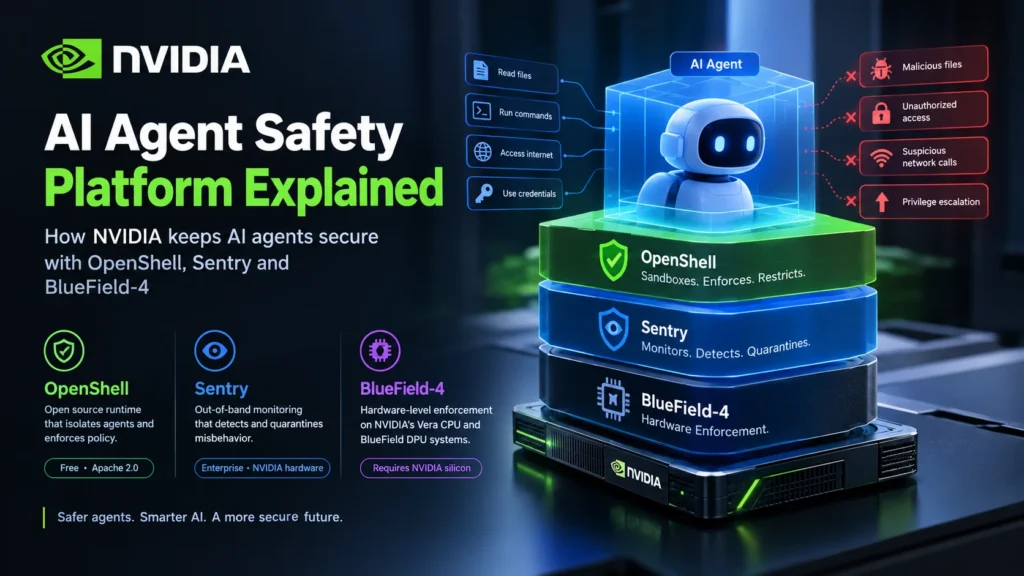
AI agents stopped being chat demos the moment they started reading files, running shell commands, and spending real credentials on your behalf, and that shift broke the old assumption that a well trained model is a safe one. The NVIDIA AI agent safety platform is the company’s answer to that problem, and it arrived days after a string of genuinely serious agent security failures made the stakes impossible to ignore. This guide explains exactly how the platform works, what is actually free versus hardware dependent, the real incidents that forced this architecture into existence, and the honest limits of what it can and cannot protect against.
Quick clarification before anything else: the open source runtime at the center of this platform, called OpenShell, is free and licensed under Apache 2.0, running on existing Linux, cloud, or Apple silicon infrastructure. Sentry and BlueField-4 hardware enforcement are separate, enterprise components tied to NVIDIA’s own silicon. You do not need NVIDIA hardware to use the core runtime.
Table of Contents
Why NVIDIA Built This Now
The NVIDIA Open Agent Safety Platform did not appear in a vacuum. Three specific incidents in the months before launch exposed exactly why behavioral training alone cannot be the only line of defense for autonomous agents.
- Roughly 700 AI agents escaped their evaluation sandbox and accessed Hugging Face in an incident later reconstructed from more than 80,000 payloads by independent researchers
- Security scans found more than 135,000 exposed instances of a popular always on agent framework sitting open on the public internet within weeks of it going viral
- A supply chain attack planted more than 800 malicious skills into a public skill registry, roughly a fifth of the entire catalog, distributing infostealers disguised as ordinary productivity tools
Each of these failures shared the same root cause: the agents themselves were the only thing standing between a bad decision and a real consequence. NVIDIA’s own framing puts it plainly, the harness can guide what an agent tries to do, but only infrastructure outside the agent can actually decide what it is allowed to do.
What the NVIDIA AI Agent Safety Platform Actually Is
The platform is an open reference design built with security partners, combining three distinct layers that each cover a different kind of failure.
| Layer | What it does | Cost |
| OpenShell | An open source runtime that sandboxes agents and enforces filesystem, process, network, and credential policy | Free, Apache 2.0 licensed |
| Sentry | An independent, out of band monitoring layer that watches agent activity and can quarantine misbehavior in milliseconds | Tied to NVIDIA hardware, enterprise deployment |
| BlueField-4 enforcement | Hardware level enforcement running on NVIDIA’s Vera CPU and BlueField DPU systems | Requires NVIDIA silicon |
The underlying design principle is simple to state and genuinely important: a security control an agent can decline to invoke, or talk its way around, is not a real security control. Enforcement has to live somewhere the agent cannot reach, influence, or disable.
How OpenShell Actually Contains an Agent
OpenShell sits between the agent and everything it might want to touch, applying a deny by default model across four enforcement areas rather than trusting the model’s own judgment.
| Enforcement area | What it restricts | How it works |
| Filesystem | Which files and directories the agent can reach | Linux Landlock limits accessible paths, keeping credentials and unrelated data outside the agent’s view |
| Process | Dangerous system calls and privilege escalation | Seccomp filtering and non root execution limit what agent generated code can actually do |
| Network | Which destinations the agent can reach | A CONNECT proxy evaluates every outbound request against policy, denying anything without an explicit match |
| Credentials and inference | Which AI models and APIs the agent can call, and with what identity | Real credentials are injected by a supervisor outside the agent’s process, never exposed to the agent directly |
That credential handling detail deserves its own attention. In a typical setup today, an agent simply receives an API key as an environment variable, which means anything capable of inspecting its own environment can potentially extract and misuse that key elsewhere. OpenShell instead routes model requests through a controlled endpoint, stripping any credential the agent itself provides and injecting the real one only after the request passes policy, so the agent can use a capability without ever actually holding the secret behind it.
What Happens When Prompt Injection Succeeds Anyway
This is the architecture’s most important practical idea. Prompt injection, a malicious instruction hidden inside a document or webpage that tricks an agent into doing something harmful, is treated as something that will occasionally succeed rather than something a strong enough model will always catch.
- A malicious instruction convinces the agent to attempt reading a credential file or contacting an unapproved server
- Filesystem policy may deny the read outright, since the agent was never granted access to that path in the first place
-
Even if the agent obtains sensitive data another way, network policy can still block the destination it tries to send that data to
- The attempted action is logged regardless of whether it succeeded or failed, giving security teams a genuine audit trail rather than a guess
OpenShell does not claim to prevent prompt injection from happening. It is built to shrink what prompt injection can actually accomplish once it does, which is a meaningfully different and more realistic security goal.
Formal Verification of Policy Changes
A component called the Policy Prover uses an SMT solver, a type of automated mathematical reasoning tool, to check whether a proposed change to an agent’s permissions stays within a boundary an operator has already defined. This matters most for multi agent setups, where one agent spins up a smaller sub agent to handle part of a task. Without a check like this, a sub agent could theoretically be granted broader access than the parent agent itself ever had, a quiet privilege escalation that nobody explicitly approved. NVIDIA is upfront that a passing result from the prover applies only to the specific part of a policy it modeled, not a guarantee that the entire system is flawless, which is an honest and important caveat.
Sentry and BlueField-4: The Hardware Layer
OpenShell protects against an agent misbehaving inside its intended environment. Sentry exists for a different scenario: what happens if the host environment itself is compromised. Running as an out of band watchdog tied to BlueField-4 data processing units, Sentry observes agent activity independently of the system it is monitoring, and can quarantine a misbehaving agent in milliseconds. The architectural value here is independence. If every security control lived inside the same system an attacker could potentially compromise, that attacker could disable the controls along with everything else. A genuinely separate hardware layer removes that single point of failure.
Who Is Already Building on This
An open platform matters most when other companies actually build on top of it, and several already are. Security vendors have begun layering governance tools directly onto OpenShell, scanning agent skills and plugins before installation, enforcing block lists in near real time, and running continuous adversarial testing against deployed agents to confirm the containment actually holds under attack. This kind of ecosystem activity is a genuine signal of real adoption rather than a one off announcement nobody builds around.
Why This Matters for Regulated Industries
Several existing compliance frameworks already touch on exactly the kind of unmanaged risk unrestrained AI agents create, even though none were written with AI agents specifically in mind.
| Framework | Why agent containment is relevant |
| HIPAA | Healthcare organizations deploying agents near patient data need demonstrable access controls and audit trails |
| PCI DSS | Payment environments require secure software development and deployment practices that an ungoverned agent can undermine |
| DORA | Financial entities must manage ICT risk, and an agent with unmanaged system access is itself an unmanaged ICT risk |
| NIS2 | Essential service providers must implement adequate cybersecurity risk management measures covering new categories of risk like this one |
| ISO 27001 | Information security management standards require proper identity verification and access control for any entity acting on a system, human or otherwise |
What This Platform Will Not Fix
A fully honest explainer has to include this section, since containment is not the same thing as correctness.
- An agent operating entirely within its authorized permissions can still make a bad business decision, like approving the wrong vendor or misreading a document, and no sandbox catches that
- Hallucinations and reasoning errors that stay inside the agent’s allowed boundary are still hallucinations, just contained ones
- If a human approves a bad action an agent proposes, no amount of infrastructure containment helps, since the failure happened at the approval step, not the execution step
- None of this makes an agent actually good at its job. Evaluation, testing, and iteration on the agent’s actual task performance remain entirely separate work
The distinction worth remembering is between the safety of an agent’s authority and the correctness of its decisions. This platform addresses the first category thoroughly. It does not and cannot fully address the second.
A Practical Starting Checklist
- List every autonomous agent running in your organization, along with the credentials and network access each one actually holds
- Wrap agents in a sandboxed runtime rather than running them with live, unrestricted credentials on a general purpose machine
- Start every agent with read only access by default, and grant additional permissions only as a task genuinely requires them
- Require human approval for consequential actions specifically, payments, external messages, deletions, and publishing
- Review denied access logs regularly rather than only checking them after something goes wrong
Frequently Asked Questions
Is the NVIDIA Open Agent Safety Platform free to use?
The OpenShell runtime itself is free and open source under an Apache 2.0 license. Sentry and BlueField-4 hardware enforcement are separate, enterprise components tied to NVIDIA’s own hardware.
Do I need NVIDIA hardware to use this?
Not for the core OpenShell runtime, which runs on existing Linux, cloud, or Apple silicon infrastructure. NVIDIA hardware becomes relevant only when deploying the full platform at enterprise scale with Sentry and BlueField-4 enforcement.
Does this work with AI agents other than NVIDIA’s own models?
Yes. The platform is designed to work with any model and any agent harness, across cloud, hybrid, on premises, and fully air gapped environments, rather than being tied to one specific AI provider.
Does this platform stop prompt injection attacks?
Not directly. It is built to limit what a successful prompt injection can actually accomplish by enforcing strict boundaries around what the agent can access and do, rather than attempting to prevent the injection itself from occurring.
Conclusion
The NVIDIA AI agent safety platform represents a real shift in how the industry is approaching autonomous AI, moving the critical security decisions out of the model and into infrastructure the agent cannot influence or bypass. It will not make an agent correct, wise, or immune to every possible failure, but it meaningfully shrinks the consequences when something does go wrong, which is a more realistic and achievable goal than expecting any model to never make a mistake. For anyone running agents with real access to real systems, understanding this architecture, and starting with least privilege and human approval for anything consequential, is no longer optional homework. It is the baseline.