
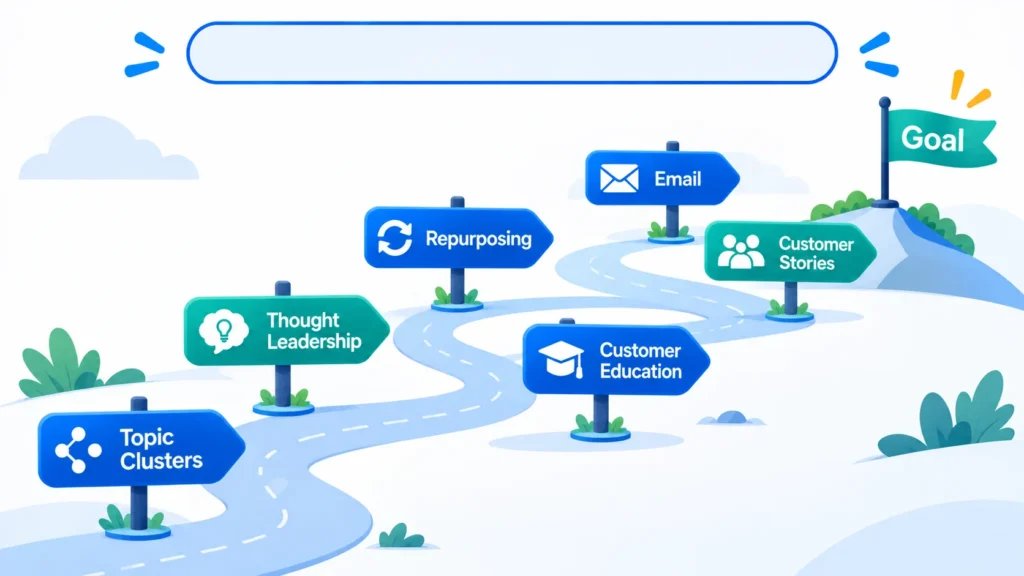
The main content marketing strategies are topic clusters, thought leadership, customer education, repurposing, customer stories and email or community led content. No single one is best. The right choice depends on your goal, your team and how long your customers take to decide. Pick one main strategy, support it with one or two others, and write it down.
Most guides stop at defining content marketing. This one compares the strategies, shows how to choose among them, and walks through how to create a content marketing strategy you can document and review. It also covers blog posts, publishing rhythm, AI, and measurement.
Table of Contents
Content marketing, content strategy and a content plan
These three terms get mixed up. The Content Marketing Institute separates them, and the distinction is useful, so here it is in plain words.
- Content marketing strategy: the why. It says who you are helping, what you want to achieve and what makes your content different.
- Content strategy: the wider job of managing all of an organization’s content, including how it is created, published and maintained.
- Content plan: the tactical document, such as a calendar, that says what you will publish and when. It comes after the strategy.
If you skip the first step and jump to a calendar, you tend to publish a lot without knowing what it is for.
The main content marketing strategies compared
The table below is my own grouping of common approaches, not an official list. Real programs usually combine two or three.
| Strategy | What it means | Best goal | Effort | Main risk |
| Topic clusters | A central guide plus many linked posts on related questions | Search visibility and authority | High at the start | Slow to show results |
| Thought leadership | Original opinions, research or experience from named experts | Trust and brand reputation | Medium to high | Vague opinions with no evidence |
| Customer education | Guides and how to posts that solve customer problems | Leads and fewer support questions | Medium | Content that never mentions a next step |
| Repurposing | Turning one strong piece into several formats | Reach with a small team | Low to medium | Thin copies that add nothing |
| Customer stories | Real customers describing a problem and result | Conversion, especially for longer sales | Medium | Needs permission and honest results |
| Email or community led | A newsletter or group you own and nurture | Retention and repeat visits | Medium, ongoing | Slow to build an audience |
How to choose the right content marketing strategy
Start with the outcome, then pick the approach that fits it.
- You need people to find you: topic clusters, supported by customer education.
- You sell something expensive or complex: customer stories and thought leadership, with email follow up.
- You have a tiny team: repurposing around one strong piece a month.
- You already have customers and want them back: email or community led content.
- You want trust in a crowded market: thought leadership backed by original data or real experience.
Also be honest about capacity. A topic cluster needs steady publishing for months, so it is a poor fit for a one person team that cannot keep it up. In that case, a smaller plan done consistently will beat a larger plan that stalls.
How to create a content marketing strategy in six steps
Here is the process in order. It works for a small business or a larger team, and it gives you a written document at the end.
1. Define the audience
Describe who you are writing for in specific terms: their role or situation, the problem they face and what they use today. Talk to a few real customers if you can. Write down the words they use, because those words belong in your headlines and your posts.
2. Set goals you can measure
Choose one or two goals, such as qualified leads, newsletter sign ups or sales from content. Write them as SMART goals: specific, measurable, achievable, relevant and time bound. A goal like get 200 new subscribers in four months gives you something to check. Get more traffic does not.
3. Audit what you already have
List your existing posts, pages and videos. Mark what still performs, what is outdated and what can be improved or merged. An audit often shows that updating a handful of old pieces is quicker than starting from zero.
4. Choose your strategies and topics
Use the comparison table to pick one main strategy and one or two supporting ones. Then list the questions your audience asks and group them into themes. This is the core of a content creation strategy: each piece should answer a real question for a defined reader.
5. Create and distribute
Decide who writes, who reviews and where each piece will appear: your site, email, social platforms or partner sites. Plan the distribution before you publish, not after.
6. Measure and adjust
Check results on a set schedule, compare them with your goal, and change one thing at a time.
A good first step is to copy the template below into a document and fill it in before you write anything.
| Strategy template section | What to write |
| Audience | Who they are, their main problem and what they use now |
| Goal | One or two SMART goals with a date |
| Core message | What makes your content different and useful |
| Main strategy and support | The strategies you chose and why |
| Topics | The themes and questions you will cover first |
| Formats and channels | Where each piece will be published and shared |
| People and process | Who writes, reviews and approves |
| Calendar | What you will publish in the next 8 to 12 weeks |
| Measures and review date | The numbers you will check and when |
Plan a publishing rhythm you can keep
There is no published rule for how often to post that works for everyone, and nobody can credibly promise one. A better method is to decide what you can maintain for three months and plan from there.
- Choose a rhythm based on the time one finished piece really takes, including review and promotion.
- Plan blog posts in batches by theme so each piece links to related ones.
- Leave room each month to update older posts.
- Keep a short backlog of ideas so a missed week does not stop the plan.
Consistency matters because content strategies rarely pay off quickly. Judge a new approach over months, not days.
Use AI without lowering the quality of your content
Many teams now use AI tools to create content. In the 2026 B2B survey from the Content Marketing Institute and MarketingProfs, which drew 1,132 global responses and reported on 861 B2B marketers, accuracy (54%), quality control (54%) and brand voice and authenticity (52%) were the top worries when creating content with AI. The survey was fielded from June to August 2026, is self reported and is mostly North American, so treat it as a useful signal, not a universal figure.
Google’s guidance for helpful content points in the same direction. It asks whether content provides original information or analysis, notes that crediting other sources does not replace original effort, and suggests making clear who created the content and how, including any use of automation or AI, when readers would expect to know. It also says experience, expertise, authoritativeness and trust are a framework for judging quality, not a specific ranking factor.
Practical rules that follow from this:
- Have a named person review and fact check every piece before it goes live.
- Add something only you can offer: your data, your process, customer examples or expert input.
- Keep a short style guide so the voice stays consistent.
- Be open about how content is made where readers would reasonably wonder.
How to measure what is working
Match the numbers to the goal you wrote down.
| Goal | Useful measures | Watch out for |
| Visibility | Organic visits, impressions and queries in Google Search Console | Traffic that does not match your audience |
| Leads | Sign ups, enquiries, conversion rate from content pages | Counting low quality sign ups as wins |
| Trust | Repeat visits, returning subscribers, referrals | Judging only by followers |
| Sales | Orders or deals with a content touchpoint | Giving content credit for every sale |
Expect ups and downs. In the same CMI and MarketingProfs survey, 31% of B2B marketers saw website traffic increase over the previous 12 months, 31% saw a decrease, 24% saw no change and 14% did not track it. If your traffic falls, check whether search results or your topics changed before blaming the strategy, update the weakest pages, and compare against your goal, not against last month alone.
A worked example: Harbor Books, a small accounting firm
Harbor Books is a made up firm used here only as an illustration. The figures are invented.
- Audience: freelancers who are confused by quarterly tax tasks.
- Goal: 60 qualified enquiries in six months.
- Main strategy: customer education, supported by customer stories and a monthly email.
- Topics: the 12 most common client questions, each answered in a clear guide, and linked together as a small cluster.
- Rhythm: two new guides a month plus one update, which the owner can keep up.
- Measures: enquiries from guide pages, newsletter sign ups and the questions clients ask on the first call.
- Review: at three months, the team updates the two guides with the most visits and adds a customer story to each.
The example works because every piece answers a real question and leads to one next step.
Common mistakes
- Starting with a calendar before choosing a goal.
- Trying every strategy at once.
- Writing for search engines instead of for a defined reader.
- Publishing AI drafts without review or original input.
- Never updating old content.
- Measuring only traffic.
Frequently asked questions
What is the difference between content marketing and content strategy?
Content marketing uses content to reach and persuade an audience. Content strategy is the broader practice of planning and managing content, including how it is created, published and maintained.
Do small businesses need a documented content marketing strategy?
A short written plan helps even a small team because it keeps goals and topics clear. The template above fits on one page.
How long does a content marketing strategy take to work?
There is no reliable timeline. Plan on months, and set review dates at 30, 90 and 180 days.
How many blog posts should I publish?
Publish at a rate you can maintain with good quality. Quality and usefulness matter more than a fixed number.
Should I use AI to create content?
You can use it for support, but a person should check accuracy and add original input. Google’s guidance asks for helpful content made for people.
Conclusion
Good content marketing strategies start with a clear reader and a clear goal, then match an approach to what your team can sustain. This week, pick one goal, choose one main strategy from the table and fill in the one page template. You can refine the details after your first review.