
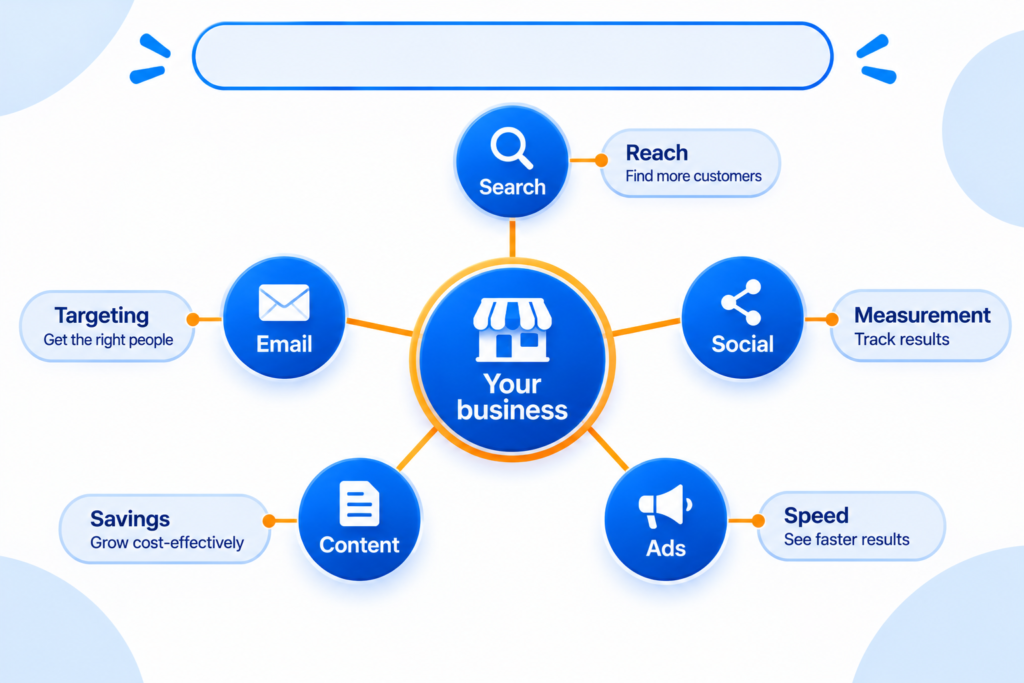
Internet marketing is the promotion of a business through internet channels such as search engines, email, social media and a company website. Its main benefits are that it lets a business reach more people, target the right ones, control costs, measure results, adjust quickly, talk with customers, personalize messages, and build lasting assets such as content and an email list.
It is not a guarantee of sales, and it has limits. This guide explains each advantage with an example and a caveat, compares internet marketing with traditional marketing, and covers the rules and risks that most guides skip.
Table of Contents
What is internet marketing?
Internet marketing, also called online marketing, is any marketing done over the internet. It includes search engine optimization (SEO), paid search ads, email, social media, content marketing, influencer and affiliate marketing, and display or video ads. Digital marketing is the broader term. It can also include digital channels that don’t depend on being online at that moment, such as some digital screens, so internet marketing is usually treated as a part of it.
People often call this approach online business promotion: a way to make a business visible and easy to choose where customers already spend time.
The scale explains the appeal. The International Telecommunication Union (ITU) estimates that about 6 billion people, roughly 74% of the world’s population, used the internet in 2025.
The 8 main benefits of internet marketing
- You can reach a larger audience. A small shop can be found by people far beyond its street, and a local business can appear when nearby customers search. Caveat: reach is uneven. ITU data show 94% internet use in high-income countries but 23% in low-income ones, and 58% in rural areas worldwide, so check that your own customers are online.
- You can target the right people. Search ads appear when someone looks for a term, social platforms offer targeting by interests and location, and email goes to people who asked to hear from you. That wastes less effort than broadcasting to everyone. Caveat: targeting options differ by platform and are shrinking in places because of privacy rules.
- You can control costs and start small. With pay-per-click advertising on Google Ads, you set the most you will pay for a click and an average daily budget, and you are charged when someone clicks, not when the ad is shown. Email and content cost mostly time. Caveat: the daily budget is an average, so a single day can run over, and prices rise in crowded markets.
- You can measure what happens. Analytics tools show clicks, sign-ups and purchases, and tagged links show which channel brought each visitor. This lets you compare the cost of a lead across channels. Caveat: measurement has gaps. Consent rules, ad blockers and people switching devices hide part of the journey, and awareness effects rarely show up in a last-click report.
- You can adjust quickly. You can change a headline, offer or ad the same day and test two versions against each other. Caveat: changing too often hides what works. Give each test enough visitors to mean something.
- You can talk with customers, not just at them. Comments, messages, chat and email replies give quick feedback and a way to help buyers before and after a sale. Caveat: public conversation includes public complaints, so someone has to respond promptly.
- You can personalize at scale. You can send one message to new subscribers and another to past buyers, or remind visitors about products they viewed. Caveat: personalization needs data, and in many places consent, so it must follow the privacy rules below.
- You can build assets that keep working. A helpful page that ranks in search can bring visitors for months, and an email list you own is not controlled by a platform. Caveat: SEO takes time, often months to show results, and platforms can change their rules or reach.
To get a feel for which benefits matter most to you, write down the three places your customers look before they buy. Those are where the benefits above will count.
| Benefit | Helpful channels | What to track | Watch out for |
| Reach | SEO, social, email | Visitors, new subscribers | Customers who aren’t online |
| Targeting | Paid search, social ads | Click-through rate, cost per lead | Narrow audiences, privacy limits |
| Cost control | Paid search, email | Cost per click, cost per customer | Budget overruns, rising prices |
| Measurement | All channels | Conversions by channel | Tracking gaps, last-click bias |
| Speed | Ads, email, site changes | Test results over time | Tests too small to trust |
| Engagement | Social, chat, email | Response time, replies, reviews | Slow replies, public complaints |
| Personalization | Email, remarketing | Segment conversion rates | Consent and data rules |
| Lasting assets | SEO, content, email list | Organic visits, list growth | Slow start, platform changes |
How internet marketing helps businesses grow
The benefits work together as a chain. Reach and targeting bring the right people to you. Content and conversation help them trust you. Measurement shows where they drop off. Quick changes let you fix those gaps, and personalization and email bring them back.
In practice that chain usually runs from awareness to leads to first sales to repeat customers. If you want a closer look at those stages, see the guide to the marketing funnel. The key point is that internet marketing helps you see and improve each step, which is harder to do with channels that give you little feedback.
Internet marketing vs. traditional marketing
Neither is better for every business. This comparison is deliberately balanced:
| Factor | Internet marketing | Traditional marketing |
| Reach | Local to global; can target by interest or search | Strong for local and mass audiences; harder to target |
| Cost | Can start with a small budget; costs rise with competition | Often needs larger commitments, such as print runs or airtime |
| Measurement | Detailed data, but with gaps | Harder to measure; often relies on surveys or codes |
| Changing course | Fast: edit or pause within hours | Slow once printed or aired |
| Audience fit | Best where customers are online | Can reach people who spend less time online |
| Trust and presence | Needs time to build online | Can feel established, especially in local communities |
Many businesses combine both, for example a shop sign and a printed flyer that also point to a website, or an event that collects emails.
Disadvantages and limitations
- Competition and rising costs. Popular keywords and audiences are crowded, which pushes prices up.
- Platform dependence. A change in a search algorithm, ad policy or social feed can cut your reach overnight. Owning an email list reduces this risk.
- Ad fatigue and blockers. People ignore or block ads, so results can fade without fresh ideas.
- Privacy and tracking limits. Consent rules and browser changes limit what you can track and target.
- Skills and time. Good internet marketing takes planning, testing and steady effort. Cheap to start does not mean effortless.
- Measurement gaps. Reports can overcredit the last click and undercount brand-building work.
- Not every customer is online. Some audiences, such as certain age groups or regions, are reached better offline.
Rules you need to follow
This is a summary, not legal advice. Check the rules where your customers live.
- Email (United States). The CAN-SPAM Act applies to commercial email, including business-to-business messages, not only bulk mail. Messages need honest headers and subject lines and a clear way to opt out, which you must honor.
- Email (United Kingdom). Under PECR, unsolicited marketing email to individuals generally needs consent, or you must meet all the conditions of the “soft opt-in” for your own similar products. The rules for corporate subscribers differ.
- Influencers and affiliates. In the U.S., the Federal Trade Commission expects clear disclosure of paid or gifted relationships when someone promotes your product.
- Cookies and tracking. Consent rules for cookies and similar tools vary by country and are changing. Check your local regulator’s current guidance before relying on tracking for targeting or measurement.
A small-budget example
This is a hypothetical example to show the math, not typical results.
A small online shop sells handmade candles. It spends $300 a month on search ads.
| Step | Result |
| Ad budget | $300 |
| Cost per click | $1.50 |
| Clicks (300 ÷ 1.50) | 200 |
| Share of visitors who buy | 3% |
| Orders (3% of 200) | 6 |
| Cost per order (300 ÷ 6) | $50 |
If the average order is $40 and the profit on it is $15, each first order loses money at that cost. The benefit of internet marketing here is that the numbers are visible, so the shop can act on them.
It could improve the page and offer so that 5% of visitors buy. Then 200 clicks give 10 orders at a cost of $30 each. It could also lower the cost per click with better targeting, or encourage repeat sales through email. Each change shifts the result, and the shop can measure each one.
Try it with your own numbers: write down your cost per click, the share of visitors who buy, and your profit per order. If the cost to win a customer is above the profit they bring in, something needs to change before you spend more.
How to get the benefits: a simple start
- Pick one goal. For example, more enquiries, more sales, or more email sign-ups.
- Define your audience. Who needs what you offer, and where do they look for it?
- Choose one or two channels that match, such as search and email, rather than trying everything.
- Set up measurement before you spend. Tag your links and decide which numbers you will check.
- Review monthly and adjust, keeping what works and dropping what doesn’t.
Frequently asked questions
What are the main benefits of internet marketing?
Wider reach, better targeting, cost control, measurable results, fast adjustments, direct conversations with customers, personalization, and lasting assets such as content and an email list.
What are the disadvantages of internet marketing?
Competition and rising costs, dependence on platforms, ad fatigue, privacy and tracking limits, the time and skills required, and measurement gaps.
Is internet marketing cheaper than traditional marketing?
It can be easier to start small and to stop quickly, but it is not automatically cheaper. Costs depend on competition and results. Compare the cost of winning a customer in each channel.
Can small businesses compete using internet marketing?
Yes, especially in focused or local niches where they can answer customers’ questions well. They are unlikely to outspend big brands, so clear targeting and good content matter more.
How long does internet marketing take to work?
Paid ads and email can produce results within days or weeks. SEO and content often take months. There is no fixed timeline, so track progress from a baseline.
Is internet marketing the same as digital marketing?
They overlap and are often used interchangeably. Digital marketing is the broader term, and internet marketing is the part done over the internet.
Conclusion
The benefits of internet marketing are real: reach, targeting, control, measurement, speed, conversation, personalization, and assets that last. They come with limits, such as competition, privacy rules and measurement gaps, so the best results come from a clear goal and steady testing.
Choose one goal and one channel, set up measurement, and review your numbers in a month. That small start will show which benefits matter most to your business.