
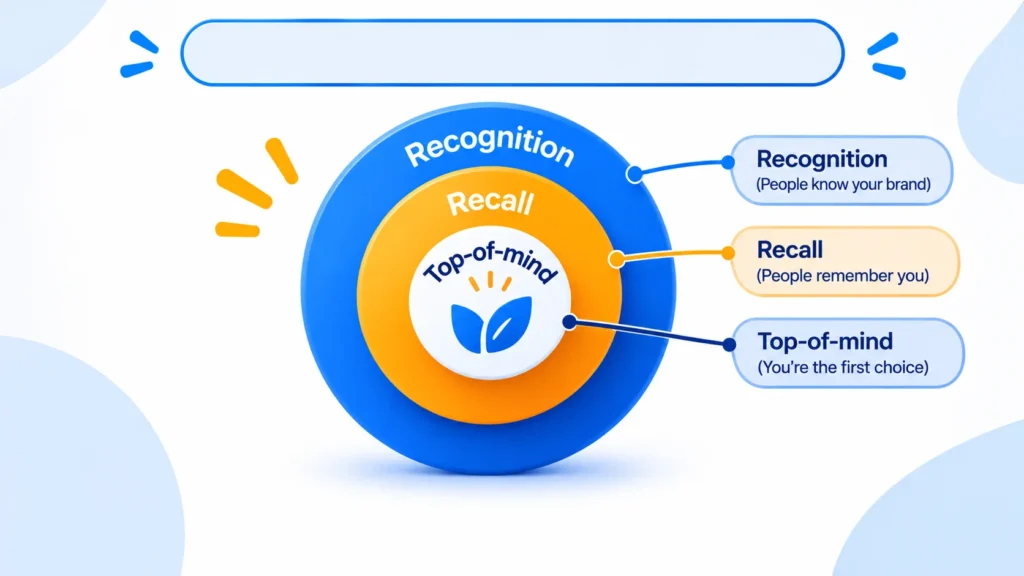
Brand awareness is how familiar your target audience is with your brand: whether people can recognize it when they see it, and whether they remember it when they need what you sell. It is the first step toward making a business recognizable to potential customers. People rarely buy from a brand they have never heard of.
This guide gives a clear definition, explains the types of brand awareness, shows how to measure it with a simple survey, and covers practical ways to build it, including on a small budget.
Table of Contents
Brand awareness in simple terms
Imagine you need running shoes. A few brand names come to mind right away. You also recognize others when you see them on a shelf. Those two experiences, remembering a brand and recognizing it, are the heart of brand awareness.
The academic definition says the same. Kevin Lane Keller’s widely cited 1993 paper on brand equity describes brand awareness as consisting of brand recognition and brand recall. Recognition is the ability to confirm you have seen or heard of a brand when it is shown to you. Recall is the ability to retrieve the brand from memory when you think of a product category or a need.
Awareness is always measured against a target audience. A neighborhood bakery needs to be known by people nearby, not by the whole world.
Brand awareness is also easy to confuse with related ideas:
| Concept | What it measures | Question it answers |
| Brand awareness | Whether people know the brand exists | “Have you heard of it?” |
| Brand reputation | What people think of the brand | “Do people trust and like it?” |
| Brand equity | The extra value a brand adds in people’s choices | “Does the name make people more likely to choose it?” |
| Brand loyalty | Whether customers keep coming back | “Do they stay with it?” |
A brand can be well known and disliked. Awareness is necessary for the others, but it does not guarantee them.
Types and levels of brand awareness
Awareness comes in levels, from simply recognizing a brand to naming it first. The terms below follow Keller’s recognition and recall split, plus the common marketing idea of top-of-mind awareness.
| Level | What it means | Example survey question | Also called |
| Brand recognition | People recognize the brand when it is shown, such as a name or logo | “Which of these brands have you heard of?” (with a list) | Aided awareness |
| Brand recall | People name the brand themselves when thinking about a category | “Which bakeries in town can you name?” (no list) | Unaided awareness |
| Top-of-mind awareness | The brand is the first one people name in the category | The first brand named in the unaided question | Unaided recall, first mention |
Some sources use “brand awareness” and “brand recognition” as if they were the same thing, and others split them. In this guide, recognition is one part of awareness, alongside recall.
Try this quick test: ask five customers to name businesses like yours before showing them a list. Who they name, and in what order, tells you more than you might expect.
Why brand awareness matters
Awareness matters because people can only choose from the options they know. Keller’s work links awareness to which brands people consider when they decide. If your brand is not in someone’s mind or recognized when they see it, you start from behind.
In practice, awareness helps in three ways:
- It puts you on the shortlist. Familiar names get considered first.
- It makes other marketing easier. People tend to find an unfamiliar brand riskier than a familiar one, so you have to work harder to explain who you are.
- It builds a base for loyalty and word of mouth. People can only recommend what they remember.
There are limits. Awareness does not guarantee sales. It can also be negative: a brand may be widely known for the wrong reasons, such as poor service or a public mistake. And awareness is slow and hard to attribute, so it rarely shows up neatly in a sales report.
Brand awareness examples
Large brands show how the levels differ. Many people can identify a famous sports brand’s logo without seeing its name. That is recognition. Others can name a few sports brands when asked to list them. That is recall. The brand named first has top-of-mind awareness.
A small business works the same way, only on a smaller scale. Here is a hypothetical example showing how a bakery might measure its awareness:
| Measure | Before | Six months later | Change |
| Unaided awareness (name bakeries in town) | 12% (24 of 200) | 20% (40 of 200) | +8 points |
| Aided awareness (recognize from a list of 8) | 35% (70 of 200) | 48% (96 of 200) | +13 points |
Numbers are invented to illustrate the method. With only 200 people per round, small changes can be noise, so surveys should reach similar groups each time and include enough responses.
The bakery did local events, partnered with a café, and posted regularly on community pages. The survey showed awareness rising, even though sales hadn’t yet jumped. That is typical: awareness often moves before revenue does.
How to measure brand awareness
There is no single perfect measure. The most direct method is a survey. Other signals act as clues.
Step 1: Run a simple awareness survey
- Pick your audience. Choose the group that matters, such as local residents or small-business owners.
- Ask the unaided question first. For example: “Which brands of [category] can you name?” Asking this before showing any list avoids prompting people.
- Then ask the aided question. Show a list that includes your brand and competitors: “Which of these have you heard of?” Some researchers add a made-up brand to catch people who tick everything.
- Calculate the share.
Awareness (%) = respondents who named or recognized your brand ÷ total respondents × 100
- Repeat the survey on a schedule (for example every quarter) with a similar audience and the same questions, and compare with competitors.
Step 2: Watch proxy signals
Proxies are easier to collect, but they show only part of the picture:
| Proxy | What it suggests | What can mislead you |
| Branded search | More people look for your name directly | Spikes from a short promotion or news event |
| Direct traffic | More people type your address or use bookmarks | Returning customers can inflate it |
| Social mentions and share of voice | How much people talk about you versus competitors | Can be negative; bots and giveaways distort it |
| Reach and impressions | How many people may have seen your content | Seeing is not remembering; impressions are not awareness |
| “How did you hear about us?” | Which channels people credit | People forget or credit the last touchpoint |
Step 3: Use brand lift studies if you advertise
Ad platforms offer brand lift studies. Google describes a method in which people eligible for a campaign are split into a group that sees the ads and a control group that does not, and both get a short survey question such as “Which of these brands have you heard of?” The difference in answers shows the lift caused by the ads.
Hypothetical example: 22% of the control group and 30% of the exposed group say they have heard of the brand. Absolute lift is 8 percentage points. Relative lift is 8 ÷ 22, or about 36%.
Sample size matters. Google’s Display & Video 360 help page notes that more survey responses allow smaller lifts to be detected. For example, 1,200 to 2,800 responses can detect an absolute lift of more than 4%.
To get started, write a ten-question version of the survey above, test it on a few people, and run it once as your baseline. A baseline is what makes later results meaningful.
How to build brand awareness
Building awareness means making your brand easy to recognize and easy to remember to the right people, repeatedly, over time. These approaches work at different budgets.
- Keep your identity consistent. Use the same name, logo, colors and tone everywhere. Keller notes that simple, distinctive names, logos and symbols help people recognize and remember a brand.
- Publish helpful content and make it findable. Answer the questions your target audience asks, so you appear when they search.
- Earn attention. Press coverage, reviews, podcasts, guest articles and partnerships put your name in front of people who already trust the source.
- Show up in person. Sponsor or join local events and communities your audience cares about.
- Work with creators and influencers who fit your audience. In the U.S., the Federal Trade Commission expects clear disclosure when someone is paid or given free products to promote a brand. Check your local advertising rules too.
- Use paid awareness campaigns carefully. Video, display and social ads can build reach. Judge them by recall or awareness, not only by clicks or sales.
- Encourage word of mouth. A good product and service, plus an easy way to refer friends, spreads your name at low cost.
On a small budget: pick one or two channels where your audience already is, stay consistent, and measure with a simple survey. Consistency over many months usually beats a single big push. There is no fixed timeline, because awareness builds through repeated exposure.
A helpful exercise is to write one sentence describing your target audience and one sentence naming the two places they are most likely to notice you. Everything else can follow from that.
Brand awareness and the marketing funnel
Awareness sits at the top of the marketing funnel. It is where people first learn you exist, before they consider, compare and buy. Because it is the first stage, awareness efforts usually do not show immediate sales. Treat them as groundwork: judge them by whether more of the right people recognize and recall you, then watch whether the later funnel stages improve.
Common mistakes and myths
- Assuming awareness equals sales. It helps, but does not guarantee purchases.
- Treating impressions as awareness. An ad shown is not an ad remembered.
- Reaching for everyone. Awareness among the wrong audience is wasted effort.
- Changing your look and voice too often. Constant changes reset recognition.
- Chasing a single viral moment. One spike fades; steady presence builds memory.
- Ignoring negative awareness. Being known for problems can hurt more than being unknown.
- Measuring once. A single number says little. The trend matters.
Frequently asked questions
What is brand awareness in simple words?
It is how well people know your brand: whether they recognize it when they see it and remember it when they need what you sell.
What is the difference between brand awareness and brand recognition?
Recognition is one part of awareness. It means identifying a brand when shown it. Awareness also includes recall, which means naming the brand without help.
What is top-of-mind awareness?
It means your brand is the first one people think of in a category.
How do you measure brand awareness?
The most direct way is a survey of your target audience with an unaided question and an aided question. Proxy signals like branded search and social mentions give extra clues but are not the same thing.
How long does it take to build brand awareness?
It depends on your audience, budget and consistency. Awareness grows through repeated exposure, so expect months rather than weeks, and track progress with the same survey over time.
Is brand awareness the same as brand equity?
No. Awareness is whether people know the brand. Equity is the added value the brand creates in their choices. Awareness is one building block of equity.
Conclusion
Brand awareness comes down to two questions: can people recognize your brand, and do they remember it when it matters? Measuring both, with a simple survey, tells you where you stand. Building both takes consistency, helpful content, and showing up where your target audience already is.
Pick one number to track, such as unaided awareness among your target audience, and measure it now. Everything you do next can then be judged against it.