
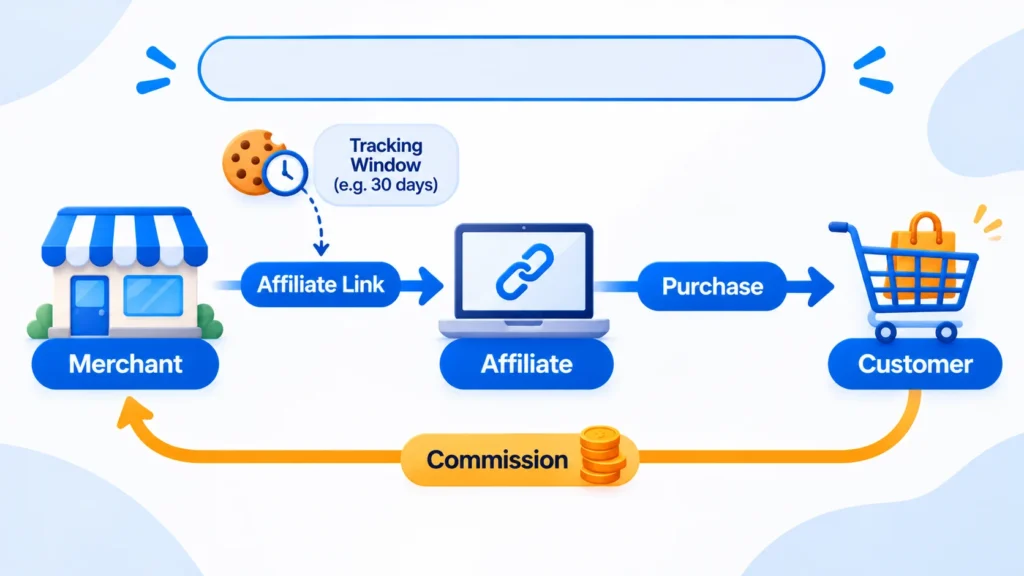
Affiliate marketing is a way to promote another company’s products or services and earn a commission when someone buys, signs up, or takes another agreed action through your unique tracking link. The company only pays for results, and the person promoting only earns when those results happen.
This guide explains how it works step by step, how affiliates get paid, what the rules are, and what you can realistically expect. It is written for both sides: people who want to earn commissions and businesses that want others to promote their products.
Table of Contents
Affiliate marketing in simple terms
Think of it as a performance-based referral. A company agrees to pay a reward each time a person it did not hire sends a real customer its way. The reward is tracked using a special link.
Four roles are involved:
| Role | Who they are | What they do |
| Merchant (advertiser) | The company selling the product | Creates the program, sets the commission and rules, and pays affiliates |
| Affiliate (publisher) | A blogger, reviewer, creator, newsletter or website | Recommends the product and shares a tracked affiliate link |
| Network or platform (optional) | A service between the two | Supplies links, tracking, reporting and payments |
| Customer | The buyer | Clicks the link and buys; usually pays the same price as anyone else |
A simple example: A reviewer writes a guide to standing desks and includes affiliate links. A reader clicks one, buys a desk, and the reviewer earns a percentage of the sale. The reader gets a recommendation, the retailer gets a customer, and the reviewer gets paid for sending the buyer.
Try describing this process for a product you know well, from the click to the payment. It is the quickest way to see where each role fits.
How affiliate marketing works, step by step
- The merchant creates a program. It sets the commission, the length of the tracking window, the payout rules, and what affiliates may or may not do. Many merchants use an affiliate network or software to handle tracking and payments.
- The affiliate joins and gets approved. Some programs approve almost anyone; others review the website or channel first. Each approved affiliate gets links that include a unique ID.
- The affiliate promotes the product. This usually happens through reviews, guides, videos, emails or posts that genuinely help the audience decide.
- A visitor clicks the link. The click is recorded, and a small file called a cookie (or a similar tracking method) is stored so the sale can be matched to the affiliate later.
- The visitor buys within the tracking window. If the purchase happens before the window closes, the sale is credited to that affiliate. This is called attribution.
- The merchant pays the commission. Most merchants wait until the return or cancellation period passes, and many only pay once the affiliate reaches a minimum balance.
A worked example with numbers
These figures are hypothetical and only show how the math works.
| Step | Result |
| Product price | $50 |
| Commission rate | 10% |
| Clicks on the affiliate link | 100 |
| Share who buy | 2% (2 buyers) |
| Commission earned | 2 × $5 = $10 |
A refund would usually cancel that commission. A visitor who buys after the tracking window closes, or who switches devices before buying, may not be credited at all. That is why affiliates test links and read each program’s terms.
Tracking is not perfect. Browser settings affect it. Safari, Firefox and Brave block third-party cookies by default, while Chrome has kept them and decided against a standalone prompt asking users to turn them off. Many programs also use other methods, such as tracking through the merchant’s own site and coupon codes, so a sale can still be matched. This is one reason cookie windows and tracking methods are worth checking before you join a program.
How affiliates get paid
Programs pay in different ways. The model decides what counts as a “result.”
| Model | Paid when | Good to know |
| Pay per sale | A purchase is made | The most common model. Pays a percentage of the sale or a flat amount. |
| Pay per lead | Someone completes a set action, such as a sign-up or free trial | Merchants often check lead quality before paying. |
| Pay per click | A visitor clicks the link | Less common, and easier to abuse, so merchants watch it closely. |
| Recurring commission | A subscriber keeps paying | Common with subscription software; earnings continue while the customer stays. |
| Hybrid or tiered | A mix of the above, or bonuses for top performers | Used to reward consistent results. |
Rates vary widely by product type and program: from low single digits for many physical goods to much higher for some software and digital products. Tracking windows vary too. Amazon’s program, for example, is widely reported to use a 24-hour cookie that can extend up to 90 days for items added to a cart, while other programs offer windows of 30 days or more. Always read the current terms for the specific program, because both rates and windows change.
Types of affiliate marketing, with examples
Affiliates promote in many ways. These are the main channels and how each works in practice:
| Channel | How it works | Example |
| Review and comparison sites | Readers researching a purchase click through to buy | Product review sites such as Wirecutter |
| Blogs and niche sites | Guides and tutorials attract search traffic and include links | Tech, finance or travel blogs |
| YouTube and video | Demonstrations with links in the description | Gadget reviewers, software tutorials |
| Email newsletters | Curated recommendations sent to subscribers | Deals and niche newsletters |
| Coupon and cashback sites | A code or cashback offer leads to the purchase | Coupon sites such as RetailMeNot |
| Social media creators | Links or codes shared in posts and bios | Lifestyle and product creators |
| Retail programs | Anyone with an approved site or channel can link to products | Amazon Associates |
You will also see affiliates described as unattached (no connection to the product), related (their content fits the product’s topic), or involved (they have used and vouch for it). These labels describe how closely the affiliate is tied to what they promote, not how they are paid. Readers tend to trust involved recommendations more, but the origin of these terms is not firmly established, so treat them as informal.
Affiliate marketing for individuals and for businesses
| As an affiliate (promoter) | As a business (merchant) | |
| What you do | Create content and add tracked links | Run a program: recruit, supply links, track and pay affiliates |
| Upfront cost | Often low: time, a site or channel, some tools | Setup, tracking software or network fees, commissions, marketing materials |
| Main benefit | Earn from recommendations without owning a product | Pay mostly for results and reach new audiences |
| Main risks | Slow start, uneven income, rule changes, loss of audience trust | Fraud, poor-fit affiliates, lost margin, low-quality traffic |
| First question to ask | Can I honestly recommend this? | Can I afford the commission after my margin? |
If you run a business, start by working out the highest commission you can afford after costs and returns. That number shapes everything else, including which affiliates will find your program worth promoting.
Rules you need to follow
Disclosure. In the United States, the Federal Trade Commission’s Endorsement Guides require people to disclose a “material connection” to a brand when they endorse it. The guides were revised in 2023, and an affiliate commission counts as such a connection. A disclosure must be “clear and conspicuous,” meaning difficult to miss and easy for ordinary people to understand. That generally means placing it close to the affiliate links, not hiding it in a footer or behind a click.
A simple disclosure might read: “Some links on this page are affiliate links. If you buy through them, we may earn a commission.”
Other countries have their own rules, set by advertising regulators. If your audience is outside the U.S., check your local regulator’s guidance on affiliate and sponsored content.
Program terms. Every program has rules about how you may promote. Amazon’s program, for instance, is widely reported to require at least three qualifying sales within the first 180 days or the account may be closed. Terms change, so confirm them in the program’s own documents.
Truthful claims and taxes. Do not make claims you cannot support, and remember that commission income is generally taxable. Check your local tax authority’s guidance.
Before publishing a single affiliate link, write your disclosure sentence and place it above the first link. It takes a minute and protects both you and your audience.
Is affiliate marketing worth it? A realistic view
Benefits: low upfront cost for promoters, performance-based spending for merchants, flexibility, and the chance to build income from content people find useful.
Limits: it is competitive, trust takes time, and income can be uneven. Programs can change rates or rules. Short tracking windows, refunds and tracking gaps reduce earnings. Content also needs updating to stay accurate, so “passive income” overstates how hands-off it is.
No reliable figure exists for what a typical affiliate earns, because results depend on audience, niche, trust, and effort. A better approach is to estimate your own situation:
Earnings = visitors × click rate × purchase rate × commission per sale
Hypothetical example: 10,000 monthly visitors, 3% click an affiliate link (300 clicks), 2% of those buy (6 sales), and each sale pays $5. That is $30 for the month. A larger audience, a higher-converting offer, or higher commissions would change it, but it shows why scale and trust matter. Plug in your own numbers to see what a realistic month looks like.
Affiliate marketing vs. influencer marketing, referral programs and MLM
These models overlap, and people mix them up. They differ in how you earn:
| Model | How you earn | Key point |
| Affiliate marketing | A commission on sales or leads from your tracked link | No recruiting needed; disclose your link |
| Influencer marketing | A fee, free product or both for creating content | Can include affiliate links; disclosure still applies |
| Referral program | A reward when an existing customer refers a friend | Usually run by the merchant for its own customers |
| Multi-level marketing (MLM) | Selling products and earning from a network of recruited sellers | Legal in the U.S. if revenue comes mainly from real retail sales |
| Pyramid scheme | Mostly from recruiting new members | Illegal |
The FTC explains that the key difference between a legitimate MLM and a pyramid scheme is where the money comes from: sales to real customers versus recruitment. A normal affiliate program pays for sales or leads. Some programs also pay a small bonus for referring other affiliates, but if earnings depend mainly on recruiting, treat it as a red flag.
Common mistakes and red flags
- Promoting products you have not evaluated. Readers notice, and it hurts trust.
- Hiding or skipping the disclosure. It breaks the rules and costs credibility.
- Relying on one program. A rate cut, a short cookie window or a closed account can end your income overnight.
- Not reading the terms. Rules on trademarks, coupon use, paid ads and link placement vary.
- Never testing links. Broken or wrongly tagged links earn nothing.
- Believing “guaranteed income” promises. Courses that guarantee results, or push you to recruit others, deserve skepticism.
- Stuffing pages with links. Content that helps first and sells second performs better and keeps readers.
How to get started
If you want to earn commissions:
- Choose a topic you know well and can recommend honestly.
- Build a channel: a site, newsletter, video channel or social account.
- Join programs that fit your audience and read their terms.
- Create genuinely useful content and add disclosed links where they help.
- Track clicks and sales, then improve what works.
If you run a business:
- Work out the commission you can afford.
- Choose a network or tracking software.
- Write clear program terms, including disclosure and prohibited tactics.
- Recruit affiliates your customers already trust and supply helpful materials.
- Monitor traffic quality and pay promptly.
Frequently asked questions
Is affiliate marketing legit?
Yes. It is a legal and widely used way for companies to pay for results. Scams exist around it, mainly courses promising guaranteed income, so judge any offer by whether you can recommend the product honestly and whether the terms are clear.
How do affiliates get paid?
Through the merchant or network, usually after a waiting period for returns, and often once a minimum balance is reached. Payment methods and schedules differ by program.
Do I need a website for affiliate marketing?
Not always. Some programs accept newsletters, video channels or social accounts. Others require a site. Check each program’s requirements.
How long do affiliate cookies last?
It depends on the program. Some use 24 hours, others 30 days or more. The length is set in the program’s terms.
Do I have to disclose that I earn commissions?
In the United States, yes: affiliate links are treated as a material connection under the FTC’s Endorsement Guides. Many programs also require disclosure. Other countries have similar rules, so check your local regulator.
How much can I earn?
It varies enormously and no trustworthy average exists. Use the earnings formula above with your own traffic and conversion estimates, and expect results to take time.
Conclusion
Affiliate marketing is simple at its core: someone recommends a product, a tracked link records who sent the buyer, and the merchant pays a commission for the result. The details matter, though: tracking windows, payment models, disclosure, and honest expectations about income.
If you plan to join a program, pick one and read its terms from start to finish before you apply. That one habit prevents most of the problems newcomers run into.