
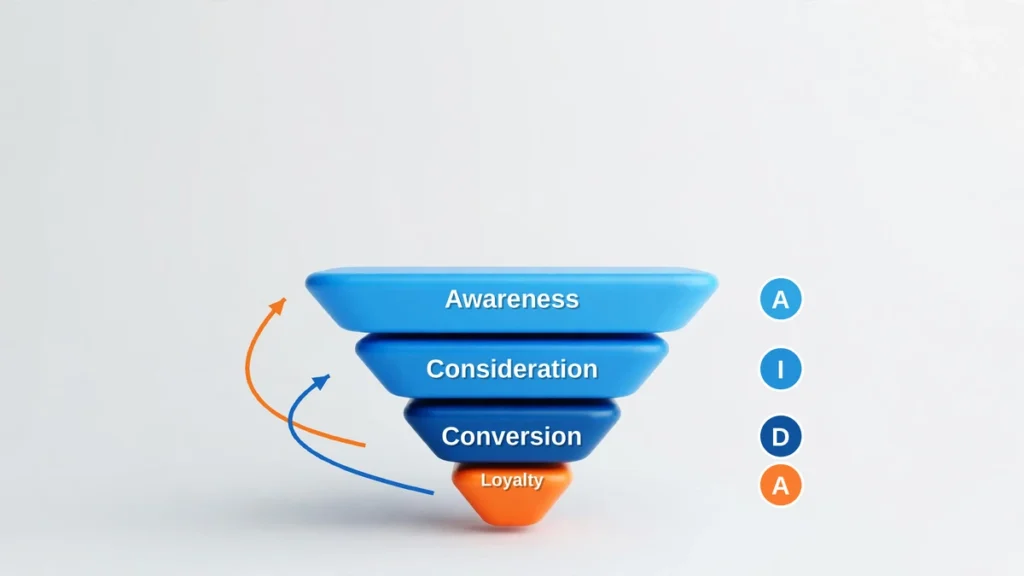
A marketing funnel is a model that maps the path people take from first hearing about your business to becoming a customer, and often to staying loyal. It is shaped like a funnel because many people enter at the top and fewer move on at each step.
Marketers use it to plan campaigns for each stage and to spot where they lose people. This guide explains the stages, the classic AIDA model, how a funnel differs from similar terms, and how to build and measure one.
Before reading on, try sketching your own funnel on one page. Write the steps a typical customer really takes with your business, even if they look messy.
Table of Contents
The marketing funnel in plain terms
Imagine a small online shop. In one month, thousands of people see its ads or find it through search. Some visit the website. Fewer sign up for emails. Fewer still add something to a cart. Fewer still buy.
At each step, some people drop out. That drop is normal. The funnel gives you a way to see how many drop out and where, so you can decide what to improve.
The idea is useful because it forces a simple question: what does a person need at this stage before they will take the next step?
The three main stages: top, middle, and bottom
Most funnels use three stages. Marketers often call them TOFU, MOFU, and BOFU, short for top, middle, and bottom of the funnel.
| Stage | What the person is thinking | Your goal | Example activities | Example metrics |
| Top (awareness) | “I have a problem or a need.” | Get noticed by the right people | Blog posts, search content, social posts, video, ads | Reach, clicks, new visitors |
| Middle (consideration) | “Which option fits me?” | Build trust and show fit | Email series, case studies, comparison pages, webinars | Email sign-ups, engagement, demo requests |
| Bottom (conversion) | “Am I ready to buy?” | Make buying easy and low-risk | Free trial, clear pricing, offers, reviews | Conversion rate, cost per acquisition |
| After purchase (loyalty and advocacy) | “Was it worth it?” | Keep customers and earn referrals | Onboarding, support, loyalty perks, referral asks | Repeat purchases, retention, referrals |
Some businesses stop at conversion. Others add the loyalty and advocacy stages, because keeping a customer and getting referrals is part of growth too.
AIDA: the classic version of the funnel
AIDA is the oldest and best-known funnel model. It stands for:
- Attention: the person notices you.
- Interest: they want to know more.
- Desire: they start to want what you offer.
- Action: they buy, sign up, or contact you.
AIDA is credited to Elias St. Elmo Lewis, an American advertising pioneer. He first described the idea in his 1898 book about selling real estate, but he did not use the acronym AIDA himself. Others coined the acronym later, based on his original concept.
AIDA maps roughly onto the three-stage funnel:
| AIDA step | Roughly matches |
| Attention | Top of the funnel |
| Interest | Upper middle |
| Desire | Lower middle and bottom |
| Action | Bottom |
The match is not exact, and models name their stages differently. What matters is that each stage has a clear job.
Marketing funnel vs. sales funnel vs. conversion funnel
These terms overlap, and different companies draw the lines in different places. This is a common source of confusion, so here is a practical way to separate them:
| Term | Main focus | Usually owned by |
| Marketing funnel | Attracting, engaging, and converting prospects through campaigns, often continuing to loyalty | Marketing |
| Sales funnel | Turning qualified leads into paying customers (qualifying, proposals, closing) | Sales |
| Conversion funnel | The steps a visitor takes to complete one goal on a site or app, used to find drop-offs | Web, product, or growth teams |
| Customer journey | Everything a customer does and feels, seen from their side | Shared across teams |
The marketing funnel usually hands qualified leads to the sales funnel. If you report on funnels, define your terms at the start so everyone means the same thing.
A worked example with numbers
This is a hypothetical example to show how the math works.
A software company that sells a scheduling tool tracks one month:
| Step | People | Rate from previous step |
| Website visitors | 10,000 | n/a |
| Email sign-ups | 500 | 5% |
| Free trials started | 100 | 20% |
| Paying customers | 20 | 20% |
The overall conversion rate is 20 ÷ 10,000 = 0.2%. That number alone tells you little. The step rates are more useful.
Suppose last quarter the trial-to-customer step was 30% and now it is 20%. The leak is near the bottom, so more ads at the top would not help. The team should look at the trial experience, pricing page, or follow-up emails instead.
Compare step rates with your own past results first. Published averages vary a lot by industry and often come from different years.
Try this with your own business: gather counts for each step over the last 90 days and calculate the rate between each pair.
How to build a marketing funnel
You don’t need special software to begin. A spreadsheet works.
- Define your target audience. Who has the problem you solve? Be specific about their situation, not just their age or job title. A funnel built for “everyone” attracts no one in particular.
- List the steps customers really take. Ask recent customers how they found you, what they compared, and what nearly stopped them.
- Match content to each stage. Early on, people need help understanding their problem. In the middle, they need proof and comparisons. Near the end, they need clarity on price, risk, and next steps.
- Connect the stages. Give people a reason to move on, such as an email series after a sign-up or a retargeted reminder after a pricing-page visit.
- Choose one or two metrics per stage. Too many numbers hide the problem.
- Review and adjust. Fix the biggest drop-off first, then measure again.
A helpful exercise is to write one sentence per stage describing the biggest question your ideal customer has at that point. Those questions become your content plan.
Metrics to track at each stage
| Stage | Useful metrics | How to calculate |
| Top | Reach, click-through rate, new visitors | Clicks ÷ impressions × 100 for click-through rate |
| Middle | Sign-up rate, engagement, demo requests | People who took the step ÷ people who saw the offer × 100 |
| Bottom | Conversion rate, cost per acquisition (CPA) | CPA = campaign cost ÷ number of conversions |
| After purchase | Repeat rate, retention, referrals | Returning customers ÷ total customers × 100 |
Stage conversion rate works the same way at every step: people who moved to the next stage, divided by people who entered the stage, times 100.
For cost, a campaign that costs $2,000 and wins 20 customers has a CPA of $100. Compare that with what a customer is worth over time, often called customer lifetime value (LTV). A low CPA matters little if customers leave quickly.
Why the funnel is not the whole story
Real buyers don’t move neatly from top to bottom. Someone might see a friend’s recommendation, buy the same day, and never read your content. Others compare options for weeks.
McKinsey researchers made this point in 2009. They argued that the decision process is better seen as a circular journey with four phases: initial consideration, active evaluation, purchase, and post-purchase experience. They also found that the number of brands a consumer considers can grow during active evaluation instead of shrinking, as the funnel would suggest.
Startups often use a different measure called AARRR, or “pirate metrics.” Dave McClure, founder of 500 Startups, introduced it in a 2007 presentation. It breaks growth into acquisition, activation, retention, referral, and revenue, and it focuses more on how people use a product after they arrive than on how they first hear about it.
None of this makes the funnel useless. It remains a simple planning tool. Just treat it as a map of common paths, not a rule that every customer follows.
Limits and common mistakes
- Treating it as a straight line. People skip stages, loop back, and re-enter. Allow for it in your content.
- Only investing at the top. More awareness does not help if the middle and bottom leak.
- Measuring only the final sale. Step rates show where the problem is.
- Using one message for everyone. A person at the awareness stage needs different content from someone comparing prices.
- Ignoring existing customers. Retention and referrals often cost less than finding new customers, so don’t leave the post-purchase stage empty.
- Copying another company’s funnel. Yours depends on your product, price, and audience. A low-cost impulse purchase has a short funnel. A business software contract can take months.
Frequently asked questions
What are the stages of a marketing funnel?
Most models use awareness, consideration, and conversion (top, middle, bottom). Many add loyalty and advocacy after the purchase.
What does AIDA stand for?
Attention, Interest, Desire, Action. It is the classic four-step model of how a buyer moves toward a purchase.
What do TOFU, MOFU, and BOFU mean?
They stand for top, middle, and bottom of the funnel. They are shorthand for awareness, consideration, and conversion.
Is a marketing funnel the same as a sales funnel?
Not exactly. A marketing funnel covers attracting and engaging prospects. A sales funnel focuses on turning qualified leads into customers. They connect, and some companies use the terms loosely.
Does every business need a marketing funnel?
Every business has some path from stranger to customer. Writing it down as a funnel helps you see it and improve it, even if you only track three steps.
Conclusion
A marketing funnel is a simple way to describe how people become customers: they notice you, learn about you, decide, and buy, and some stay and recommend you. Its value is practical. It shows which stage needs help and what the customer needs at each one.
Start small. Define your audience, list the real steps, measure the rate between each step, and fix the biggest drop-off first.