
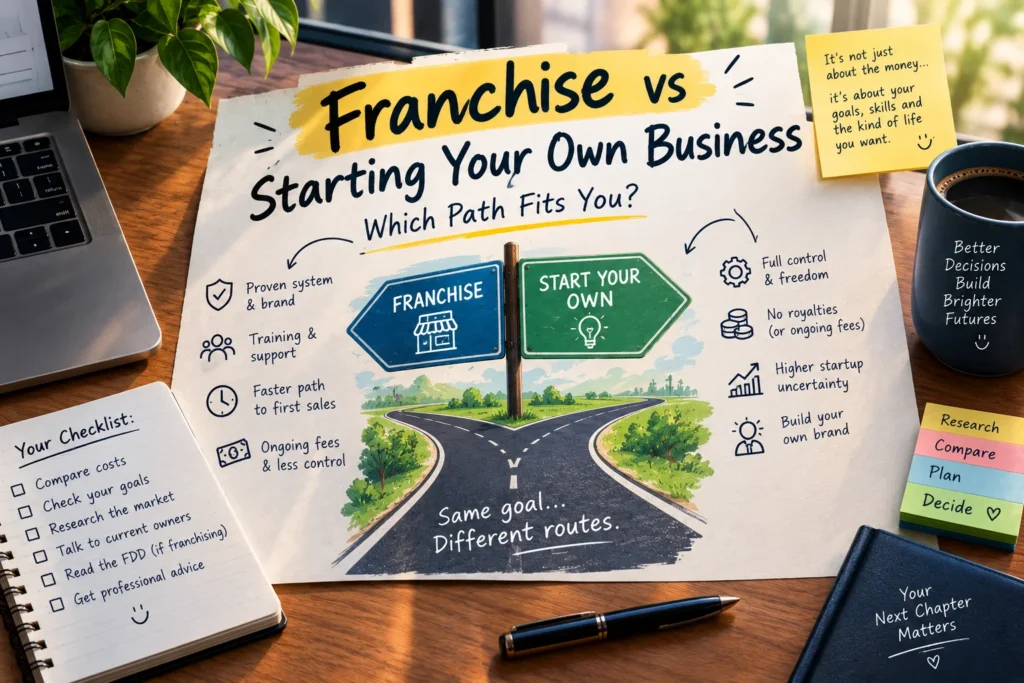
Franchise vs starting your own business comes down to one trade: a franchise sells you a tested system and a known brand in return for fees and rules, while starting on your own gives you freedom and lower ongoing costs but more uncertainty. Neither is automatically safer or more profitable. The better choice depends on your money, your experience, how much control you need and how long you can wait to earn. This guide compares the two paths with worked examples, explains what the success rate claims really mean, and gives you a simple scorecard to decide.
General information only, not legal, tax or financial advice. Franchise and business rules differ by country and state. This guide mainly reflects the United States. Speak to an accountant and, for a franchise, a franchise lawyer before you commit.
Table of Contents
Franchise vs Starting a Business at a Glance
| Factor | Franchise | Starting your own |
| Brand | Existing name and customer awareness | You build recognition from zero |
| Business method | A set system, training and manuals | You design, test and fix it yourself |
| Control | Limited by the franchise agreement | Full control over prices, products and suppliers |
| Upfront cost | Initial franchise fee plus setup and working capital | Setup, branding, legal and working capital |
| Ongoing fees | Royalties and marketing fund, often a percentage of sales | No royalties, but you pay for your own marketing |
| Speed to first sales | Often faster, because the model is proven | Often slower, because you are still learning |
| Support | Training and head office help | Advisers, mentors and your own research |
| Exit | Sale usually needs franchisor approval | You can sell or close on your own terms |
These are general patterns. A weak franchise can offer little support, and a strong independent founder can reach customers faster than a franchisee in a crowded market.
What Each Path Really Costs
The initial franchise fee gets the headlines, but it is only one part of the budget. To compare franchising with independent business ownership fairly, you need the full picture on both sides. This illustration uses invented figures for the same kind of service business. It does not describe any real brand.
| Upfront cost (illustrative) | Franchise | Startup |
| Initial franchise fee | $30,000 | $0 |
| Equipment and setup | $60,000 | $60,000 |
| Legal, licences and insurance setup | Included in fee and setup | $5,000 |
| Branding and website | Provided by franchisor | $8,000 |
| Launch marketing | Provided in part by franchisor | $15,000 |
| Working capital | $40,000 | $60,000 |
| Total | $130,000 | $148,000 |
The startup needs more working capital in this example because sales are assumed to build more slowly. The franchise is not always cheaper. Many franchises cost far more, and many startups cost far less. The point is to build both columns for your own case.
Ongoing costs matter more over time. Assume the franchise pays 8 percent of sales to the franchisor, split as 6 percent royalty and 2 percent marketing fund, while the startup spends 4 percent of sales on its own marketing. Assume both businesses keep 40 percent of sales after direct costs such as materials and labor, before these fees. Sales for the first three years are also assumed.
| Franchise | Startup | |
| Sales, year 1 | $250,000 | $150,000 |
| Sales, year 2 | $350,000 | $260,000 |
| Sales, year 3 | $400,000 | $340,000 |
| Three year sales | $1,000,000 | $750,000 |
| Fees or marketing paid | $80,000 | $30,000 |
| Left after direct costs and fees | $320,000 | $270,000 |
Under these assumptions the franchise is $50,000 ahead after three years, thanks to its faster start. But once both reach $400,000 a year, the franchise keeps 32 percent of sales (40 percent minus 8) and the startup keeps 36 percent (40 percent minus 4). That is $16,000 a year in the startup’s favor. At that rate the head start is used up in about three more years.
Next step: Build this same table with your own estimates. If a franchise only wins under optimistic sales, treat that as a warning.
What the Success Rate Claims Really Mean
You will see bold claims online: some franchise sellers say the great majority of franchises survive five years, while many pages say about half of independent startups fail. Treat these with caution.
- Startup figures are broad. Government data on new businesses in general suggests that roughly half survive five years, but that covers every business type, including part time ventures and one person shops, not only serious startups.
- Franchise figures vary with definitions. Studies funded by franchise groups may count only outlets still in the system, or leave out those that were sold, rebranded or closed quietly.
- The groups differ. A franchise is usually run by a buyer with capital who has passed the franchisor’s checks, so the two groups are not directly comparable.
- Averages hide the individual. Brand strength, location, your skills and your finances matter more than which model you pick.
A safer conclusion is this. A good franchise can reduce certain risks, such as not knowing how to run the business, but it adds others, such as fees and dependence on the franchisor. It does not guarantee success. For any specific brand, ask for outlet closures and turnover data, which US franchisors must report in their Franchise Disclosure Document.
Control, Freedom and the Rules You Accept
Control is the clearest difference in franchise business advantages and disadvantages. As an independent owner you choose your products, prices, suppliers, hours, branding and where to grow. If an idea works, you keep the whole gain.
A franchisee follows the system. The agreement can set required suppliers, pricing guidance, opening hours, design standards and your territory. You may need approval to change products or to sell the business. Some people value the structure. Others find it frustrating once they have experience.
- Some franchisors protect an exclusive area and others do not, so check the agreement.
- Agreements often run for many years and renewal terms vary.
- Noncompete limits. You may be limited in competing in the same field after you leave.
- Shared reputation. A strong brand can attract customers, but a brand problem you did not cause can hurt your sales.
Franchise Business Advantages and Disadvantages
| Franchise | Independent business | |
| Advantages | Known brand, training, tested method, group buying and marketing support, lender familiarity | Freedom, lower ongoing fees, full ownership of the brand, flexible changes, easier exit |
| Disadvantages | Ongoing royalties, little control, required suppliers, contract limits, dependence on the franchisor | Slower start, more trial and error, you pay to build awareness, fewer built in systems, less lender comfort |
Who Suits a Franchise, and Who Suits a Startup?
- A franchise may suit you if You want to run a proven model, you have capital but little experience in the field, and you are comfortable with rules.
- A startup may suit you if You have deep experience in your field, you want to set your own prices and style, and you can live with a slower and less certain start.
- Temperament matters. Franchisors often want buyers who can follow the system. Independent founders often have more freedom but must create every process.
- Budget matters. Some franchises need a large investment. Some startups, such as online or service businesses, can begin with very little.
A Five Question Scorecard
Score each question from 1 to 3. Add your total at the end. This is a thinking tool, not a prediction.
| Question | Score 1 leans to startup | Score 3 leans to franchise |
| How much experience do you have in this field? | A lot | Little or none |
| How much do you value control? | Very much | Not much |
| How soon do you need income? | I can wait | As soon as possible |
| How comfortable are you building a brand? | Very comfortable | Not comfortable |
| How do you feel about fees and rules? | I dislike them | I accept them for support |
A total of 5 to 8 leans toward starting your own business, 9 to 11 means you should compare both seriously, and 12 to 15 leans toward a franchise. If you land in the middle, test the idea by pricing both options in the cost table above.
Next step: Score yourself, then ask a partner or mentor to score you. Differences are worth discussing.
Financing: Franchise vs Starting Your Own Business
Lenders look at risk and evidence. A franchisor with a track record can make a loan easier to arrange, because the lender can study the brand, the fees and the results of other owners. Some franchisors also help buyers find financing, but you should compare offers and read the terms carefully.
A startup has no history, so lenders rely on your plan, your credit, your experience and any assets you can offer. Many founders use personal savings first, then add a loan, family support or a partner. Whichever path you choose, borrow only an amount you could repay if sales come in below plan. Using your home as security adds serious risk.
Loan rates, limits and eligibility change often, so ask several lenders for current terms. Test the repayment against the lower sales scenario in the cost section above.
How Long Until You Earn Money?
Time to income is where a franchise often feels different. A franchisee usually completes training, follows a set opening plan and starts with a known price list and supplier list. A founder is still testing the offer, the pricing and the marketing while spending cash.
That does not mean a franchise pays quickly. Opening can take months, build out can run late, and many owners take little or no pay at first. In both paths, plan for a period when the business does not cover your living costs. The illustration earlier shows why: even the faster path needs a working capital cushion.
- Your runway. Count how many months of personal expenses your savings can cover without any pay from the business.
- Ask current owners how long it took them to draw a regular income, and compare that with the franchisor’s claims.
- Keep a separate emergency fund so that a slow quarter does not force you to close.
Legal and Tax Setup for Both Paths
In both cases you choose a legal structure, such as a sole proprietorship, a limited liability company or a corporation. The choice affects personal liability and tax. A franchise agreement is normally signed by your business entity, and some franchisors ask for a personal guarantee, which can expose your own assets. An accountant and a lawyer can explain the trade offs for your country and state.
Middle Options Worth Considering
- An existing business. Buying a small existing business gives you customers and income records, though you must check them carefully.
- A franchise resale. Some franchises are sold by current owners. Their records show real results, but you still need franchisor approval.
- A license or dealership. A license lets you use a brand or method with lighter rules and fewer fees, but with less support.
- A part time start. Testing the idea alongside your job lowers the risk before you commit.
Checks Before You Commit
If you lean toward a franchise, ask for the Franchise Disclosure Document and read the costs, outlet closures, litigation and any earnings claims. Call several current and former owners. A dedicated guide on how to buy a franchise covers those steps in detail. Then hire a franchise lawyer and an accountant before you sign anything.
If you lean toward a startup, write a simple business plan, test demand before you spend, choose a legal structure, check licences and insurance, and keep a cash cushion for the slow months. Talk to people who run similar businesses and ask what they wish they had known.
Conclusion
Franchise vs starting your own business is not a contest with a single winner. A franchise buys speed and structure at the price of fees and freedom. An independent business buys control and lower costs at the price of uncertainty and effort. Run both sets of numbers, score yourself honestly, and test your plan with lower sales than you hope for. The path that still works under those conditions is usually the right one.