
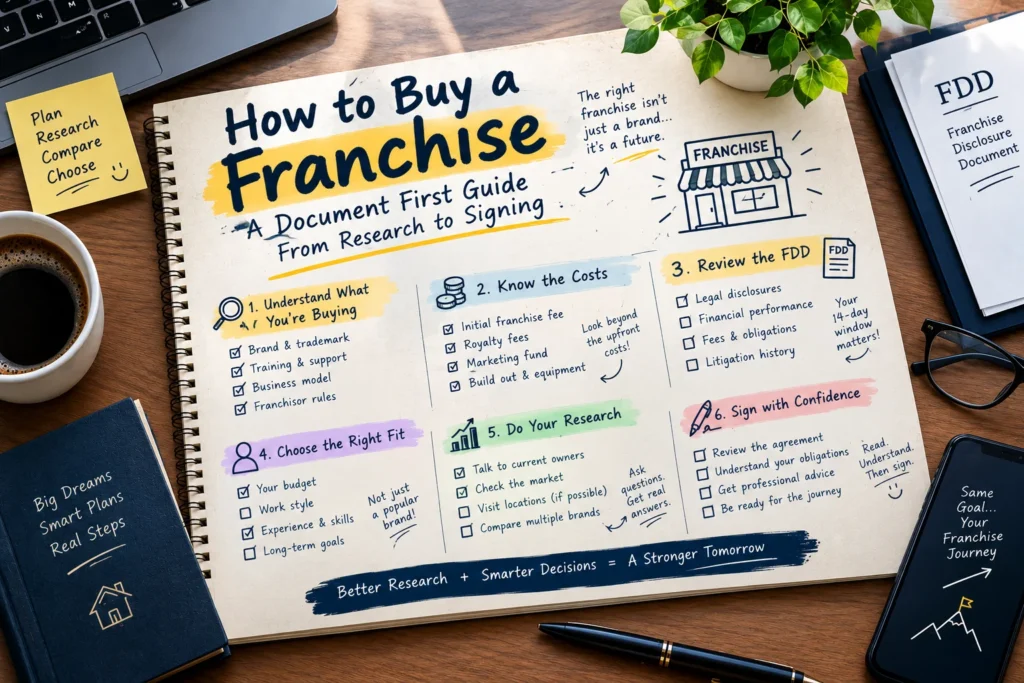
To learn how to buy a franchise, start with the paper, not the brand. In the United States, the franchisor must give you a Franchise Disclosure Document, called the FDD, at least 14 days before you sign anything or pay any money. That document, plus honest numbers and conversations with current owners, tells you more than any sales pitch. This guide shows how to buy a franchise for beginners in a clear order: what you are buying, what it really costs, how to read the FDD, and what to check before you sign.
General information only, not legal, tax or financial advice. Franchise rules vary by country and state, and buying one is a major financial commitment. Speak to a franchise lawyer and an accountant before you sign. The rules described here mainly reflect the United States.
Table of Contents
What Is a Franchise Business?
A franchise business is an arrangement in which you, the franchisee, pay a company, the franchisor, for the right to operate under its brand and system. You usually get training, a business method and a trademark. In return you pay fees, follow the franchisor’s rules and sign a contract that can run for many years.
Buying a franchise is different from starting your own business, and the trade offs are real.
| Buying a franchise | Starting your own business | |
| Brand | Existing name and customers | You build it from zero |
| Method | Set system and training | You design and test it |
| Freedom | Limited by franchisor rules | Full control |
| Costs | Franchise fee plus ongoing royalties | No royalties, but often higher marketing needs |
| Risk | Lower in some ways, but not removed | Higher uncertainty about whether it works |
A franchise is not a guaranteed result. A strong brand can still produce a weak location or an owner who struggles with long hours and tight margins.
Every Fee You May Pay
People often focus on the initial franchise fee and miss the rest. The FDD lists each charge, mainly in Items 5 and 6. Compare them across brands on the same basis.
| Fee | How it usually works |
| Initial franchise fee | A one time payment for the right to open, often due when you sign |
| Royalty | A regular payment, usually a percentage of sales, paid even if you make no profit |
| Marketing or advertising fund | A pooled contribution, often a percentage of sales, spent on brand promotion |
| Technology or software fees | Charges for required systems, apps or point of sale tools |
| Training fees | Costs for initial or ongoing training, plus your travel |
| Transfer and renewal fees | Charged if you sell the business or extend the agreement |
A low initial fee does not mean a cheap franchise. A brand with a small upfront fee and a high royalty can cost far more over ten years.
Which Type of Franchise Fits You?
The right franchise depends on how you want to work, not only on which brand is popular. Use this table to narrow your shortlist before you ask for any FDDs.
| Style | What it means | Best suited to |
| Owner operator | You work in the business daily | People who want a hands on job and lower payroll |
| Semi absentee | You hire a manager and oversee | Buyers with management skills and a larger budget |
| Home based or mobile | Low premises costs, smaller scale | Buyers with a limited budget and flexible hours |
| Location based retail or food | Higher build out and rent | Buyers who can fund a larger opening and long hours |
Can You Afford It? A Worked Cost Example
The initial franchise fee is only one line in the budget. The franchisor must list the full estimated initial investment in the FDD. This illustration uses invented numbers to show how the total builds up. It does not describe any real brand.
| Upfront cost (illustrative) | Amount |
| Initial franchise fee | $35,000 |
| Build out or renovation | $120,000 |
| Equipment and signage | $60,000 |
| Opening inventory | $15,000 |
| Licenses, legal and training travel | $5,000 |
| Working capital for the first months | $50,000 |
| Total | $285,000 |
Working capital is the cash that keeps you going while sales build. Many advisers suggest holding several months of operating costs, but the right amount depends on the business, so check the range in Item 7 of the FDD.
Now look at the yearly picture. Assume the shop earns $600,000 in sales. Royalties are a percentage of sales, here assumed at 6 percent, and a pooled marketing fund takes another 2 percent. The other percentages are assumptions too.
| Yearly item (illustrative) | Share of sales | Amount |
| Sales | 100% | $600,000 |
| Cost of goods | 32% | $192,000 |
| Payroll | 28% | $168,000 |
| Rent and utilities | 10% | $60,000 |
| Royalty to franchisor | 6% | $36,000 |
| Marketing fund | 2% | $12,000 |
| Other costs | 8% | $48,000 |
| Left before owner pay, loan and tax | 14% | $84,000 |
If you borrowed $200,000 of the $285,000 at an assumed 8 percent over 10 years, the repayments would be about $2,427 a month, or roughly $29,100 a year. That leaves about $54,900 before you pay yourself and your taxes. Royalties come off sales, not profit, so you pay them even in a slow year.
Now test a weaker year. Suppose sales fall 20 percent to $480,000. Cost of goods, royalty and marketing move with sales, so together they take 40 percent, or $192,000. Payroll, rent and other costs stay about the same at $276,000. That leaves $480,000 minus $192,000 minus $276,000, which is $12,000. After $29,119 of loan repayments you would be about $17,100 short, before you pay yourself. A plan has to survive this kind of test.
Next step: Build this same table for each brand on your shortlist, using the figures from its own FDD, and see what is left after royalties and loan payments.
How to Buy a Franchise Step by Step
Follow these eight steps in order. Do not pay any deposit before you have read the FDD.
Set Your Goals and Budget
Decide how much you can invest, how much you can afford to lose, and how many hours you want to work. Be honest about your skills. A restaurant, a fitness studio and a cleaning service ask for very different things.
Shortlist Brands
Use franchise directories, trade events, local owners and, if you choose, a franchise broker. Remember that brokers are often paid by franchisors, so ask how they earn money. To evaluate franchise business opportunities fairly, compare at least three brands in the same field.
Request the FDD
Ask each franchisor for its Franchise Disclosure Document. The law gives you at least 14 calendar days to review it before signing or paying. Keep the date you received it.
Read the Key Items
The FDD has 23 numbered sections, called Items. The table in the next section shows the ones that matter most.
Talk to Franchisees
The FDD lists current and former franchisees. Call several, including people who left the system. Ask what they earn, what surprised them and whether they would buy again.
Test the Numbers and Financing
Rebuild the cost tables above with real figures. Ask lenders what they require. Check how much debt you can carry if sales come in below plan.
Get Professional Review
Hire a lawyer with franchise experience and an accountant. They can explain the agreement, the renewal and exit terms and the tax side.
Sign and Prepare to Open
Only sign when every question is answered and the 14 days have passed. After that come site approval, training, hiring and the opening. The whole process often takes several months, and sometimes longer, depending on the brand and location.
The FDD Items That Matter Most
| Item | What it tells you | What to look for |
| 1 | The franchisor and its history | Years in business, parent companies |
| 3 | Litigation | Repeated lawsuits with franchisees |
| 5, 6, 7 | Initial fee, other fees and total initial investment | Every fee, and the full range |
| 8 | Required suppliers and products | Limits on where you can buy |
| 11 | Training, support and advertising | What is promised in writing |
| 12 | Your territory | Whether you have exclusive rights |
| 17 | Renewal, termination, transfer and disputes | How you can leave and what it costs |
| 19 | Financial performance claims | Whether the franchisor shows earnings at all |
| 20 | Outlets and turnover | Closures, transfers and cancellations |
| 21 | Financial statements | The franchisor’s own financial health |
Item 19 is optional for franchisors. If a company gives no earnings data, ask why, and rely more on your calls with owners.
Franchise Agreement Terms to Understand
The agreement is the contract you will live under, so read it with your lawyer. The FDD usually includes a copy. These points deserve the closest attention.
- Term and renewal. Agreements often run for many years. Ask how long, and what it costs to renew.
- Check whether the franchisor can open another outlet near yours, or sell online in your area.
- Supply rules. Find out what you must buy, from whom, and whether the franchisor earns on it.
- Learn when the franchisor can end the agreement and what you owe if you leave.
- Noncompete clauses. Many agreements restrict you from running a similar business for a time after you leave.
- Selling or transferring. Check whether you can sell the business, who must approve the buyer, and what fees apply.
Do not assume that terms are fixed. Some can be negotiated, and others are the same for every buyer. A franchise lawyer can tell you which is which.
How to Read Earnings Claims
An earnings claim is only useful if you know what it measures. Look at gross sales versus net profit, whether the figures cover all outlets or only the best ones, and how long those outlets have been open. Averages can mislead. In this illustration, five outlets have yearly sales of $300,000, $350,000, $400,000, $450,000 and $1,500,000.
| Measure | Result |
| Average sales | $600,000 |
| Median sales (the middle outlet) | $400,000 |
One outlier lifts the average far above what most owners earn. Ask for the median and the range, and check how many outlets are in the data.
Questions to Ask Current and Former Franchisees
- What were your total costs compared with the FDD estimate?
- How long did it take to cover your costs, and are you paid for your own time?
- How good is training and ongoing support when something goes wrong?
- Have fees, required suppliers or rules changed since you signed?
- Would you buy this franchise again, and what would you do differently?
Red Flags to Watch For
| Warning sign | Why it matters |
| Pressure to sign or pay quickly | You are entitled to time to review the FDD |
| Promises of income not in the FDD | Verbal earnings claims may not be reliable |
| High turnover or many closed outlets | Item 20 may show owners leaving |
| Franchisees who will not talk | The system may have problems |
| Heavy litigation with owners | Item 3 may reveal repeated disputes |
| Weak or unclear franchisor finances | Item 21 may show it cannot support owners |
Next step: Write down every red flag you notice for each brand, then ask the franchisor to explain it in writing.
Mistakes Beginners Make
Most problems come from the buyer’s own process, not from the franchise itself.
- Buying the brand, not the business. Falling for a brand you like as a customer without checking how owners actually earn.
- Underfunding working capital. Spending the whole budget on the opening and having no cash for slow months.
- Trusting verbal claims. Relying on a salesperson’s figures instead of the FDD and owner calls.
- Rushing the deadline. Paying a deposit before the 14 days of review are over.
- Skipping professional advice. Treating the lawyer and accountant as a final formality.
- Ignoring the exit. Not asking what happens if the business fails or you want out.
Financing Your Franchise
Many buyers combine personal savings with a loan. Options include bank and Small Business Administration backed loans, financing offered by some franchisors, equity from a partner or home equity, though borrowing against your home adds serious risk. Lenders look at your credit, your own investment and the franchise’s record, so expect to put in a meaningful amount of your own money.
Loan terms, rates and limits change often. Ask lenders for current figures, and test your plan with lower sales and higher payments. A plan that only works if everything goes right is not safe.
Check State Rules and the Franchisor’s Record
Federal rules require the FDD, but some states add registration or filing requirements, and rules differ from state to state. Check with your state securities or franchise regulator and your lawyer. Verify the franchisor’s trademark with the US Patent and Trademark Office, search for complaints with your state attorney general and consumer agencies, and check the Better Business Bureau. Outside the United States, find your country’s franchise laws before you pay anything.
Conclusion
The safest way to buy a franchise is the slowest one: read the document, rebuild the numbers with your own assumptions, speak to people who run the business, and get professional advice before you sign. A good franchise should still look good after you test it with lower sales and higher costs. If it does not, walk away. There will be other opportunities.