
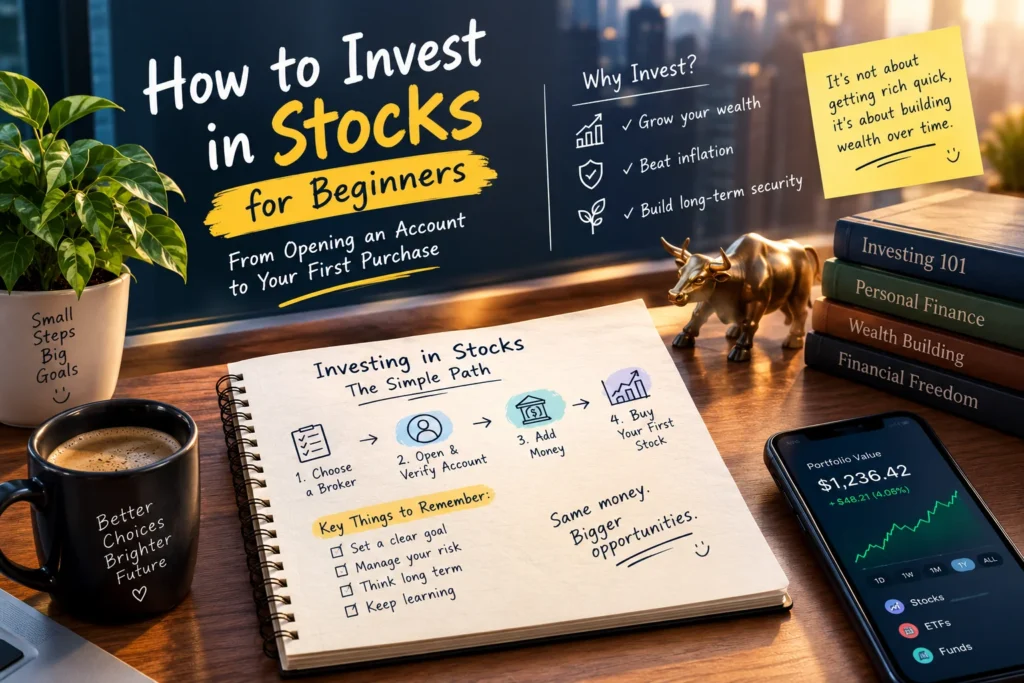
To learn how to invest in stocks, you need four things: an account with a broker, a decision between a stock fund and individual companies, an amount you can leave alone for years, and an order placed on the stock exchange. None of it needs a lot of money, because many brokers now sell fractions of a share. What takes care is the choices around the purchase: which account, what costs, how much risk, and which sellers to trust. This guide walks you through the full path in plain English, with small worked examples, so your first purchase is a planned one.
General information only, not personal financial advice. Investing involves risk, including the loss of money. This guide mainly reflects the United States. Rules, taxes and protections differ in other countries, so check your local regulator or a licensed adviser.
Table of Contents
Are You Ready to Invest?
Stocks can fall sharply and stay down for years. Money you may need soon should not go into them. Before you buy, check three things.
- High interest debt. Interest on credit cards and similar debt often costs more than you can reasonably expect to earn, so paying it down usually comes first.
- An emergency fund. Keep a cash cushion for emergencies, often described as three to six months of essential spending, so you never have to sell stocks at a bad moment.
- A long time horizon. Money you will need within about five years belongs in safer places. Stocks suit goals that are many years away.
What Are Stocks and How Do They Work?
A stock, also called a share, is a small piece of ownership in a company. If the company grows and earns more, the share price can rise. Some companies also pay part of their profit to shareholders as dividends. You can earn from price growth, dividends, or both, and you can also lose money if the price falls.
Shares are bought and sold on a stock exchange, a regulated marketplace such as the New York Stock Exchange or Nasdaq. You do not deal with the exchange directly. A broker places the order for you. Prices move all day as buyers and sellers agree on new levels.
You can own stocks in two main ways, and the choice shapes your risk.
| Individual stocks | Stock funds (index funds and ETFs) | |
| What you own | A share in one company | A small slice of many companies at once |
| Risk | High, because one company’s problems hit you hard | Lower, because the risk is spread out |
| Effort | You research and monitor each company | Low, the fund follows a set list |
| Cost | Trading fees may apply | A yearly fund fee, often small for index funds |
| Often suits | A small part of a portfolio, for those who enjoy research | A core holding for most beginners |
An index fund copies a list of companies, such as the S&P 500, which tracks 500 large US companies. An ETF is a fund that trades on an exchange like a share. Many beginners choose a broad fund for the core of their money because it spreads risk automatically. If you want to try individual companies, many people keep that to a small slice.
Which Account Should You Use?
The account decides where your stocks are held and how they are taxed. In the US, the two common choices are a regular brokerage account and a retirement account.
| Taxable brokerage account | Retirement account (IRA or workplace plan) | |
| Access to money | Withdraw any time | Penalties may apply before retirement age |
| Tax treatment | Gains and dividends are taxed | Tax benefits depend on the account type |
| Limits | No yearly contribution cap | Yearly contribution limits set by law |
| Best for | Goals before retirement | Retirement savings |
If your employer offers a retirement plan with a matching contribution, many people start there, because the match is extra money. Contribution limits and tax rules change, so check the current figures on the IRS website. If you live outside the US, look for the equivalent tax advantaged accounts in your country.
Next step: Write down your goal and the year you will need the money. It decides which account fits.
How to Invest in Stocks Step by Step
Here is the path to open a stock trading account and place your first order.
Choose a Broker
A broker is a company licensed to buy and sell investments for you. Compare fees, the account types offered, fractional shares, account minimums and customer support. In the US, you can check that a firm and its representatives are registered using FINRA BrokerCheck and the SEC’s Investor.gov tools. Do not choose a broker only because of a sign up bonus.
Open and Verify the Account
You fill in an online application with your name, address, date of birth, tax identification number and employment details. You also confirm your identity, usually with a photo of an ID. Approval can take from minutes to a few days.
Add Money
Link your bank account and transfer funds. A bank transfer is usually the cheapest method. Your cash may take a few days to become available for trading, so plan ahead.
Find What You Want to Buy
Each stock or fund has a short code called a ticker symbol. Search for it in your broker’s app and read the fund’s fact sheet or the company’s summary page. For a fund, check the yearly fee, which is called the expense ratio, and what the fund holds.
Place the Order
You choose how many shares or how many dollars, then the order type.
- Market order. Buys right away at the best available price. It is simple, but the price can move slightly before it fills.
- Limit order. Buys only at a price you set or better. You control the price, but the order may never fill.
Review the details and confirm. After the trade settles, the shares appear in your account. Keep the confirmation for your records.
How Much Should You Invest?
A common question about how to invest in stocks is whether a small budget is worth the effort. It is, as long as costs stay low.
There is no required amount. Many brokers allow fractional shares, which means you can buy a dollar amount of a stock or fund instead of a whole share. Some funds have minimums, so check before you buy. The most useful rule is to invest only what you can leave alone for years.
These three plans are illustrations only, not recommendations. They show how a beginner might split a small amount between a broad fund and one individual company.
| Starting amount | Broad stock fund (90 percent) | One individual stock (10 percent) |
| $100 | $90 | $10 |
| $500 | $450 | $50 |
| $1,000 | $900 | $100 |
After the first purchase, many people add a fixed amount every month. This keeps the habit going and avoids trying to guess the best day to buy.
What Does Investing in Stocks Cost?
Fees look tiny and still matter over decades. Watch for three kinds: trading commissions at your broker, account fees, and the yearly fund fee, which is shown as a percentage of your balance. Many brokers no longer charge commissions on regular online stock trades, but check your own.
Here is a simple illustration. You invest $10,000 once and leave it for 20 years. Assume a return of 6 percent a year before fees. This is an assumption for the example, not a forecast. Compare a fund with a 0.05 percent yearly fee to one with a 1.00 percent yearly fee.
| Yearly fee | Approximate value after 20 years |
| 0.05 percent | about $31,770 |
| 1.00 percent | about $26,530 |
| Difference | about $5,240 |
The higher fee costs roughly a sixth of the final value in this example. Fees are one of the few things you can control, so check the expense ratio before you buy a fund.
Understanding Risk in Real Numbers
Diversification means spreading your money across many companies so that one failure does not wreck your plan. A broad fund does this for you, but it cannot remove the risk of the whole market falling. A loss also needs a larger gain to recover, which surprises many beginners.
| If your stocks fall by | Gain needed to get back to even |
| 20 percent | 25.0 percent |
| 30 percent | 42.9 percent |
| 50 percent | 100 percent |
Stock markets have recovered from past declines, but there is no guarantee, and recoveries can take years. Ask yourself an honest question before you invest: if my stocks fell 30 percent next year, could I leave the money alone? If the answer is no, hold a smaller share in stocks or choose a lower risk mix with bonds.
Next step: Decide in advance what you will do in a market fall. Writing it down makes panic selling less likely.
Taxes in Plain English
In the US, you generally owe tax in two ways. Dividends you receive are taxed. Profit when you sell is a capital gain. If you held the stock for one year or less, the gain is usually taxed like regular income. If you held it for more than a year, it usually gets a lower rate. Losses can sometimes offset gains. Inside a retirement account, the rules differ.
Tax rates and thresholds change and depend on your income and country. Use the IRS website or a tax professional for your own situation. Keep your trade confirmations and year end statements.
Beginner Mistakes to Avoid
Most errors in how to invest in stocks come from emotion or haste, not from lack of intelligence. These are the common ones.
- Concentrating too much. Putting everything into one company or one hot idea.
- Chasing hype. Buying because a price jumped or a stranger online recommended it.
- Timing the market. Trying to guess the best day to buy or sell.
- Panic selling. Selling everything after a drop, which locks in the loss.
- Using borrowed money. Borrowing to invest, which can multiply losses.
- Overlooking fees. Ignoring yearly fund fees and account costs.
- A short time horizon. Investing money you will need soon.
How to Spot Scams and Protect Your Money
Fraudsters target new investors, and no honest guide on how to invest in stocks will promise a sure profit. Be cautious if someone promises guaranteed returns, pushes you to act today, contacts you unprompted on social media, or asks you to move money into an account you do not control. Before you deal with any firm or adviser, verify that they are registered using FINRA BrokerCheck or Investor.gov, or contact your state securities regulator.
In the US, a brokerage account is usually protected by SIPC if the broker fails, up to set limits. SIPC does not protect you from market losses or poor advice. Check the current limits on the SIPC website.
Your First 30 Days Plan
- Check your emergency fund and high interest debt.
- Choose an account type that fits your goal.
- Compare two or three brokers and verify their registration.
- Open the account and link your bank.
- Pick a broad fund, check its yearly fee, and place a small first order.
- Set a monthly amount you can keep up.
Next step: Start small. Learning how the process feels with a modest amount is worth more than waiting for the perfect moment.
Conclusion
Knowing how to invest in stocks is mostly about preparation and patience: a safety net first, a low cost broad fund as your base, a clear view of risk, and a habit you can keep. You do not need to pick winners or predict the market. Take it one step at a time, check the rules for your country, and consider speaking with a licensed adviser if your situation is complicated.