
Most teams do not struggle with software testing because they lack tools. They struggle because nobody ever wrote down a real plan that the whole team agreed to follow. That gap is exactly what software testing strategies are meant to close, turning scattered testing effort into a repeatable system that catches problems before customers do. In this guide, you will learn what a software testing strategy actually is, how it differs from a test plan, and a clear step by step process for building one your team will actually use. We will also look at strategies for AI systems, compliance heavy industries, and the mistakes that quietly undermine most testing efforts.
Table of Contents
What Is a Software Testing Strategy?
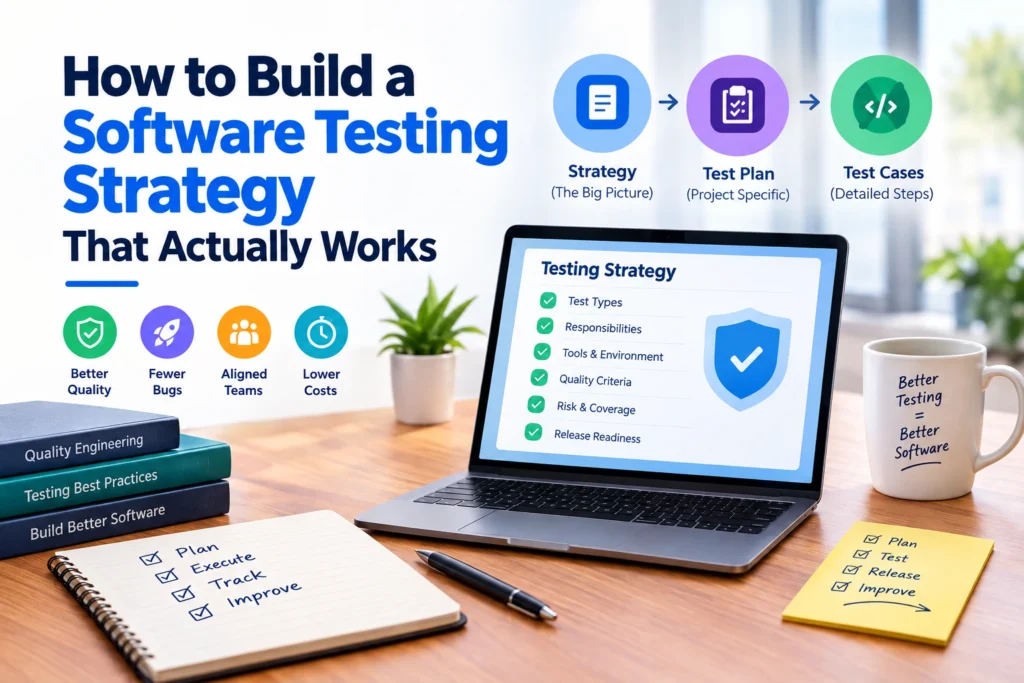
A software testing strategy is a high level document that defines how quality will be approached across an entire project or organization. It sets the principles, not the individual test cases. Think of it as the constitution for your testing effort. It explains what types of testing will be used, who is responsible for each type, what tools support the process, and how much testing is enough before release.
People often confuse a testing strategy with a test plan, but they operate at different levels.
- A testing strategy is broad and reusable. It rarely changes and applies across multiple projects or releases.
- A test plan is specific and short lived. It describes how the strategy will be applied to one particular release, sprint, or feature.
- A test case is the smallest unit, a single scenario with clear steps and an expected result.
If your team only writes test cases and skips the strategy layer, testing tends to become reactive. Everyone tests what feels important that week, coverage becomes inconsistent, and the same categories of bugs keep slipping through. A documented software quality strategy prevents that drift by giving every tester, developer, and product manager the same reference point.
Why Software Testing Strategies Matter in the Development Lifecycle
Quality problems get more expensive the later they are found. A bug caught during code review costs a few minutes to fix. The same bug found by a customer after release can cost days of firefighting, a patch release, and damage to trust. This is the core argument for investing time in software testing strategies rather than treating testing as an afterthought added at the end of development.
A good strategy also does something less obvious. It aligns expectations. Developers know what quality bar they are writing code against. Testers know where to focus limited time. Product managers know what ready to ship actually means. Without that shared definition, teams argue about readiness instead of measuring it.
Types of Software Testing Strategies
There is no single correct testing strategy. The right choice depends on your product, your risk tolerance, and your team’s maturity. Here are the main categories most teams draw from, often combining more than one.
| Strategy Type | Best For | How It Works |
| Analytical (risk based) | Products with clear risk areas, like payments or healthcare | Testing effort is weighted toward the parts of the system most likely to fail or cause the most damage if they do |
| Model based | Complex systems with many states | Testers build a model of how the system should behave, then generate test cases from that model |
| Methodical | Regulated or safety critical software | Testing follows a fixed, documented checklist based on known failure categories |
| Process compliant | Enterprises with formal standards | Testing follows an external standard, such as ISO, or an internal quality framework |
| Reactive and exploratory | Startups and fast moving teams | Testers explore the product with minimal scripting, relying on experience to find issues quickly |
| Consultative | Teams with limited in house QA expertise | Test priorities are set by talking directly to users, stakeholders, or domain experts |
Most real world software testing strategies blend two or three of these. A fintech startup, for example, might combine analytical testing on the payment flow with exploratory testing everywhere else.
How to Build a Software Testing Strategy Step by Step
Building the strategy does not need to be complicated. These are the steps that consistently produce a document teams actually follow.
- Define the quality goals first. Before choosing any tools, write down what good enough to ship means for this product. Is it zero critical bugs, 99.9 percent uptime, or passing a specific compliance audit?
- Map the risk areas. List the parts of the system where a failure would be expensive, embarrassing, or dangerous. This becomes the backbone of your test planning and tells you where to spend the most effort.
- Choose the testing types you need. Common categories include unit testing, integration testing, system testing, performance testing, security testing, usability testing, and regression testing. Not every project needs all of them at the same depth.
- Decide what gets automated and what stays manual. Repetitive, stable, high frequency checks are strong automation candidates. New features, visual details, and exploratory sessions usually stay manual longer.
- Assign ownership. Every testing type needs an owner, even if that owner is a developer wearing a QA hat part time. Strategies fail quietly when nobody is accountable for a category of testing.
- Set entry and exit criteria. Define what must be true before testing starts on a feature and what must be true before it can ship. This removes the guesswork from release decisions.
- Pick supporting tools. Choose test management, automation, and bug tracking tools that fit your team’s workflow rather than chasing the most popular option on a review site.
- Document and share it. A strategy that lives only in one person’s head is not a strategy. Put it somewhere the whole team can see, and revisit it every quarter or after a major incident.
Once this document exists, individual test plans for each release simply apply it. That is the real payoff. Less debate, faster planning, and more consistent quality.
Choosing a Strategy for Your Team’s Size and Stage
The strategy that works for a ten person startup will not work for a five hundred person enterprise, and most guides skip this part entirely. Here is a practical breakdown by team stage.
Startups with no dedicated QA. Lean on developers for unit and integration testing, and use structured exploratory sessions before releases instead of a full test case library. Automate only the flows that would be most damaging if broken, usually signup, checkout, and core navigation.
Growing product teams with one or two testers. This is the stage where a written strategy pays off fastest. Introduce a lightweight risk based approach, start building a regression suite for the features that change least often, and formalize entry and exit criteria so releases stop depending on one person’s judgment call.
Established teams with a dedicated QA function. Combine risk based and process compliant approaches. Invest in a real automation pyramid, with a large base of fast unit tests, a smaller layer of integration tests, and a thin layer of end to end tests. Track coverage and defect trends over time so the strategy can be adjusted with data instead of guesswork.
Regulated enterprises. Testing strategy becomes partly a compliance document. Traceability between requirements and test cases matters as much as finding bugs, since auditors will ask to see the link between what was required and what was verified.
Testing Strategy for AI and Machine Learning Features
Most existing guides on software testing strategies were written before AI features became standard in everyday products, and it shows. Testing a system that includes a machine learning model or an AI generated component needs a few additions to a traditional strategy.
- Test the model’s outputs, not just the code around it. A model can behave correctly from an engineering standpoint while still producing wrong or biased answers. Build a set of known inputs with expected output ranges and check them regularly.
- Watch for data drift. A model that performed well at launch can quietly degrade as real world data shifts away from its training data. Add scheduled checks that compare current performance against a baseline.
- Treat AI generated code like a third party dependency. If part of your codebase was written or suggested by an AI tool, it still needs the same review, testing, and security scrutiny as code from an unfamiliar contributor.
- Build a human review loop for high stakes decisions. For anything involving money, health, or legal outcomes, keep a human checkpoint in the process rather than trusting the model’s output outright.
This is a fast moving area, so it is worth checking your model provider’s latest guidance every few months rather than assuming last year’s approach still applies.
Compliance Testing Checklist for Regulated Industries
If your product touches healthcare data, payment information, or personal data covered by privacy law, your software testing strategy needs a compliance layer. Here is a starting checklist by common framework.
| Framework | What Testing Should Verify |
| HIPAA | Access controls work correctly, patient data is encrypted in transit and at rest, and audit logs capture every access attempt |
| PCI DSS | Cardholder data is never stored in plain text, payment flows are covered by penetration testing, and access to payment systems is restricted and logged |
| GDPR | Data deletion requests actually remove data everywhere it is stored, consent flows work as designed, and data exports are complete and accurate |
| SOC 2 | Security controls behave as documented, incident response steps work when tested, and change management processes are followed for every release |
This is a starting point, not a full audit checklist. Work with your compliance or legal team to confirm the exact requirements for your industry and region before treating this as complete.
Common Mistakes That Undermine a Testing Strategy
- Treating the strategy as a one time document. Products change, teams change, and risk areas shift. A strategy that is never revisited becomes outdated within a year.
- Automating too early. Automating a feature that is still changing weekly wastes effort rewriting scripts. Wait until a flow stabilizes.
- No clear ownership. When testing responsibility is vague, categories of risk get silently skipped.
- Chasing coverage numbers instead of risk. A team can hit ninety percent code coverage and still miss the one bug that matters most, because coverage measures lines executed, not risk addressed.
- Ignoring non functional testing. Performance, security, and accessibility testing are often treated as optional extras, but they are frequently where the most expensive failures happen.
Tools That Support a Modern Software Testing Strategy
Rather than recommending one tool, it helps to think in categories, since the right tool depends on your stack and budget.
- Test management: organizes test cases, tracks execution, and links tests back to requirements.
- Automation frameworks: run repeatable checks across browsers, APIs, or mobile devices without manual effort.
- Bug and defect tracking: captures issues with enough detail for developers to reproduce and fix them.
- Performance and load testing: simulates real world traffic to catch bottlenecks before customers do.
- CI/CD integration: runs your automated tests automatically on every code change, so problems surface within minutes instead of days.
It is worth exploring a few options in each category with your own workflow in mind rather than picking based on a single review article, since the best fit depends heavily on your team’s existing tools.
Frequently Asked Questions
What is the difference between a test plan and a test strategy?
A strategy is the broad, reusable approach to quality across a project or company. A test plan applies that strategy to one specific release or feature, with concrete dates, scope, and resources.
How often should a software testing strategy be updated?
Most teams review their strategy quarterly, and always after a major incident or a significant change in the product’s architecture or risk profile.
Can a small team really benefit from a formal strategy?
Yes, and often more than large teams. A short, one page strategy still gives a small team clarity on where limited testing time should go, which prevents the common failure of testing whatever feels urgent that day.
Is 100 percent test coverage a realistic goal?
No. Coverage is a useful signal, not a target. The goal is covering the areas of highest risk thoroughly, not covering every line of code equally.
Conclusion
A strong software testing strategy is not about having more tests. It is about having the right tests, owned by the right people, aimed at the risks that actually matter to your product. Start small if you need to. Write down your quality goals, map your riskiest areas, and assign ownership. From there, the rest of the process in this guide builds naturally. Revisit the strategy as your product grows, add the AI and compliance layers if they apply to you, and treat it as a living document rather than something you write once and forget. Teams that take software testing strategies seriously ship fewer surprises and spend far less time firefighting after release.