
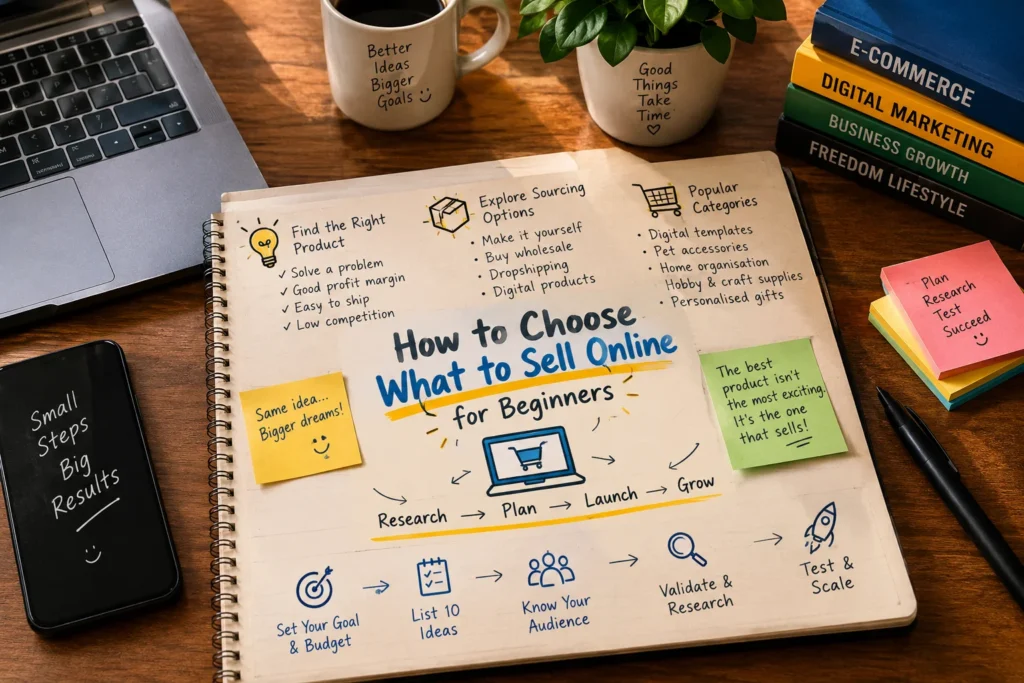
Most new sellers lose money long before they lose motivation, and the cause is almost always the same: they picked a product on a hunch. This guide explains how to choose what to sell online for beginners using a simple scoring method, real margin maths, and small tests that cost very little. You will learn how to find a product to sell online, how to research it, and how to decide with numbers instead of excitement. We also cover the safety and legal checks that other guides skip. Read on, and by the end you will have one product ready to test.
Table of Contents
What Makes a Good Starter Product
When you decide how to choose what to sell online for beginners, remember that a good starter product is not the most exciting one. It is the one that is easy to sell, easy to ship, and leaves enough money after costs. Use this table as a first filter.
| Good signs | Warning signs |
| Solves a clear problem or serves a hobby | A generic item sold by every big retailer |
| Price covers product, shipping, fees, and ads | Very cheap items with tiny margins |
| Light, durable, and simple to pack | Fragile, heavy, oversized, or perishable |
| Few sizes and variants | Clothing with complex sizing and high returns |
| People buy again or buy add ons | One time purchase with no follow up |
| No special permits or safety rules | Supplements, cosmetics, or children’s products |
What to Sell Online for Beginners: Four Sourcing Routes
Choosing a product also means choosing how you will get it. Each route changes your costs and your risks.
| Route | Upfront cost | Margin | Main risk |
| Make it yourself | Low to medium | High, but your time is the cost | Slow to scale |
| Buy wholesale | Medium to high | Medium | Unsold stock |
| Dropshipping | Low | Often thin | Slow shipping, returns, competition |
| Digital products | Lowest | High | Piracy and trust |
If you have little money, dropshipping, print on demand, or digital products let you test ideas without buying stock. If you have a craft or skill, making it yourself can give you a product that no one else sells.
Next step: Decide which sourcing route fits your budget and skills before you start listing ideas. It narrows your choices fast.
Beginner Friendly Product Categories
You do not have to pick from these, but they show the kind of products that tend to suit new sellers. Always run your own numbers first.
| Category | Why it suits beginners | Watch out for |
| Digital templates and planners | No stock, no shipping, high margin | Many sellers, so style and niche matter |
| Pet accessories | Passionate buyers who buy often | Safety rules for items that touch animals |
| Home organisation items | Clear problem, light products | Cheap copies from large retailers |
| Hobby and craft supplies | Loyal communities and repeat orders | Many variants to manage |
| Personalised gifts | Higher prices and fewer direct rivals | Longer production time |
How to Choose What to Sell Online for Beginners in Six Steps
These six steps show how to choose what to sell online for beginners without guessing. Work through them in order, because each step ends with a clear output, so you always know when to move on.
Step 1: Set Your Goal and Test Budget
Decide what you want from the store: a side income, a full time business, or a hobby that pays for itself. Then set a test budget you can afford to lose, such as a few hundred dollars, and write down a stop rule. A simple rule is to stop and rethink if your cost to win one sale is higher than the profit on that sale.
Output: A goal, a test budget, and a stop rule.
Step 2: List Ten Product Ideas
Do not stop at the first idea. Write ten, and use these sources to fill the list.
- What you know. Your job, hobbies, and skills. Experience helps you spot problems and earn trust.
- Daily problems. Things you or friends struggle with. A product that fixes a small daily annoyance often sells.
- Review gaps. Read three star reviews of existing products. Repeated complaints show what buyers want fixed.
- Community questions. Check niche forums, groups, and video comments for questions that keep returning.
Output: A list of ten ideas.
Step 3: Define Your Target Audience
A product without a clear buyer is hard to market. Your target audience is the specific group of people most likely to buy. Describe them in one line.
My buyer is [who], who wants [result], and struggles with [problem].
Example: My buyer is a new dog owner who wants a clean home and struggles with muddy paws after walks.
Narrow audiences are easier to reach than broad ones, because you can speak directly to their needs. It also helps you avoid competing head on with large retailers.
Output: One sentence describing your buyer for each idea.
Step 4: Do Product Research for Beginners
Now check whether people actually want each idea. Product research for beginners does not need paid software. These free checks are enough to start.
| Check | How to do it | What it tells you |
| Search interest | Look up the idea in Google Trends over several years | Rising, steady, or fading demand |
| Search suggestions | Type the idea into a search box and read the suggestions | What buyers actually ask for |
| Marketplace lists | Browse best seller lists and reviews on large marketplaces | Proven demand and price ranges |
| Competitor reviews | Read the lowest rated reviews of top sellers | Problems you can solve better |
| Seasonality | Check the yearly pattern in the trend chart | Whether sales come in short bursts |
Example walkthrough: Say your idea is a paw cleaner for muddy dogs. Google Trends shows steady interest all year with a small rise in autumn and winter. Search suggestions show people asking for a “paw cleaner for small dogs” and a “portable” version. Marketplace lists show several top sellers at similar prices, and their three star reviews complain that the cups leak and are too big for small breeds. That tells you demand exists, the price range is clear, and a smaller leak proof version is your difference.
Two warning notes. First, a product with no competitors is not always an opportunity, because it may mean no one wants it. Second, a product with huge competition needs a clear difference, such as a better design, bundle, or service.
Output: A short list of ideas that show real demand.
Step 5: Check the Numbers
Many beginners skip this and learn the hard way. Work out what is left after every cost for each remaining idea. The example below uses a set of reusable silicone food covers and assumes a payment fee of 2.9 percent plus $0.30, which is common but varies.
| Per order | Amount |
| Selling price | $24.99 |
| Product cost from supplier | $7.00 |
| Shipping you pay | $4.00 |
| Payment fee | $1.02 |
| Advertising cost per sale | $7.00 |
| Profit per order | $5.97 |
That is about a 24 percent profit margin before taxes and your time. If the ad cost rose to $12, the profit would drop below $1. A good rule of thumb is to look for products where profit per order stays comfortable even when costs rise a little. Margin levels differ by industry, so compare your result with similar products rather than a single fixed target.
Shipping and returns also change your profit, so check them for each idea.
| Product trait | Effect on profit |
| Heavy or oversized | Higher shipping cost, fewer buyers willing to pay it |
| Fragile | More breakage, replacements, and refunds |
| Many sizes or colours | More returns and harder stock handling |
| Perishable | Short shelf life and strict rules |
| Small and light | Cheaper shipping and easier free shipping offers |
Next step: Run your own top three ideas through this table with real supplier prices and real shipping quotes. Do not guess.
Output: A profit per order for each idea.
Step 6: Score Your Ideas and Pick One
Give each idea a score from 1 to 5 on five points. For competition, a higher score means easier competition. Add the scores to get a total out of 25.
| Criteria | Food covers (dropship) | Pet bandanas (print on demand) | Meal planner (digital) |
| Profit margin | 3 | 3 | 5 |
| Demand | 4 | 3 | 3 |
| Competition | 2 | 3 | 3 |
| Shipping ease | 4 | 3 | 5 |
| Fit with your skills | 3 | 5 | 4 |
| Total out of 25 | 16 | 17 | 20 |
These scores are only an example, so score your own ideas honestly. A total of about 18 or more is worth testing. Under about 15, drop the idea or improve it. In this example the digital planner wins because of margin and easy delivery, but the right pick depends on your skills.
If two ideas tie, use these tie breakers:
- Pick the one with lower startup cost.
- Pick the one you can test fastest.
- Pick the one with a clearer buyer you can reach for free.
Output: One product to test, and two backups.
Run a Small Test Before You Commit
The final part of how to choose what to sell online for beginners is testing. A score is a guess until real people respond. Test before you pay for a full store or bulk stock.
- Interest test. Share a photo or mock up with a price in a niche community and count real responses.
- Pre sale page. Build a one page sign up or pre order and send a small amount of traffic to it.
- Ad test. Run a short ad test within your budget and track cost per sale.
- Sample check. Order a sample to check quality, and time the delivery yourself.
If ten strangers sign up or buy, you have a real signal. If no one does, return to your list and test the next idea. Using your stop rule from Step 1 keeps this cheap.
What to Do After You Pick
Once a product passes the test, keep your next moves small.
- Choose a supplier or print partner and order a sample before listing.
- Set up a simple store or marketplace listing with your own photos and descriptions.
- Write clear shipping, return, and contact details.
- Aim for your first ten sales, then review what buyers say and adjust.
Safety, Legal, and Restricted Products
Rules differ by country, so check with your local authority or an accountant. These areas trip up many beginners.
- Regulated products. Supplements, cosmetics, electronics with batteries, toys, and baby items often need testing, labels, or certificates.
- Do not sell items with logos, characters, or team names that you do not own. Search trademark databases before you print or list.
- Duties and taxes. Imported goods may carry duties and VAT, which change your margin.
- Consider product liability cover for physical items, especially anything used by children or on the body.
Quick Decision Checklist
Before you commit, answer these seven questions. If you cannot say yes to at least six, keep researching.
- Can I describe my target audience in one sentence?
- Did I find proof of demand beyond my own opinion?
- Do I know my profit per order using real costs?
- Does my profit survive a small rise in ad or shipping costs?
- Can I ship or deliver it without big problems?
- Have I checked rules, trademarks, and safety needs?
- Can I test it for less than my budget?
This list takes ten minutes and prevents many expensive mistakes. Save it and repeat it for every new product you consider.
Common Mistakes to Avoid
- Chasing fads. Choosing something because it is trending, not because buyers will stay.
- Skipping the maths. Listing products without checking real costs and shipping.
- No target audience. Trying to sell to everyone instead of one clear group.
- Hard to ship products. Starting with fragile, heavy, or highly regulated items.
- Over ordering. Buying large stock before any sale.
Frequently Asked Questions
What is the easiest product to start with?
Light, durable items or digital products usually have the fewest problems. Choose something you understand and can describe clearly.
Do I need a niche?
A niche is not required, but it makes marketing cheaper and competition easier. Beginners usually do better with a narrow focus.
How much money do I need to test a product?
A few hundred dollars can cover samples and a small ad test. Digital products can cost less.
Can I sell something I do not enjoy?
You can, but passion helps you stay consistent through slow weeks. At least pick a product you understand well enough to answer customer questions.
How do I know if a product is too competitive?
If many sellers offer the same item at the same price and you have no clear difference, it is risky. Look for a better angle, bundle, or audience.
Should I use trending product lists?
Use them for ideas, not decisions. A trending list does not show your margin or your competition.
Conclusion
Now you know how to choose what to sell online for beginners: set a budget, list ideas, define your buyer, research demand, check the numbers, score the options, and test one product before you commit. Careful product research for beginners saves more money than any marketing trick.
Take your list of ten ideas today and score the top three. Then explore the sourcing option that fits your budget, and keep your results so you can improve with each test.