
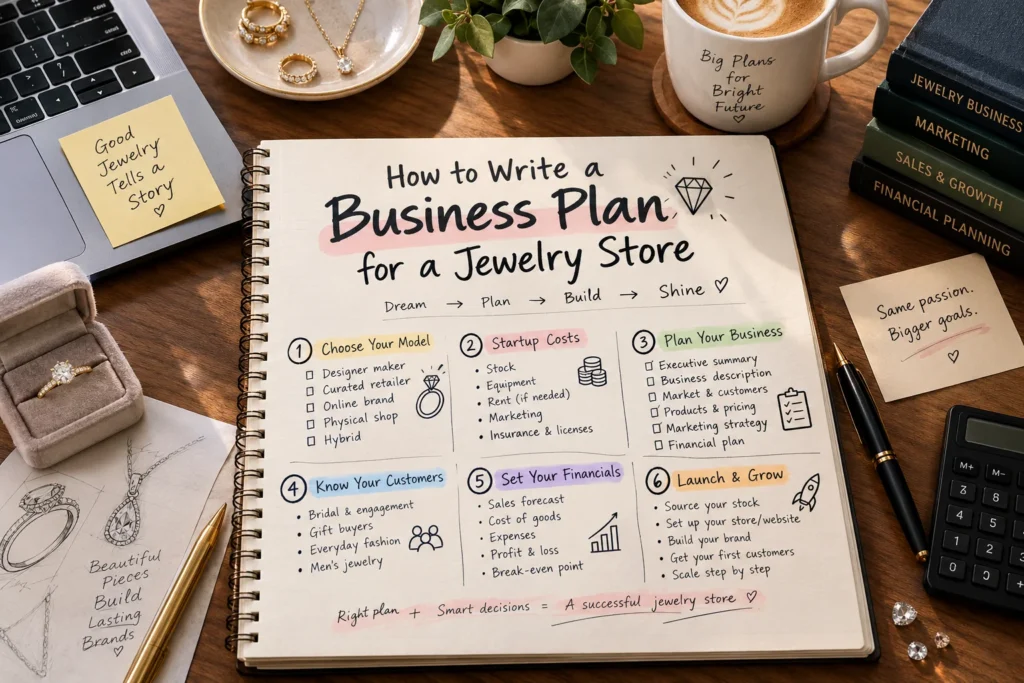
A jewelry store ties up more cash in stock than almost any other small shop, so a weak plan gets expensive fast. This guide shows how to write a business plan for a jewelry store using real costing examples, a metal price stress test, and templates you can copy. You will see how to choose a model, estimate startup costs, price your pieces, and build the financial section lenders ask for first. Whether you want a home studio, an online brand, or a shop on the high street, the same structure works. Let us start with the decision that shapes everything else.
Table of Contents
Create a Jewelry Store Business Plan From Scratch: Pick a Model
If you are wondering how to start a jewelry store, do not begin with the logo or the website. Begin with the model, because it sets your costs, your risks, and the way you will sell.
| Model | How it works | Main risk |
| Designer maker | You design and make the pieces | Your time limits growth |
| Curated retailer | You buy finished pieces from suppliers | Unsold stock ties up cash |
| Online brand | You sell through your own website | Paying for traffic and trust |
| Physical shop | You sell from a rented retail space | Rent, stock, and security costs |
| Hybrid | A mix of shop, online, and events | Spreading yourself too thin |
Next step: Write your chosen model in one sentence at the top of a new document. Every later section builds on it.
What It Costs to Start a Jewelry Store
Costs vary a lot by country and city, so treat these as rough ranges and collect real quotes before you finalize anything.
| Model | Rough startup range | Biggest cost |
| Home studio maker | $3,000 to $10,000 | Tools and materials |
| Market stall or pop up | $3,000 to $12,000 | Display and stock |
| Online store | $5,000 to $25,000 | Stock and marketing |
| Physical shop | $50,000 to $200,000 or more | Rent, fit out, and stock |
Stock is usually the largest and riskiest line. Many new owners cut that risk by starting with a small collection, taking pieces on consignment, or making items to order.
How to Write a Business Plan for a Jewelry Store, Section by Section
When you learn how to write a business plan for a jewelry store, the structure is the easy part. A jewelry store business plan usually has nine sections. Write them in this order, except for the executive summary, which you should write last.
Executive Summary
The executive summary is a one page snapshot of the whole plan. Lenders often read it first and decide whether to read the rest. Include what you sell, who buys, your key numbers, and the money you need.
[Business] is a [model] selling [product type] to [customer] in [place].
Our pieces stand out because [reason].
We expect [sales] in year one and break even by [month].
We are seeking [amount] to cover [stock, equipment, or rent].
Example: Gold and Grace is an online jewelry brand selling handmade silver and gold plated pieces to women aged 25 to 40 who want everyday jewelry with meaning. Each piece comes with an engraving option, which most competitors charge extra for. We expect to break even at about 38 orders a month and are seeking $15,000 for stock and photography.
Business Description
Explain your model, your legal structure, your location, and your goals. State your story briefly, because jewelry buyers care about who made the pieces and why. Add your mission in one line and three goals you can measure, such as monthly sales or collection launches.
Business name: [name] Model: [model] Location: [place]
Legal structure: [sole owner, partnership, or company]
Mission: [one line]
Year one goals: [sales target], [number of collections], [email list size]
Market and Customers
Do not describe your buyer as everyone who wears jewelry. Choose two or three segments and say how each buys.
| Segment | How they buy | What builds trust |
| Bridal and engagement | Slowly, with research and appointments | Certificates, consultations, warranties |
| Gift buyers | Quickly, near holidays and birthdays | Gift packaging and fast delivery |
| Everyday fashion | Often, at lower prices | Reviews, photos, easy returns |
| Men’s jewelry | Fewer, simpler purchases | Clear sizing and style guides |
Then study three nearby or online competitors. Note their price range, materials, photos, and reviews. Use free sources such as local government statistics and trade association reports for your market size, and avoid quoting old global figures that do not match your area.
Products and Pricing
In any guide on how to write a business plan for a jewelry store, pricing deserves extra care, because it is where most new jewelers lose money. Add up every direct cost, then apply a markup. The example below shows a silver pendant with a stone. Many retailers who resell finished pieces start with double the wholesale price, known as keystone markup, which gives about a 50 percent gross margin.
| Silver pendant cost | Amount |
| Metal | $18.00 |
| Stone | $12.00 |
| Labor, 1.5 hours at $20 | $30.00 |
| Packaging | $3.00 |
| Total direct cost | $63.00 |
| Retail price at 2.5 times cost | $159.00 |
| Gross margin | About 60 percent |
Now stress test it, because gold and silver prices move. The table shows how the gross margin changes if metal prices rise and you do not change your selling price. The gold ring has a metal cost of $300 in a total cost of $380 and sells for $950.
| Metal price change | Silver pendant margin | Gold ring margin |
| No change | 60.4% | 60.0% |
| Up 20% | 58.1% | 53.7% |
| Up 50% | 54.7% | 44.2% |
Notice how much harder a metal price rise hits the gold ring, because metal is most of its cost. Protect yourself by repricing on a schedule, buying metal in small batches, and adding a note in your plan about how often you will review prices. These figures are illustrations, not market data.
Sales Channels and Marketing
| Channel | Good for | Watch out for |
| Own website | Brand control and customer emails | You must bring the traffic |
| Online marketplaces | Ready made shoppers | Fees and price competition |
| Markets and pop ups | Testing products and meeting buyers | Event fees and time |
| Boutique wholesale | Bulk orders | Lower margins and slow payment |
| Custom commissions | High value orders | Long lead times |
Jewelry sells on photos and trust. Plan clear product photography, honest descriptions with sizes and materials, customer reviews, and an email list. Choose one or two marketing channels and set a number to track for each, such as email sign ups per month.
A simple first month plan keeps marketing realistic:
- Week 1: Shoot clean photos of your best five pieces from several angles, plus one worn on a model or hand.
- Week 2: Launch your store or listings with full material, size, and care details.
- Week 3: Start an email list with a small welcome offer, and share behind the scenes posts.
- Week 4: Ask your first buyers for reviews and photos, and use them on your pages.
Operations and Team
- List your key suppliers for metals, stones, and findings, and name a backup for each.
- Describe how you will count, store, and track stock, and how often you will review slow sellers.
- Explain how pieces are packed, shipped, insured, and returned.
- State who does what, including any repair work, bookkeeping, or part time staff.
- For a shop, include safes, alarms, cameras, and cash handling rules.
Inventory deserves its own plan, because it is where cash gets stuck. Compare your options:
| Approach | Benefit | Drawback |
| Small batch collections | Limits stock risk and keeps designs fresh | More frequent production |
| Made to order | No unsold stock | Longer delivery times |
| Consignment | Boutiques hold the stock risk with you | Lower margin and slow payment |
| Bulk buying metal or stones | Lower unit cost | Cash tied up and price risk |
Legal, Compliance, and Insurance
Rules differ by country, so check with your local authority or an accountant. Cover these points in your plan.
- Hallmarking and descriptions. Some countries require precious metal items above set weights to be hallmarked, such as the United Kingdom through its assay offices. Elsewhere, rules guide how you describe metals and stones, such as the Federal Trade Commission Jewelry Guides in the United States.
- Honest disclosure. Say clearly whether a stone is natural or lab grown, and whether a piece is solid gold, plated, or filled.
- Responsible sourcing. Ask suppliers about origin and certification, and keep records.
- Skin safety. Some regions limit nickel release in jewelry worn against skin, so check materials for earrings and rings.
- Consider cover for stock, theft, public liability, and shipping losses.
- Registration and tax. Register the business and collect sales tax or VAT where required.
Financial Plan
The financial plan is the part of how to write a business plan for a jewelry store that lenders check first. Include a startup budget, a sales forecast, a profit and loss statement, a cash flow forecast, and a break even calculation. Here is a simple break even example for an online jewelry store with a 55 percent gross margin.
| Monthly fixed cost | Amount |
| Website and software | $60 |
| Marketing | $600 |
| Insurance | $100 |
| Packaging and supplies | $240 |
| Owner pay | $1,500 |
| Total | $2,500 |
Break even sales equal fixed costs divided by gross margin: $2,500 divided by 0.55 gives about $4,545 a month. With an average order of $120, you need about 38 orders a month. Add a cautious case with lower sales, and track cash carefully, because stock purchases can drain cash even when you are profitable.
A sales forecast should show a slow start, not instant success. Here is a six month ramp for the same store, using a $120 average order and a 55 percent gross margin.
| Month | Orders | Sales | Gross profit | After fixed costs |
| 1 | 10 | $1,200 | $660 | Loss of $1,840 |
| 2 | 15 | $1,800 | $990 | Loss of $1,510 |
| 3 | 22 | $2,640 | $1,452 | Loss of $1,048 |
| 4 | 30 | $3,600 | $1,980 | Loss of $520 |
| 5 | 38 | $4,560 | $2,508 | Profit of $8 |
| 6 | 45 | $5,400 | $2,970 | Profit of $470 |
Total losses reach about $4,900 by month four, so you need cash to cover that gap on top of your stock. This is exactly the kind of detail lenders want to see.
Funding options: Most founders mix several sources. Common ones are personal savings, a small business loan, family support, pre orders from customers, supplier credit terms, and local small business grants where available. Lenders usually want to see your own money in the plan, a clear break even point, and proof that you can manage stock.
Next step: Replace these numbers with your own supplier quotes and rent estimates. Even rough real numbers beat copied ones.
Risks
| Risk | Response |
| Metal prices rise | Reprice on a schedule and buy in small batches |
| Theft or loss | Insurance, secure storage, tracked shipping |
| Slow selling stock | Small collections, discounts, made to order options |
| Fashion shifts | Mix trend pieces with classic styles |
| Supplier delays | Backup supplier and buffer stock |
| Returns and disputes | Clear policy and good photos |
Quick Plan Checklist
Before you share your plan, check that it answers these questions.
- Is my model clear in one sentence?
- Does my executive summary fit on one page?
- Do I know my cost and margin for each product type?
- Have I tested what happens if metal prices rise?
- Is my break even point realistic for my first year?
- Have I listed hallmarking, disclosure, tax, and insurance needs?
- Do I have a plan for stock, storage, and security?
- Did I leave out private details such as ID numbers or home addresses?
Common Mistakes to Avoid
- Over buying. Buying too much stock before testing what sells.
- Unpaid labor. Forgetting your own time as a cost.
- Fixed prices in a moving market. Ignoring metal price changes.
- Compliance gaps. Skipping hallmarking, disclosure, or insurance.
- Generic plans. Copying a sample plan without your own numbers.
Frequently Asked Questions
How much does it cost to start a jewelry business?
A home studio can start with a few thousand dollars, while a physical shop can need many times more. Stock and rent drive most of the difference.
Do I need a business plan to sell handmade jewelry?
It is not always required, but it helps you price correctly and is usually needed for loans or investors.
How long should the plan be?
A lean plan of five to ten pages is enough for most beginners. A shop seeking a loan may need more.
Should I sell natural or lab grown stones?
Either can work if you disclose clearly. Choose based on your customer, price range, and values.
How do I handle changing gold prices?
Review prices regularly, keep metal cost visible in your costing, and avoid long fixed price promises.
Can I start a jewelry business from home?
Often yes, especially as a designer maker or online brand. Check local rules on home businesses, insurance, and tools or chemicals used at home.
What insurance does a jewelry business need?
Common types cover stock, theft, public liability, and shipping losses. Ask an insurer which covers apply to your model and location.
What goes in the executive summary?
Your business, customer, products, key numbers, and funding request, in about one page.
Conclusion
You now know how to write a business plan for a jewelry store: choose your model, estimate costs, price with real maths, stress test metal prices, cover compliance, and finish with a clear executive summary. A good jewelry store business plan does not need fancy language. It needs honest numbers and a plan for stock, security, and trust.
Start by choosing your model and costing one product today. Then check your local hallmarking and tax rules before you order stock.