
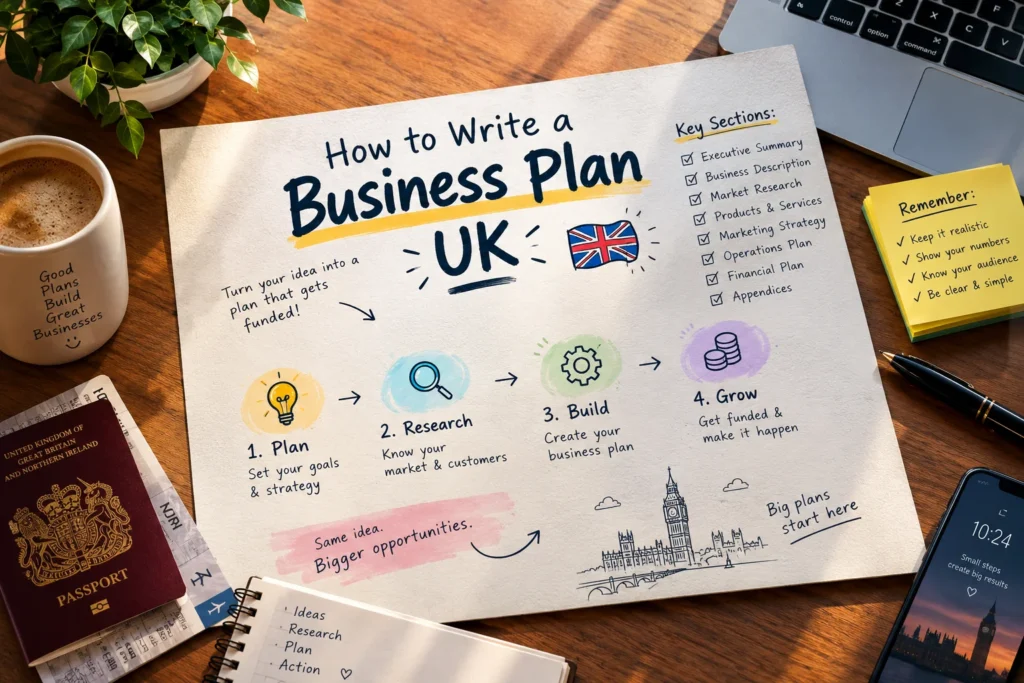
A UK business plan is not a legal requirement, but it is the first thing most lenders and loan schemes ask to see. Many first time founders write pages of market talk and forget the part that gets plans approved: the cash flow forecast. This guide shows how to write a business plan UK lenders can trust, using one worked example with real numbers in pounds. You will learn what to calculate first, how to structure the plan, which UK registrations to cover, and how to present your executive summary. Read on and you will finish with a plan you can actually use.
Table of Contents
What UK Lenders and Loan Schemes Look For
Before you write, know who will read it. Different readers care about different parts.
| Reader | What they check first |
| High street bank | Cash flow, your own money in the business, ability to repay |
| Start Up Loans style scheme | Realistic forecast, your personal budget, a clear use of funds |
| Investor | Market size, growth potential, team, how the money will be used |
| You | A roadmap, monthly targets, and early warning signs |
Notice that numbers come up in almost every row. That is why this guide starts with the numbers and writes the story afterwards.
Pick a Plan Format That Fits
| Format | Length | Best for |
| One page plan | 1 page | Testing an idea or planning a side business |
| Lean plan | 5 to 10 pages | Most startups and small loan applications |
| Full plan | 10 to 20 pages | Larger loans, investors, or complex businesses |
If you want to know how to create a business plan in the UK without wasting time, there is no official rule on length, so aim for the shortest plan that answers your reader’s questions. If you are not sure, write the lean version.
How to Write a Business Plan UK in Eight Steps
These steps show how to write a business plan UK readers will take seriously. Follow them in order, because they run numbers first, then the written sections, which is how many lenders read a plan. Our example is Paws on Wheels, a fictional mobile dog grooming van in England.
Work Out Your Personal Survival Budget
Lenders want to know what you need to live on. Your personal survival budget is the minimum you must take home each month, and it becomes the owner pay line in your forecast.
| Monthly personal cost | Amount |
| Rent or mortgage | £750 |
| Council tax | £120 |
| Energy, water, phone, broadband | £160 |
| Food and household | £280 |
| Travel and personal costs | £60 |
| Other and savings | £60 |
| Total | £1,430 |
Be honest here. Include debt repayments, childcare, and any regular costs you already have. A budget that is too low looks unrealistic, and an unrealistic budget makes the whole forecast less believable.
Cost Your Startup
List everything you must pay before the first sale, plus a cash buffer. Many UK plans fail here because working capital is forgotten.
| Startup cost | Amount |
| Second hand van and fit out | £7,500 |
| Grooming equipment | £1,800 |
| Insurance, first year | £900 |
| Website and branding | £600 |
| Supplies | £400 |
| Training and qualifications | £500 |
| Cash buffer | £3,300 |
| Total startup cost | £15,000 |
Paws on Wheels plans to fund this with £5,000 of savings and a £10,000 loan.
Describe the Business and Your Customer
Now write the story. Say what you sell, who buys it, where you work, and why you can do it. Include your skills and experience, because lenders back people as much as ideas.
[Business] provides [service] to [customer] in [area].
Customers choose us because [reason].
My experience: [relevant skills, jobs, or training].
Example: Paws on Wheels provides mobile dog grooming to busy owners within 15 miles of Leeds. Customers choose us because we groom at their door, which suits anxious dogs and tight schedules. I have six years of experience as a groomer and hold a recognised grooming qualification.
Research the Market
Show that real customers exist near you. Use free UK sources and write down what you find.
| Source | What it tells you |
| Office for National Statistics | Local population and household data |
| Companies House search | Competitors that are limited companies |
| Local council and Valuation Office Agency | Business rates and commercial rents |
| Competitor websites and reviews | Prices, gaps, and common complaints |
| Trade bodies and Google Trends | Industry trends and seasonal demand |
Count real people, not global figures. For example, note how many dog owning households live in your catchment area and how many competitors serve them. Then price against the competition that actually exists near you.
Then build a simple competitor table. Here is the Paws on Wheels version.
| Competitor | Price | Strength | Weakness |
| Salon A | £45 to £60 | Busy, well known | Drop off, long waits |
| Salon B | £40 to £55 | Cheap | Poor reviews for nervous dogs |
| Mobile groomer C | £60 to £75 | Door service | Booked out for weeks |
The gap is a door service that is quick to book and priced slightly below the existing mobile option. Competitor names and prices here are examples only.
Set Prices and Find Your Break Even Point
Paws on Wheels charges an average of £55 per groom. Supplies and fuel cost about £9 a groom, leaving £46 to cover fixed costs and pay. Fixed costs are £500 a month (loan repayment £200, insurance £75, phone and software £40, accountancy £50, marketing £75, van upkeep £60) plus the £1,430 owner pay from Step 1.
Break even grooms = fixed costs / profit per groom
£1,930 / £46 = about 42 grooms a month
That is roughly ten grooms a week. A target of 60 grooms a month leaves a surplus of £830.
Add a short sales and marketing plan next to the numbers. Pick two or three channels and give each a target:
- Local social media. Post before and after photos twice a week and aim for 20 booking enquiries a month.
- Leave cards at vets and pet shops and aim for five referrals a month.
- Referral discount. Offer £5 off a friend’s first groom to turn happy customers into advertisers.
Build the Cash Flow Forecast
Bookings grow slowly, so forecast month by month. The table starts with the £3,300 buffer from Step 2.
| Month | Grooms | Money left after costs | Cash at month end |
| 1 | 15 | Loss of £1,240 | £2,060 |
| 2 | 25 | Loss of £780 | £1,280 |
| 3 | 35 | Loss of £320 | £960 |
| 4 | 45 | Profit of £140 | £1,100 |
| 5 | 52 | Profit of £462 | £1,562 |
| 6 | 60 | Profit of £830 | £2,392 |
Now test a worse month. If bookings grew half as fast, at 10, 15, 20, 25, 30, and 35 grooms, cash would run out in month 3. Show lenders you have thought about this and explain your fix, such as a bigger buffer, a part time job, or slower spending.
Next step: Replace these figures with your own and keep the formulas simple. A rough forecast with honest assumptions beats a polished one built on guesses.
Cover Structure, Risks, and Registrations
State your legal structure and the registrations you need, using the next section as a guide. Then list your main risks with a response for each.
Add a short operations paragraph too: where you work, your opening hours, your suppliers, the equipment you need, and any staff you plan to hire.
| Risk | Response |
| Slow bookings | Buffer, local advertising, referral discount |
| Van breakdown | Servicing plan, breakdown cover, a backup van option |
| Injury or complaint | Public liability insurance and clear terms |
| Bad weather | Flexible scheduling and covered working space |
Write the Executive Summary and Assemble the Plan
The executive summary comes first in the document but should be written last. Keep it to one page and include your business, customer, key numbers, and funding request.
Example: Paws on Wheels is a mobile dog grooming business serving owners near Leeds. We charge an average of £55 a groom and break even at about 42 grooms a month. We forecast a monthly surplus of £830 by month six. We are seeking a £10,000 loan, alongside £5,000 of our own savings, to complete a £15,000 startup budget.
Now arrange the finished plan in this order, which is the final stage of how to write a business plan UK lenders will review:
| Section | Source |
| 1. Executive summary | Step 8 |
| 2. Business and your experience | Step 3 |
| 3. Market and competition | Step 4 |
| 4. Sales, pricing, and marketing | Step 5 |
| 5. Operations, legal, and risks | Step 7 |
| 6. Financials | Steps 1, 2, 5, and 6 |
UK Registration, Tax, and Legal Basics
If you are working out how to start a business in the UK, your plan should show you understand the basics. Check current rules on GOV.UK before you commit, because thresholds and fees change.
| Structure | Main points |
| Sole trader | Simple to set up, register with HMRC, personally liable for debts |
| Limited company | Separate legal entity, register with Companies House, more paperwork |
| Partnership | Shared ownership, needs an agreement, partners share liability |
- Register for tax with HMRC and keep proper records from day one.
- Check the current registration threshold and when you must register.
- Use the GOV.UK licence finder to see if your activity needs a permit from your council or another body.
- Public liability cover is common, and employers’ liability insurance is usually a legal requirement once you employ people.
- Data protection. Many businesses that handle personal data must pay a data protection fee to the Information Commissioner’s Office.
- If you hire staff, plan for payroll, workplace pensions, and minimum wage rules.
Funding Routes Compared
| Route | Good to know |
| Own savings | Lenders like to see your own money in the plan |
| Start Up Loans | Government backed personal loans for new businesses, with free mentoring. Check current limits and rates |
| Bank loan or overdraft | Usually needs a full plan, forecasts, and sometimes security |
| Government backed guarantee schemes | Help lenders say yes, such as the Growth Guarantee Scheme. Check eligibility |
| Investors or crowdfunding | Better for businesses with strong growth potential |
| Grants | Often local or sector specific. Check council and industry sites |
Next step: Check each scheme’s current terms on its official website before you apply, and speak to a free adviser or mentor if one is offered.
How Lenders Judge Your Plan
Even a clear plan can be turned down if it fails these checks.
- Can the business repay the loan from real cash flow, not hopes?
- Your contribution. Have you put your own money in, and how much?
- Do your skills and track record match the business?
- Do the numbers still work in a worse month?
- Credit history. Is your personal credit record in order? Check your credit file before you apply.
What Comes After the Plan
Knowing how to write a business plan UK founders can rely on is only the start. Once it is ready, keep your next steps small:
- Register your structure and open a business bank account.
- Arrange insurance before you take your first customer.
- Set up simple bookkeeping and a tax savings habit.
- Review your forecast against real results every month.
Keep Your UK Business Plan Alive
A plan on a shelf does not help anyone. Use a simple monthly routine:
- Compare real sales and costs with your forecast.
- Note which assumptions were wrong, such as price, bookings, or fuel costs.
- Update next month’s forecast and your cash buffer.
- Rewrite the plan fully once a year, or before you apply for new funding.
Lenders also like to see that you track your numbers. A founder who reviews results monthly looks far less risky than one who only prepares a plan once.
Common Mistakes to Avoid
- No forecast. Writing a long market story with no cash flow.
- Zero owner pay. Forgetting your own living costs.
- No working capital. Skipping a cash buffer.
- No stress test. Using one rosy scenario and no worse month test.
- Generic plans. Copying a template without your own numbers.
Frequently Asked Questions
Do I legally need a business plan in the UK?
No. But lenders and loan schemes usually ask for one, and it helps you spot problems early.
How long should a UK business plan be?
Most small businesses do well with five to ten pages. Write more only if a lender asks.
Can I write the plan myself?
Yes. Many founders do, often with free mentoring or feedback from an adviser or accountant.
What goes in the executive summary?
Your business, customer, key numbers, and funding request, in about one page.
What if my forecast shows a loss in the early months?
That is normal for many startups. Show how you will cover it, with a cash buffer, savings, or funding, and when you expect to break even.
Do sole traders need a business plan?
Not legally, but it still helps you price, budget, and apply for finance.
Is there a free template?
Yes. GOV.UK, banks, and loan schemes offer free templates. Use them as a guide, and add your own numbers.
How often should I update my plan?
Review your forecast monthly, and rewrite the plan yearly or before applying for funding.
Conclusion
Now you know how to write a business plan UK lenders can follow: start with your personal budget and startup costs, build a month by month cash flow, test a worse month, then write the story and executive summary. A strong UK business plan is clear, honest, and built on numbers you can explain. Open a spreadsheet today and complete Step 1 and Step 2. Then check current rules for your chosen structure on GOV.UK before you register.