
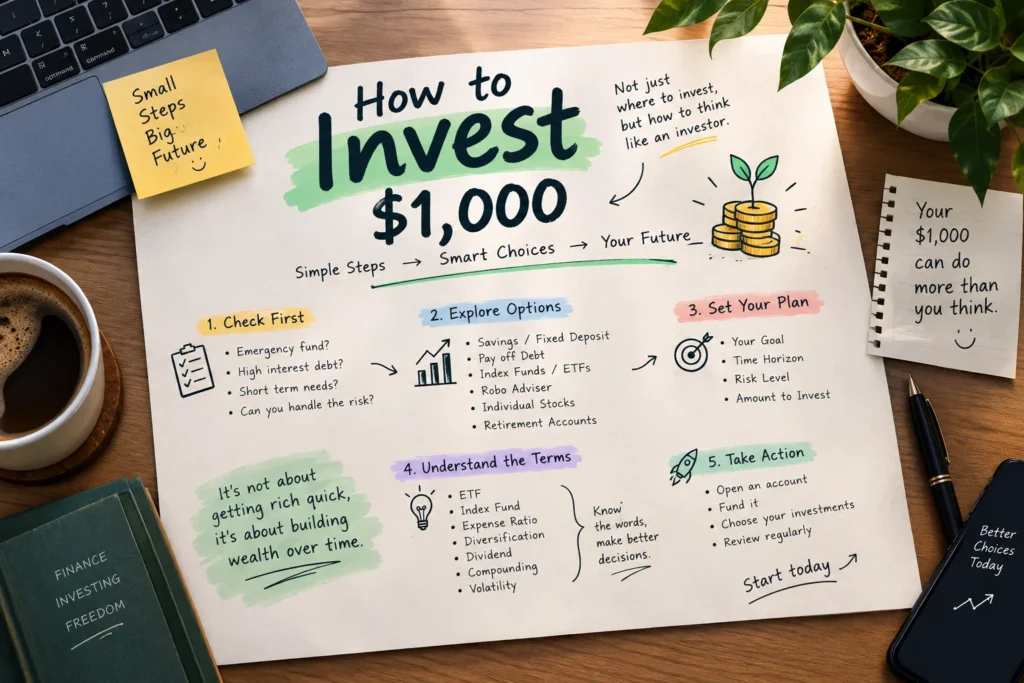
Having $1,000 to invest feels exciting until you see how many options there are and how many people want to sell you something. This guide explains how to invest 1000 dollars in plain English, with honest numbers instead of promises. You will learn what to check first, where the money can go, how fees and risk work, and a simple plan you can follow. We will not recommend any product, because the right choice depends on your country, goals, and situation. Read on and you will know exactly what to do next.
General information only, not personal financial advice. All investing carries risk, including losing money. Rules and products differ by country, so check official sources or speak to a licensed adviser.
Table of Contents
Before You Start: Four Quick Checks
The best answer to “how to invest $1,000” sometimes starts with not investing it yet. Run through this table first.
| Check | If the answer is no |
| Do you have an emergency fund of a few months of expenses? | Build it first, or at least keep some of the $1,000 in savings |
| Do you have high interest debt, such as credit cards? | Paying it off can beat most investments, because it is a certain saving |
| Will you need this money within about five years? | Keep it in a savings account, because markets can fall in the short term |
| Can you cope emotionally with seeing it drop in value? | Choose lower risk options or invest smaller amounts |
Next step: Write down your answers to these four questions. They decide how much of the $1,000 should go into investments at all.
Where Your $1,000 Can Go: Options Compared
Here is a country neutral comparison of how to invest 1000 dollars. Product names and tax rules vary, so use it as a map, not a recommendation.
| Option | Risk | Access to cash | Best for |
| Savings account or term deposit | Low | Easy, or fixed term | Short term goals and safety |
| Paying off high interest debt | None, it is a guaranteed saving | Not applicable | Anyone with expensive debt |
| Broad index fund or ETF | Medium to high, as markets move | Usually easy | Long term growth with low effort |
| Robo adviser | Medium, depends on the mix | Usually easy | People who want it managed for a fee |
| Individual stocks | High, concentrated in one company | Easy | Learning with a small amount, never all of it |
| Tax advantaged retirement account | Depends on holdings | Often limited until later | Very long term goals, check local rules |
An index fund holds many companies at once and tracks a market, so you are not betting on one business. An ETF is a fund that trades on the stock market like a share. For most beginners with $1,000, a broad, low cost fund spreads risk better than a handful of individual stocks.
One more point on safety. Cash feels safe, but inflation slowly reduces what it can buy. At 3 percent inflation, $1,000 would buy only what about $744 buys today after ten years. That does not mean you should rush into risk, but it is why people with long goals often invest part of their money.
| Term | Plain meaning |
| ETF | A fund that holds many investments and trades like a share |
| Index fund | A fund that copies a market index instead of picking winners |
| Expense ratio | The yearly fee a fund charges, as a percentage |
| Diversification | Spreading money across many investments to reduce risk |
| Dividend | A share of a company’s profit paid to shareholders |
| Compounding | Earning returns on your earlier returns |
| Volatility | How much and how fast prices move up and down |
How to Invest 1000 Dollars Step by Step
If you want to know how to start investing with 1000 dollars, follow these six steps in order.
Set a Goal and a Time Horizon
Decide what the money is for and when you will need it. A goal ten years away can handle more ups and downs than one in two years. Write both down, for example: “grow savings for a house deposit in ten years.”
Choose Where to Hold It
You hold investments inside an account, such as a brokerage account or a tax advantaged account where your country offers one. Compare fees, ease of use, and whether the provider is regulated in your country. Check that fractional shares or small purchases are allowed, because $1,000 is a small amount.
- Is the provider regulated in your country?
- Are there account fees, trading fees, or minimum balances?
- Small amounts. Can you buy fractions of shares or funds?
- Is there a protection scheme for client money, and what does it cover?
- Can you withdraw easily, and how long does it take?
Choose What to Buy
Match the investment to your goal and risk comfort. Many beginners choose a broad, low cost index fund for most of the money. If you want to try individual stocks, keep that to a small slice, such as $100, so a mistake does not hurt.
Decide How to Invest It
You can invest it all now, called lump sum investing, or spread it over time, called dollar cost averaging. Both have trade offs. This table uses an invented price path and $1,000, or about $83 a month for twelve months, to show the difference.
| Market path | Lump sum result | Spread over 12 months |
| Steady rise | $1,600 | $1,278 |
| Drop, then recovery | $1,200 | $1,278 |
Historically, lump sum investing has often done better because markets tend to rise over time, but not always. Spreading the money out can feel calmer and protects you from buying everything at a peak. Neither is guaranteed, and the example is only an illustration.
Automate the Habit
If you can add even $25 or $50 a month, set up an automatic transfer. Regular saving often matters more than the first $1,000, as the next section shows.
Review Once a Year
Check your fees, your mix, and your goal once a year. Avoid checking daily, because the stock market moves constantly and short term noise can push you into bad decisions.
Next step: Choose your account and your first fund this week, and set the date for your first annual review in your calendar.
Three Example Situations
These are illustrations of thinking, not advice. Your own numbers and country may point to a different answer.
| Situation | One possible approach |
| No emergency fund and a credit card balance | Put about $500 into emergency savings and $500 toward the debt, and invest later |
| Stable savings, no debt, goal ten years away | Put most of it in a broad, low cost fund and add monthly |
| Needs the money within three years | Keep it in a savings account or short term deposit |
Your First Twelve Months
| When | What to do |
| Week 1 | Run the four checks and write your goal |
| Weeks 2 to 3 | Compare two or three regulated accounts and their fees |
| Month 1 | Make your first investment |
| Months 2 to 11 | Add a small amount monthly and learn the basics |
| Month 12 | Review fees, goal, and mix, then adjust |
How to Pick a Fund Without Overthinking
If you choose a fund, a short checklist keeps you out of trouble.
- Does it hold many companies across a broad market, rather than one narrow theme?
- Is the yearly fee low compared with similar funds?
- Track record. Is it large and established, with a clear record and plain rules?
- Does it match your goal and your time horizon?
- Avoid complicated products you cannot explain, especially ones that use borrowing or promise fixed high returns.
Read the fund’s official fact sheet before buying. It lists the fees, the holdings, and the risks in plain language.
Tax and Rules Differ by Country
Tax is easy to forget and can change your results. Most countries tax some combination of interest, dividends, and profits when you sell. Some also offer special accounts with tax benefits, often with limits and rules about when you can withdraw. Keep records of what you buy, sell, and receive, and use your tax authority’s website for the rules that apply to you.
How to Grow 1000 Dollars Over Time
Nobody can predict returns, so this table uses assumed yearly returns of 4, 6, and 8 percent, compounded monthly, before fees and tax. Real returns vary and can be negative in some years.
| Assumed return | After 5 years | After 10 years | After 20 years | After 30 years |
| 4% a year | $1,221 | $1,491 | $2,223 | $3,313 |
| 6% a year | $1,349 | $1,819 | $3,310 | $6,023 |
| 8% a year | $1,490 | $2,220 | $4,927 | $10,936 |
Now see what regular saving adds. This uses 6 percent a year with $50 added each month.
| Time | $1,000 only | $1,000 plus $50 a month | Total you paid in |
| 10 years | $1,819 | $10,013 | $7,000 |
| 20 years | $3,310 | $26,412 | $13,000 |
The lesson is simple. The first $1,000 matters, but steady additions matter far more. This is the realistic answer to how to grow 1000 dollars into something meaningful.
Fees: Small Numbers That Matter
Fees come out of your returns every year, and on a small balance they can eat a large share. Look for the annual fund fee, often called the expense ratio, plus trading fees, account fees, and currency conversion costs if you buy foreign assets.
| Example after 20 years | Value of $1,000 |
| 6% return, 0.1% yearly fee (net 5.9%) | $3,245 |
| 6% return, 1.0% yearly fee (net 5.0%) | $2,713 |
| Difference | $532 |
Same investment, same return, and a difference of more than half your starting amount. That is why checking fees is one of the most useful habits when you learn how to invest 1000 dollars.
Risk: What a Fall Looks Like
Markets rise and fall, and a fall is harder to recover from than most people expect, because the gain needed is larger than the loss.
| If it falls by | $1,000 becomes | Gain needed to recover |
| 10% | $900 | 11.1% |
| 20% | $800 | 25.0% |
| 30% | $700 | 42.9% |
| 50% | $500 | 100% |
This is why time horizon matters when you decide how to invest 1000 dollars, and why you should never invest money you will need soon. Spreading your money across many companies through a broad fund also reduces the damage when one business fails, although it does not remove market risk.
High Risk Options to Treat With Care
- Prices can swing wildly and you can lose everything. Never put in more than you can afford to lose.
- Peer to peer lending. Borrowers can default, and you may not get your money back.
- Day trading and margin. Trading often and using borrowed money can turn small losses into big ones.
- Get rich quick offers. Promises of guaranteed or very high returns are a classic warning sign of a scam. Check that any provider is regulated in your country.
Common Mistakes to Avoid
- Chasing hype. Putting all $1,000 into one stock because it is trending.
- Overlooking costs. Ignoring fees on small balances.
- Emotional selling. Selling in a panic when prices fall.
- No safety net. Investing money you may need for rent or bills.
- Trading often and paying fees each time.
Frequently Asked Questions
Is $1,000 enough to start investing?
Yes. Many platforms allow small amounts and fractional shares. The habit matters more than the size.
Should I pay off debt first?
If the debt has a high interest rate, paying it off is often the best guaranteed return. Compare the interest rate with realistic investment returns.
Is it better to invest it all at once?
Historically, investing all at once has often done better, but spreading it out can feel safer. Choose the approach you can stick to.
What is the safest place for $1,000?
An insured savings account or a short term deposit is usually the lowest risk, though your money may not keep up with inflation.
Can I lose all my money?
In individual stocks and high risk assets, yes, it is possible. Diversified funds are less likely to lose everything, but they can still fall a lot.
How much will $1,000 be worth in ten years?
Nobody knows. The tables show assumed returns, but real results can be higher or lower, and some years will be negative.
Should I use a robo adviser or pick my own funds?
A robo adviser manages a mix for a fee, which suits people who want less effort. Choosing your own funds costs less but needs a bit more learning.
Do I pay tax on investments?
Often yes, on gains, dividends, or interest. Rules differ by country, so check your tax authority or a qualified adviser.
Conclusion
You now know how to invest 1000 dollars sensibly: run the four checks, compare your options, follow the six steps, watch fees, and respect risk. The best plan is usually simple, low cost, and built on regular saving rather than a lucky pick. Take one action today, such as comparing two accounts or writing down your goal. Then check your own country’s official guidance before you put any money in.