
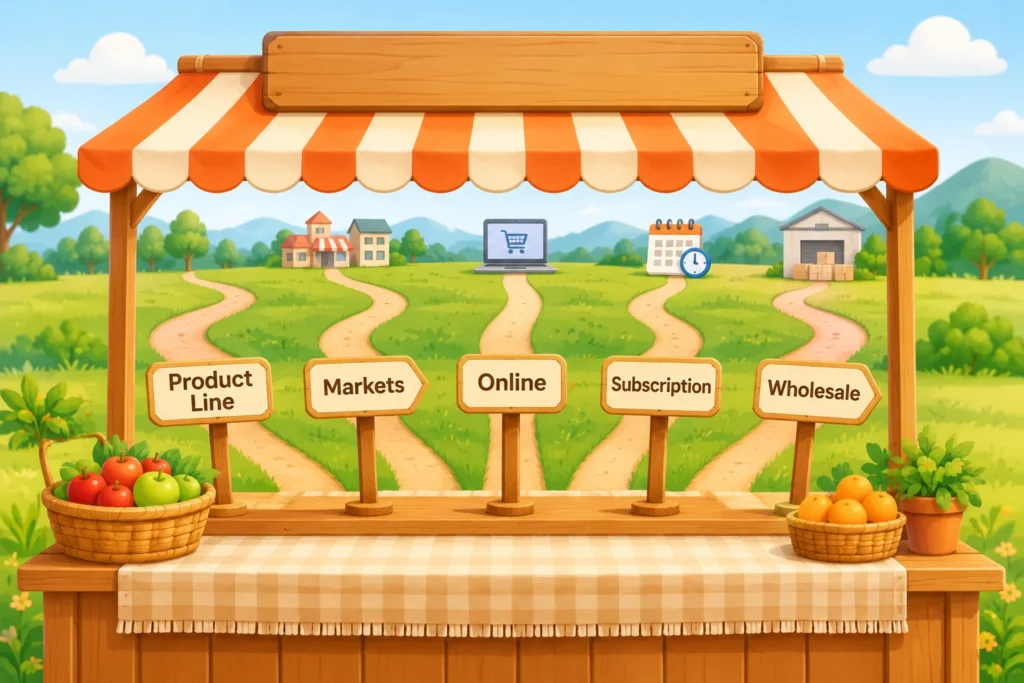
There are five common ways to expand a farmers market product business: add to your product line, sell at more markets or days, take orders online, offer subscriptions, or sell wholesale. The best one depends on what limits you today, which is usually time, land, equipment or margin. Pick one, test it small, check the rules that apply, and only then commit.
This guide is written for vendors who already sell at a market. It explains how to expand your farmers market product line with customer evidence, how to choose among the five paths, which rules to check before you grow, and where grant money may exist. Many of those rules vary by state, so treat this as a map and confirm details with your local agencies.
Table of Contents
Check your base before you grow
Growth multiplies what you already have, including the weak spots. Spend an hour on these three questions first.
- What is your margin per product? Subtract the cost of growing or making, packaging, market fees, travel and your own time. Some of your best sellers may earn less than you think.
- What limits your volume? It may be land, labor, storage, a truck or the hours in a day. Expanding anything that does not fix that limit just adds stress.
- Who already buys, and how often? Count regulars compared with one time buyers. Repeat customers tell you where demand is real.
A simple notebook or spreadsheet is enough. Record sales by product for each market day, what you brought home unsold and how long you spent preparing.
Five ways to expand compared
The table below is my own grouping of common growth paths, not an official list.
| Path | What it means | Works best when | Extra work | Main risk |
| Diversify your product line | Add products customers already ask for, including value added items | Regulars want more from you | New production, packaging and rules | Spreading yourself thin |
| More markets or days | Sell at another market or day each week | You sell out and have spare supply | More travel and staffing | Weaker sales at a new market |
| Online orders and pickup | Customers order ahead and collect at the market or farm | You have loyal customers who want reliability | Order setup, packing, messages | Time spent on small orders |
| Subscriptions or CSA | Customers pay ahead for regular boxes or shares | You can plan production and want steady income | Planning, packing, customer care | Too much commitment in a bad season |
| Wholesale and restaurants | Sell larger volumes at lower prices to businesses | You have steady surplus or consistent quality | Deliveries, invoicing, rules | Lower margin and slow payment |
How to expand your farmers market product line
Adding products is the most common first step, and the easiest one to get wrong. The goal is to diversify farmers market products in ways that fit your skills and your customers, not to chase every trend.
Find out what customers want
No reliable national list of the products customers want at farmers markets was available to cite here, so rely on your own evidence instead. These methods cost almost nothing.
- Ask at the stall. A sign saying What should we grow or make next? gets answers and starts conversations.
- Track requests. Keep a tally of what people ask for that you do not sell.
- Watch the neighbors. If a product sells out at another stall every week, there is demand. Do not copy it exactly, but look for a gap.
- Pre sell. Offer a small run of a new product with a sign up sheet or a pre order. Willingness to pay tells you more than compliments.
Choose related products
The safest additions share your growing, packaging or customer base.
| Starting point | Possible additions | What to check first |
| Fresh produce | Washed salad mixes, herb bunches, seasonal boxes, flowers | Produce handling rules and food safety expectations |
| Fresh produce, processed | Jams, salsa, dried fruit, pickles | State cottage food law or licensed kitchen rules |
| Eggs or dairy | Bundled breakfast boxes | Local health and agriculture rules, which are stricter |
| Plants and flowers | Bouquets, potted herbs, seed packets | Plant labeling and any plant sale permits |
The second row is where many vendors get stuck. Turning fresh produce into a jar of something changes the legal category, so look up your state’s rules before buying jars.
How to choose your path
- You sell out early and have spare time: try another market day or an online pickup option.
- You get requests for products you do not offer: diversify your line in small steps.
- Your income is uneven week to week: consider subscriptions or a small CSA.
- You have regular surplus: a wholesale or restaurant account can use it, but check margins first.
- Your time is already full: fix your process first, because adding a path will not help.
A good first step is to pick one path from the list and write down what a successful test would look like.
Test a new path with a small experiment
Avoid big commitments until you have evidence. A basic test looks like this:
- Choose one change. A new product, a new market or a pre order list, not all three.
- Set a time limit. Four to eight weeks, or one season for crops that need it.
- Set a target. For example, a number of units sold, or a minimum margin per hour of work, decided in advance.
- Set a stop rule. Decide what result would make you drop it.
- Review honestly. Compare the result to your target, and ask customers what they thought.
The targets are your own judgment, and no source gives a universal figure. Writing them down stops you from reading every result as a success.
Rules to check before you expand
Rules depend on what you sell, how you sell it and where you are. Use this list to ask the right questions.
- Produce safety: the FDA’s Produce Safety Rule does not cover farms with average annual produce sales of $25,000 or less, adjusted for inflation from a 2011 baseline. A qualified exemption applies if your sales to qualified end users are greater than your sales to other buyers and your average annual food sales are under $500,000, also inflation adjusted. FDA’s page does not list the current adjusted amounts, so check the federal regulations (21 CFR Part 112) and with your state.
- Cottage foods: the National Agricultural Law Center says nearly every state has a cottage food law that lets people make certain low risk foods at home, such as baked goods, jams, dry mixes and candies, but states differ a lot. Sales caps, labels and where you can sell vary, so read your state’s law.
- Labels: processed products usually need accurate labels. Ask your state agriculture or health department what yours must show.
- Insurance and permits: ask your insurer about product liability when you add processed goods or new sales channels, and ask your market manager and local authorities about permits.
- SNAP benefits: accepting SNAP at your stall usually involves authorization. One state agency page points to USDA Food and Nutrition Service approval, and some states offer free equipment. Confirm the steps with USDA and your state.
Contact your state department of agriculture and your local Cooperative Extension office before you launch something new. Many offer free advice.
Funding that may help
In March 2026 USDA announced more than $26.8 million in Local Agriculture Market Program awards. That included about $11.1 million for the Farmers Market Promotion Program, which supports producer to consumer markets such as farmers markets, roadside stands, CSAs and online sales. It also included about $11.1 million for the Local Food Promotion Program, which supports local food businesses that process, distribute or add value to products. USDA says these programs require a 25% cost share, meaning applicants match part of the federal money.
Those were awards already made, so they are not open funding. Check the USDA Agricultural Marketing Service for the next application round, and ask your state and Cooperative Extension about smaller local grants.
Grow your customers while you expand
- Start an email or text list. A sign up sheet at the stall helps customers know what is coming.
- Offer samples of new products, so people can try before they buy.
- Be consistent. Show up on the same days with a clear sign and a recognizable display.
- Tell the story of the new product. Customers like knowing where it came from.
Track four things monthly: sales per market day, margin per product, repeat customers and your hours. If a new path takes more hours than it earns, change or drop it.
A worked example: Willow Bend Farm
Willow Bend Farm is a made up vendor used only as an illustration.
- Starting point: it sells tomatoes and peppers at one market and often sells out by midday.
- Base check: tracking shows the pepper margin is thin and customers keep asking for salsa.
- Path chosen: diversify the line with a small salsa run.
- Rules check: the owner reads the state cottage food law, finds that sauces have extra requirements and uses a licensed kitchen instead.
- Test: a six week pre order sheet with a target decided in advance.
- Result: the target is met, so the owner adds a second batch size and keeps the pepper line small.
The farm grows because each step used evidence and rules, not guesses.
Common mistakes
- Adding several products at once before knowing which one sells.
- Assuming a home made product is automatically legal to sell.
- Copying a neighbor’s best seller.
- Ignoring margin while chasing volume.
- Taking on wholesale accounts with no spare capacity.
- Skipping customer feedback.
Frequently asked questions
Do I need a license to sell at farmers markets?
It depends on your state, what you sell and how it is made. Ask your state agriculture or health department and your market manager.
Can I sell jam or sauces I make at home?
Many states allow some low risk foods under cottage food laws, but limits differ, and some products need a licensed kitchen. Check your state’s rules.
Is a CSA worth it for a small vendor?
It can smooth income and help planning, but it creates a commitment to deliver. Test with a small group first.
How do I accept SNAP at my stall?
Look up USDA’s authorization process and ask your state about equipment help. A market manager may also know the steps.
Are there grants for farmers market vendors?
USDA runs programs such as the Farmers Market Promotion Program and the Local Food Promotion Program, with a 25% cost share. Check for the next application round.
Conclusion
Expanding a farmers market product works best as a series of small, tested steps. Check your margins and capacity, choose one path, confirm the rules, and keep what the numbers support. This week, start tracking sales by product and ask a few regulars what they would like you to bring next.