
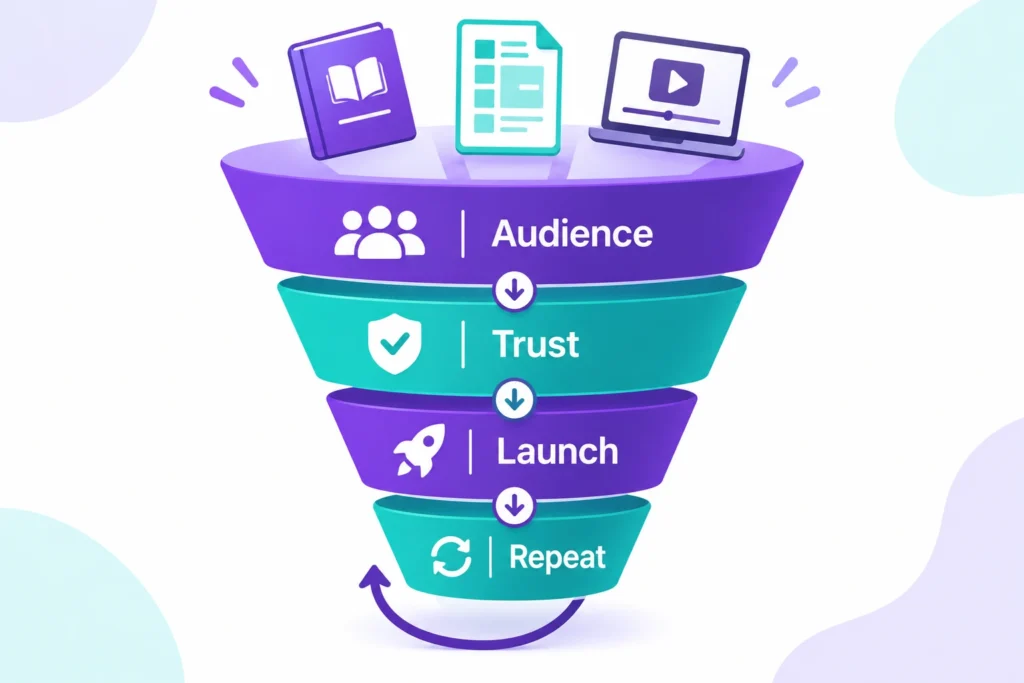
To market digital products, find out who needs yours, give people a reason to trust it before they can touch it, promote it through a few channels where those people already spend time, collect email addresses so you own the audience, run a clear launch, and track a handful of numbers. Digital product marketing is mostly trust building, because buyers cannot inspect what they are buying.
This playbook covers ebooks, templates, courses, memberships and similar downloadable or online products. It explains the ways to promote digital products online, how to choose among them, how to run a launch, and which rules to check before you sell. A short note: software products follow many of the same steps, but their channels and pricing differ.
Table of Contents
What makes digital products different to market
A digital product is something customers buy and use online or as a download, such as an ebook, template, course, membership or app. Three things make marketing them different from selling physical goods.
- Buyers cannot inspect it. They have to trust your description, your samples and your reputation.
- Copying is easy. Your edge comes from your expertise, support and brand, not just the file.
- Costs are mostly time. Delivery is cheap, so the real expense is reaching and convincing buyers.
That is why the stages below start with the audience and trust, not with ads.
Step 1: Know who you are selling to
Most weak launches come from a vague audience. Describe one specific buyer: who they are, the problem they want solved, what they use today and why it falls short. You can learn this in a few conversations and some reading, with no budget.
- Talk to potential buyers. Ask what they tried, what annoyed them and what they would pay to fix.
- Read the questions people ask in forums, reviews of competing products and search suggestions.
- Write one sentence of positioning: this product helps [who] get [result] without [pain].
- Check demand before building. A waitlist, a pre sale or a small paid pilot tells you more than compliments.
A good first step is to talk to five people who fit your buyer description before you spend time on anything else.
Step 2: Build trust before you ask for money
Trust is the main barrier for digital products. These tools lower it.
- Free samples. A chapter of an ebook, a template page or a lesson shows quality directly.
- Specific descriptions. Say exactly what is included, the file formats, who it suits and who it does not suit.
- Real reviews and examples. Use feedback from actual buyers, with their permission. Do not invent testimonials.
- Clear terms. State your refund and support policy in plain words. Some countries give buyers legal rights over digital purchases, so check the rules where you sell.
- Visible expertise. Show who made the product and why they are qualified.
Google’s guidance on helpful content asks whether content offers original information and shows who created it. That is good advice for sales pages too: the more original and specific your material, the easier it is to trust.
Ways to promote digital products online
Choose channels by product type, not by trend. The table is my own starting guide based on common practice, not a ranking from any study.
| Product | Good first channels | Why they fit |
| Ebook or guide | Search content, email, guest posts, communities | Readers research a topic before buying |
| Template or planner | Search, short video, Pinterest style visual platforms, marketplaces | Buyers want to see it in use |
| Online course | Free lessons, email, webinars, creator partnerships | Buyers need to trust the teacher |
| Membership | Community, email, free events, referrals | Value builds through relationships |
| Software or app | Search, product demos, free trials, partner listings | Buyers test before committing |
Pick two or three channels and stay with them for a few months. Spreading a small effort across six channels usually means none works.
Content and search
Write helpful pages that answer the questions your buyer already searches for, then link them to the product. This is slow, but it keeps working and costs mostly time.
Communities and partnerships
Join places where your buyers gather, answer questions honestly and follow each community’s rules on self promotion. Collaborations with creators who serve the same audience can introduce your product to people who already trust them.
Paid ads
Ads can speed things up once you know your sales page converts. Test with a small budget, track what each sale costs, and stop if the cost is higher than your margin. Do not start with ads before you have proof people want the product.
Build an audience you own
Social platforms and marketplaces can change their rules, fees or reach without warning, so depending on one channel is risky. An email list is the main way to keep a direct line to interested people.
- Offer a lead magnet: a short free resource related to the product, such as a checklist, sample chapter or mini template.
- Use one clear sign up page and say what subscribers will receive and how often.
- Send useful emails, not only sales messages.
- Respect the rules that apply where your subscribers live, including consent and unsubscribe options.
Even a small list can matter. A few hundred interested subscribers often convert better than a large cold audience, although results vary and no source gives a standard rate.
Price and package your offer
There is no proven best price for digital products, and any universal figure is a guess. Use these ideas instead.
- Anchor on value, the result the buyer gets, not the number of pages or minutes.
- Offer an entry product, such as a low priced template, that leads to a larger course or membership.
- Bundle related items, so the buyer sees more value in one purchase.
- Test prices with small groups before a full launch.
- Use discounts sparingly, since constant discounts teach buyers to wait.
Run a launch sequence
A launch is a short period when you concentrate attention on the product. Here is a simple email sequence you can adapt. The timing is a suggestion, not a documented standard.
| When | Message | Goal |
| Two weeks before | Announce what you are making and why, invite people to join the waitlist | Build interest |
| One week before | Share a sample or behind the scenes story | Build trust |
| Launch day | Open the sale with a clear offer and link | Convert early buyers |
| Mid launch | Answer common questions and share buyer feedback | Reduce doubts |
| Last day | Remind subscribers when the offer ends | Close the sale |
| After launch | Thank buyers, ask for feedback, offer support | Create repeat customers |
Keep any deadline real. Fake urgency harms trust and may break advertising rules.
Use creators and affiliates responsibly
Creators and affiliates can reach people you cannot. Agree the terms in writing, give them honest information about the product, and make sure they do not promise results you cannot support.
The Federal Trade Commission’s guidance for influencers says to disclose any financial, employment, personal or family relationship with a brand, and to place the disclosure where it is hard to miss. For video, it says to put the disclosure in the video itself, not only in the description. The FTC also says advertisers must be truthful and have evidence for their claims. That is US guidance, so check the rules where you sell.
Measure what matters
| Measure | What it tells you | How to use it |
| Sales page conversion rate | Share of visitors who buy | Improve the page if traffic is fine but sales are low |
| Email list growth | Interest in your topic | Adjust the lead magnet or traffic source |
| Cost per customer | Marketing spend divided by new buyers | Compare with your margin before spending more |
| Refund rate | How well the product matches the promise | Fix the description or the product if refunds rise |
| Repeat purchases | Whether customers come back | Focus on retention if it is low |
Check these weekly during a launch and monthly afterward. Change one thing at a time so you can see what caused a difference.
Rules to check before you sell
- Taxes: sales tax or VAT can apply to digital products, and the rules differ by country and by US state. Ask your tax authority or an accountant.
- Copyright: you own what you create, but registration can strengthen your position. Official fees change, so check the current fee page before you apply.
- Advertising claims: be truthful, and avoid promising income or results you cannot support.
- Disclosure: tell customers when you pay or reward someone for promotion.
- Privacy and consent: follow the rules for collecting emails and customer data where your buyers live.
Details differ by country and state, so treat this list as a prompt to check, not as legal or tax advice.
A worked example: Ledger Lane
Ledger Lane is a made up product used only as an illustration. It is a budgeting spreadsheet template for freelancers.
- Audience: freelancers with irregular income who find standard budgets confusing.
- Trust: a free one page sample, a short walkthrough and a clear refund policy.
- Channels: search content on irregular income budgeting, a freelancer community and an email list built with a free tax calendar.
- Offer: a low priced starter template, with a bundle for freelancers who also want invoicing tools.
- Launch: a two week email sequence to the list, with questions answered in the middle.
- Measures: page conversion, list growth and refunds. A rise in refunds leads the owner to clarify which spreadsheet apps are supported.
The owner grows by fixing one weak point each week instead of adding new channels.
Common mistakes
- Building the product before checking demand.
- Selling to everyone instead of one defined buyer.
- Skipping samples and clear descriptions.
- Relying on one social platform.
- Spending on ads before the sales page converts.
- Making income promises or using fake testimonials.
Frequently asked questions
How do I market digital products with no audience?
Start with a small, specific group: talk to potential buyers, share useful content where they gather, collect emails with a free resource and pre sell before you build.
How can I promote digital products for free?
Use search friendly content, communities where you follow the rules, email, collaborations and samples. Free methods cost time instead of money.
Should I run ads for a digital product?
Only after your sales page converts. Test with a small budget and compare the cost per customer with your margin.
What should my refund policy say?
State the terms clearly in plain words and check the consumer rules where you sell, since some countries give buyers specific rights.
How much should I charge?
There is no universal price. Base it on the value of the result, test with small groups and offer an entry product.
Conclusion
Marketing digital products works when you know your buyer, earn trust, use a few channels well, own your audience and measure results honestly. This week, pick one specific buyer, write your one sentence of positioning and talk to five people who fit it. What you learn will shape your channels, your offer and your launch.