
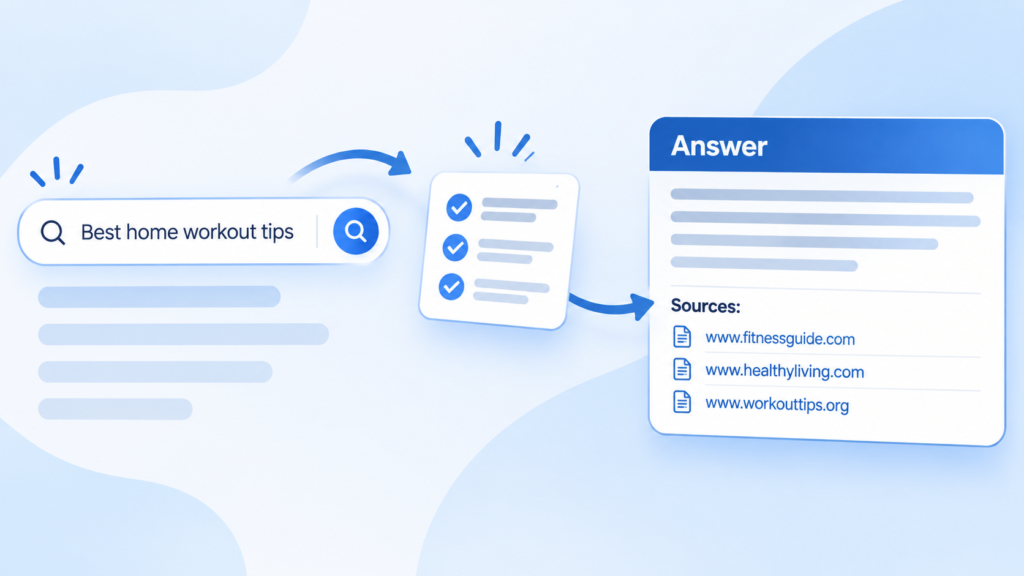
To appear in AI-powered search results, your pages need to be accessible to the relevant crawlers, eligible for indexing where required, and useful enough to be selected as a source. No platform offers a switch or a special file that guarantees a mention. What you can control is access, clarity, accuracy, and credibility—and much of that work also supports organic search visibility.
AI-assisted information seeking is already common. In a July 2025 AP-NORC poll of 1,437 U.S. adults, 60% said they used AI to find information at least some of the time; the figure was 74% among adults aged 18–29. The poll’s overall margin of sampling error was ±3.6 percentage points. These figures describe U.S. adults, not every market or every search platform. Source: https://apnorc.org/projects/young-adults-leading-the-way-in-ai-adoption/
This guide separates documented platform requirements from practical recommendations and unconfirmed SEO theories. It covers Google AI Overviews and AI Mode, ChatGPT search, Perplexity, Claude, and Microsoft Copilot. Platform documentation changes, so review the linked official pages before making technical changes.
Table of Contents
The short answer: six things that matter
- Make important pages crawlable and, where applicable, indexed and eligible to appear with a search snippet.
- Allow the search crawlers you want to reach your site. Check robots.txt, your CDN, firewall, and bot-protection settings.
- Lead with a direct, accurate answer, then provide the context, evidence, and detail that support it.
- Keep business and product information consistent across your website and relevant profiles.
- Build credibility through original expertise, reliable sources, genuine reviews, and relevant third-party references. Treat these as sound practices, not guaranteed citation factors.
- Measure performance with available webmaster reports, referral analytics, and a repeatable set of real customer questions.
A useful first step is to open yourdomain.com/robots.txt and check whether you are unintentionally blocking crawlers you want to access your content.
How AI search decides what to show
AI search systems may retrieve relevant pages or other information and then generate an answer that cites, links to, or names selected sources. The retrieval and selection processes differ by platform, and companies do not publish every detail of their systems. Being crawlable is not the same as being selected, and being selected once does not guarantee future inclusion.
Two terms are useful. A citation is a source link or credit displayed with an answer. A brand mention is a brand name included in the answer, with or without a link. Citations may send referral traffic; mentions may influence awareness. Reporting and attribution vary by platform, so do not treat the two as interchangeable.
Microsoft’s Bing Webmaster Tools AI Performance report provides a useful view of citation activity across supported Microsoft AI experiences. It includes total citations, average cited pages, sample grounding queries, page-level citation activity, and trends over time. Microsoft says these metrics show citation activity—not ranking, authority, or placement in a particular answer. Source: https://blogs.bing.com/webmaster/2026/2/Introducing-AI-Performance-in-Bing-Webmaster-Tools-Public-Preview/
For Google, eligibility and citation selection are different concepts. Google says pages must be indexed and eligible to appear with a search snippet to be eligible as supporting links in AI Overviews or AI Mode. That does not guarantee that a page will be shown or cited.
What is documented and what is hype
| Popular claim | What the documentation or evidence supports | Practical verdict |
| You need special schema for AI Overviews. | Google says no special schema or special markup is required for its AI features. Structured data should accurately describe visible page content. | Not required. Use accurate structured data where appropriate. |
| You must publish an llms.txt file. | Google says no new AI text files are needed for its Search AI features. The official platform documentation reviewed for this guide does not establish llms.txt as a requirement. | Not a documented requirement; prioritize crawlability and useful content. |
| Blocking GPTBot removes you from ChatGPT search. | OpenAI distinguishes OAI-SearchBot, used for search, from GPTBot, used to crawl content that may be used for model training. | Usually a false equivalence. Configure the bot that matches your goal. |
| Blocking Google-Extended removes you from AI Overviews. | Google documents Google-Extended as a control for certain AI uses, separately from Search indexing and snippet eligibility. | Do not treat it as the control for Google Search inclusion. |
| You must rank in the top 10 to be cited. | Third-party studies show that overlap between organic rankings and AI citations varies by dataset, query, industry, and methodology. | Organic SEO matters, but no universal top-10 rule guarantees citations. |
| Every business should spend a fixed percentage of budget on AI optimization. | The major platforms do not publish a universal budget allocation for AI-search optimization. | Set budgets based on business goals and measured results. |
| Reviews and brand mentions directly drive citations. | Reviews and third-party mentions can help people verify a business, but platforms do not disclose a universal, confirmed formula tying them to AI citations. | Useful credibility work, not a guaranteed ranking factor. |
When a tip claims to reveal exactly how an AI system chooses sources, ask for the official documentation or a transparent, reproducible study. Label vendor research as third-party evidence and explain its limits.
Let the right bots in
Some companies use separate crawlers for search, model training, or user-initiated page retrieval. Blocking the wrong crawler can prevent the type of visibility you want. The table below summarizes common user-agent purposes; confirm the current official documentation before changing your configuration.
| Crawler / user agent | Company | General purpose | What blocking generally means |
| Googlebot | Crawls pages for Google Search indexing. | Blocked pages may not be crawled or indexed normally; eligibility for Search AI features depends on Google’s Search requirements. | |
| Google-Extended | Controls certain uses of content for Google’s generative AI systems outside core Search indexing. | It is a separate control and should not be confused with Google Search indexing eligibility. | |
| OAI-SearchBot | OpenAI | Helps surface websites in ChatGPT search results. | OpenAI says sites opted out of OAI-SearchBot will not be shown in ChatGPT search answers, though they may still appear as navigational links. |
| GPTBot | OpenAI | Crawls content that may be used to train OpenAI foundation models. | Disallowing GPTBot signals that its crawled content should not be used for model training. |
| ChatGPT-User | OpenAI | Fetches pages in response to certain user-initiated actions. | It is not used to determine inclusion in ChatGPT search; user-triggered retrieval has different behavior from automatic crawling. |
| PerplexityBot | Perplexity | Supports Perplexity search and source discovery. | Blocking it can affect its ability to crawl and use pages as search sources. Check current user-agent and IP guidance. |
| Perplexity-User | Perplexity | Retrieves pages in response to user requests. | Behavior differs from the automated search crawler; verify current official documentation. |
| Claude-SearchBot | Anthropic | Supports search-related retrieval and discovery. | Blocking it may affect search visibility in Claude experiences; check Anthropic’s current guidance. |
| ClaudeBot | Anthropic | Crawls content that may be used to train models. | Its controls are separate from search-related access. |
| Claude-User | Anthropic | Retrieves pages in response to user requests. | Its behavior differs from automated indexing crawlers; verify current policy. |
Microsoft says Bing respects robots.txt and other supported content controls. Its AI Performance report provides citation metrics across supported Copilot, Bing AI summary, and partner experiences.
If you want search visibility while limiting use for training, allow the relevant search crawlers and decide separately about training crawlers. The following is an illustrative example, not a complete robots.txt file. Review your existing rules before adding it.
User-agent: OAI-SearchBot
Allow: /
User-agent: PerplexityBot
Allow: /
User-agent: Claude-SearchBot
Allow: /
# Optional: disallow GPTBot if you do not want content used for training
User-agent: GPTBot
Disallow: /
These Allow rules only help if no other applicable rule blocks the paths. Robots.txt rules apply to the relevant host, and a robots.txt file is not a security mechanism: it does not prevent a page from being accessed directly. Check your CDN, firewall, and bot-protection settings too. OpenAI says robots.txt changes can take about 24 hours to affect its systems; timing varies by platform.
Official crawler references: OpenAI https://developers.openai.com/api/docs/bots ; Google Search Central https://developers.google.com/search/docs/crawling-indexing/overview-google-crawlers ; Anthropic https://docs.anthropic.com/ (review its current crawler documentation) ; Perplexity https://docs.perplexity.ai/ (review its current crawler guidance).
Optimize website content for generative search engines
Google’s guidance is that established Search fundamentals still apply to its AI features. Keep important information available as text, use internal links, provide a good page experience, and make sure structured data matches visible content. Microsoft recommends clear structure and content supported by evidence. These practices improve usefulness and verifiability, but they do not guarantee citations.
Answer first, then explain
Put the main answer near the beginning of the page. Follow it with the reasoning, examples, limitations, and sources. A direct opening can make the page easier for readers to understand and reduce the chance that a passage is quoted without essential context.
Before: “At Northline Books, we believe every business deserves a bookkeeping partner who truly cares about growth.”
After: “Northline Books provides monthly bookkeeping for small businesses, including bank reconciliation, invoicing, and tax-ready reports. This page explains what each plan includes and how pricing works.”
The revised example identifies the service, audience, and scope. It is more informative on its own, while the rest of the page can supply details and evidence.
Make the facts easy to verify
- Identify the author and explain relevant qualifications or first-hand experience.
- Link important factual claims to primary sources where possible.
- Keep prices, opening hours, product specifications, and service details current.
- Use consistent names for your business, products, and services across your site and profiles.
- Update content when facts change. Consider IndexNow for notifying participating search engines about page additions, changes, or removals; it does not guarantee indexing or AI citations.
- Use structured data such as Organization, Product, or Article only when it accurately represents the visible page.
A practical exercise: choose your five most important pages and rewrite each opening paragraph so it answers the page’s main question in plain language. Then check that the rest of the page substantiates the answer.
Build proof beyond your own site
Search and AI platforms do not publish a complete list of ranking or citation factors. Treat the following as general credibility and customer-experience practices, not proven ways to force AI citations. Independent references may help users and systems corroborate business details, but their effects vary.
- Keep business profiles and important listings consistent.
- Invite genuine customers to leave honest reviews and respond professionally.
- Answer relevant forum or community questions when you can provide real value; disclose your affiliation where appropriate.
- Prioritize reputable directories and industry publications that matter to your customers.
- Do not buy fake reviews or create deceptive accounts. Such practices can violate platform rules and applicable consumer-protection laws, depending on the jurisdiction.
How to measure whether it is working
No single tool provides a complete picture of AI visibility. Combine available platform reports with referral analytics and repeatable manual checks.
Google Search Console
As of August 31, 2026, Google says its Search Generative AI performance insights have rolled out to websites worldwide. Use the dedicated generative AI report, where available in your property, to review visibility in supported generative AI features such as AI Overviews and AI Mode. Use the standard Performance report as well for overall Search clicks, impressions, queries, and pages. Review Google’s documentation for the metrics and feature coverage currently available. Source: https://developers.google.com/search/blog/2026/06/gen-ai-performance-reports
Bing Webmaster Tools
The AI Performance report, announced in public preview in February 2026, shows total citations, average cited pages, sample grounding queries, page-level citation activity, and trends across supported Microsoft AI experiences. It does not show a page’s ranking or placement within an answer. Check the report’s current availability and definitions in Microsoft’s documentation.
Web analytics and referral traffic
Review visits that arrive from AI assistants and inspect referral sources where analytics tools provide them. Attribution can be incomplete, so do not assume every AI-assisted visit is labeled consistently. A citation may be visible without producing a click.
Repeatable manual checks
- Write 10–20 realistic questions your customers ask.
- Test them on the same platforms at a consistent interval, such as monthly.
- Record the date, question wording, whether your brand is mentioned, the cited URL, and whether the information is accurate.
- Compare patterns over time rather than drawing conclusions from one response. Results can vary by wording, location, user context, and platform changes.
Treat an inaccurate answer as a diagnostic signal. Check whether your own page or business profile is unclear or outdated, correct the source information, and monitor again. You cannot guarantee that an AI platform will adopt the correction immediately.
How long does it take?
No universal timeline guarantees AI visibility. OpenAI says robots.txt changes can take about 24 hours to affect its systems. Google’s documentation notes that crawling and the reflection of changes can take from days to months, depending on the situation. A page may need to be crawled and indexed before it can be considered, and selection as a source is a separate step. Planning for weeks or months is a practical expectation—not an official promise or documented average.
Common mistakes
- Blocking search crawlers while trying to limit training-related crawling.
- Using noindex or nosnippet directives on pages you want eligible for search visibility.
- Adding structured data that does not match visible page content.
- Publishing vague copy that does not clearly answer the reader’s question.
- Buying reviews or manufacturing deceptive mentions.
- Treating a third-party study as a universal rule for every industry or platform.
- Judging progress from one prompt or one AI answer.
- Assuming a citation report measures rankings, answer placement, or all AI visibility.
Frequently asked questions
Is AI search optimization different from SEO?
It largely builds on established SEO practices, including crawlability, useful content, internal linking, and accurate information. The additional work is understanding each platform’s access controls and measuring visibility across different AI experiences.
Do I need schema markup for Google’s AI features?
Google says special schema is not required for AI Overviews or AI Mode. Use structured data when it accurately describes visible page content and supports a relevant Search feature.
Should I block GPTBot?
Only if you do not want your content crawled by GPTBot for potential model training. OpenAI uses OAI-SearchBot separately for ChatGPT search. Review OpenAI’s current crawler documentation before changing the rules.
Do I need an llms.txt file?
The Google Search documentation reviewed for this guide says no special AI text files are needed for its AI Search features. The other official platform pages reviewed do not establish llms.txt as a general requirement. Do not prioritize it over crawlability, content quality, and evidence.
Does ranking first on Google guarantee an AI citation?
No. Third-party research finds varying overlap between organic rankings and AI citations, and results depend on the study’s dataset and methodology. No platform guarantees inclusion.
Can I guarantee that my site will appear in AI answers?
No. You can improve access, clarity, accuracy, and credibility, but the platforms control retrieval and answer selection.
Where to start this week
Start with access, then content, then measurement:
- Check robots.txt, CDN, firewall, and bot-protection rules.
- Verify the site in Google Search Console and Bing Webmaster Tools.
- Review key pages for clear answers, accurate facts, author information, internal links, and supporting sources.
- Correct outdated business profiles and important listings.
- Create a list of customer questions and establish a repeatable monthly visibility check.
Treat AI visibility as an extension of organic search visibility, not as a separate trick. Strong technical access and useful, verifiable content give your pages a sound foundation across the search experiences your customers use, while measurement helps you decide what to improve next.