
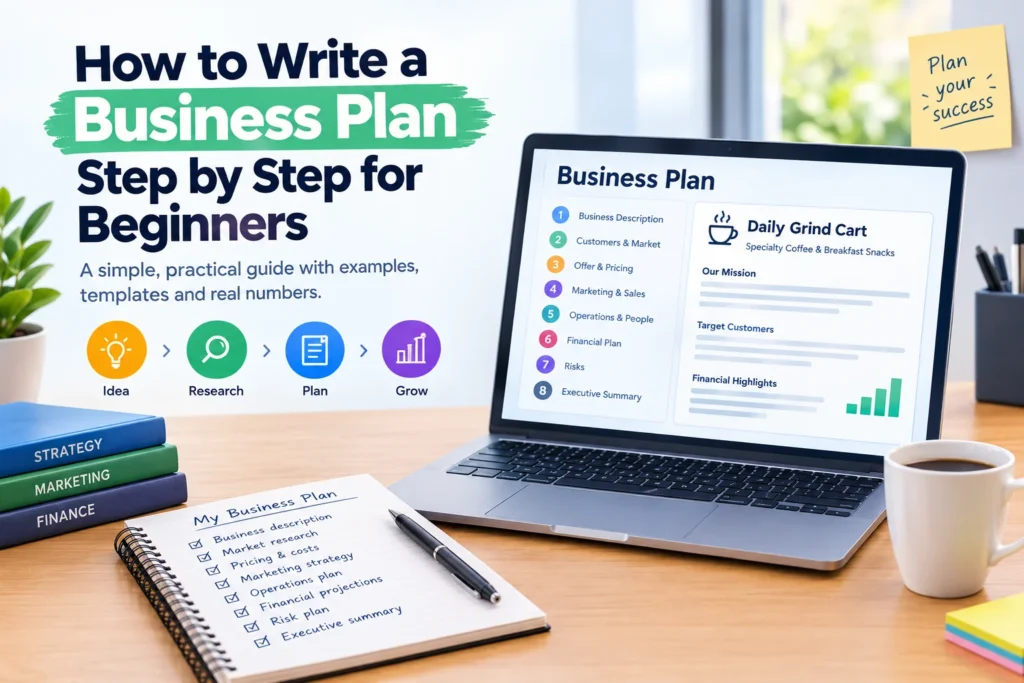
Most people put off writing a business plan because they think it needs a finance degree and fifty pages. It does not. This guide shows how to write a business plan step by step for beginners, using one small example business so you can see every section filled in. You will get a simple business plan format, copy and paste templates, and the three calculations that make your numbers believable. By the end, you will have a clear path from a rough idea to a plan that a lender, a partner, or you yourself can actually use. Let us start with the quick version.
Table of Contents
The Plan at a Glance
| Step | What you write | Time needed |
| 1. Business description | What you sell, to whom, and your first year goal | 30 minutes |
| 2. Customers and market | Who buys, how many, and who you compete with | 2 to 3 hours |
| 3. Offer and pricing | Products, prices, and cost per item | 1 hour |
| 4. Marketing and sales | Two or three ways you will find customers | 1 hour |
| 5. Operations and people | Where, how, and who does the work | 1 hour |
| 6. Financial plan | Startup costs, break even, monthly profit | 2 to 3 hours |
| 7. Risks | What could go wrong and your backup | 30 minutes |
| 8. Executive summary | A one page snapshot, written last | 45 minutes |
Throughout this guide, we will build a plan for a made up business called Daily Grind Cart, a coffee cart serving two office parks. Swap in your own details as you read.
Pick the Right Business Plan Format
Before you write, choose a business plan format that matches your goal. Many beginners lose weeks writing a long plan when a short one would have worked.
| Format | Length | Best for | Time to write |
| One page plan | 1 page | Testing an idea, a side business, quick internal use | 1 to 2 hours |
| Lean plan | 2 to 5 pages | Most beginners, early startups, small loan requests | 1 to 2 days |
| Traditional plan | 8 to 15 pages | Bank loans, investors, larger projects | 1 to 2 weeks |
If you are unsure, start with the one page version. You can expand it later, and the method for how to write a business plan step by step for beginners below works for all three formats. Most governments also publish free templates on their small business websites, so check yours before paying for software.
Create a Business Plan From Scratch: Test the Idea First
A plan built on a guess is just a longer guess. Spend a few days checking that people will pay for what you want to sell.
- Talk to buyers. Ask ten people who match your ideal customer what they use now and what annoys them.
- Study the competition. Visit competitors, note their prices, and see what customers complain about in reviews.
- Test demand. Offer a sample, a pre order, or a simple landing page and count real responses.
- Check the price. Write down what it costs to make one unit and what customers might pay.
If these tests go well, you are ready to write. If they go badly, you saved yourself a lot of money.
How to Write a Business Plan Step by Step for Beginners
Work through the eight steps of this business plan guide in order. Keep each section short and specific. Every step has a fill in template or a filled in example from Daily Grind Cart, and the numbers in Step 6 build on the prices and costs from Steps 3 to 5.
Step 1: Describe Your Business
Explain what you sell, who it is for, where you operate, and why you are the right person to do it. Five sentences are enough. Add your legal structure and location if you know them.
[Business name] sells [product or service] to [customer] in [place].
We stand out because [one clear reason].
Our goal for year one is [a measurable number].
Example: Daily Grind Cart sells specialty coffee and breakfast snacks to office workers at two business parks. We stand out because customers can pre order and skip the queue. Our goal is to sell 45 drinks a day by month six.
Step 2: Know Your Customers and Market
Describe one main customer in plain words, such as age, job, habits, and budget. Then estimate your market size by counting real people. Do not quote huge global numbers that have nothing to do with your area.
- Count how many potential customers are within reach of your location.
- List three direct competitors with their prices, strengths, and weak spots.
- Use free sources such as local government data, your chamber of commerce, and short surveys.
Example: About 1,200 people work in the two parks. The nearest cafe is a ten minute walk and charges $5.50 for a latte. If we capture just 4 percent of workers each day, we reach 48 customers.
Step 3: Define Your Offer and Pricing
List what you sell, the price, and what each item costs you to make. This cost per item feeds your financial plan later, so do not skip it.
Example: A latte sells for $4.00 and costs $1.00 in milk, coffee, and a cup. Pastries are bought in at $1.50 and sold at $3.50. Prices sit below the nearest cafe but leave a healthy margin.
Step 4: Plan Your Marketing and Sales
Choose two or three channels you can actually manage. A beginner who tries ten channels usually does none of them well. Set one number to track for each.
Example: We will use a paper loyalty card, daily posts on a local community page, and a free tasting morning for office managers. Our target is 60 loyalty sign ups a month.
Step 5: Explain Operations and People
Describe where the work happens, who supplies you, what equipment you need, and who does which job. Readers want proof that you can deliver daily, not just on your best day.
Example: The owner runs the cart from 7 am to 1 pm, five days a week. Milk and beans come from a local supplier with a backup supplier in place. A part time helper joins in month four if sales pass 40 drinks a day.
Step 6: Build the Financial Plan
Numbers are the part of how to write a business plan step by step for beginners that scares most people, but you only need three calculations. Use simple numbers you can defend and write down how you got them.
Calculation 1: Startup Costs
Add up everything you must pay before the first sale. Include a cash buffer, because early months rarely go to plan.
| Startup item | Cost |
| Cart and equipment | $6,000 |
| Permits and insurance | $800 |
| Opening stock | $700 |
| Branding and signage | $500 |
| Cash buffer (one month of fixed costs, plus a little extra) | $2,500 |
| Total startup cost | $10,500 |
Calculation 2: Break Even Point
Break even tells you how much you must sell just to cover costs. The formula is simple.
Break even units = Fixed costs per month / Profit per unit
Daily Grind Cart has fixed costs of $2,350 a month: pitch fees $600, insurance $100, loan repayment $200, supplies and phone $100, and owner pay $1,350.
| Item | Figure |
| Price per drink | $4.00 |
| Cost per drink | $1.00 |
| Profit per drink | $3.00 |
| Fixed costs per month | $2,350 |
| Break even drinks per month | 784 |
| Break even per trading day (26 days) | About 31 |
Our goal of 45 drinks a day is comfortably above the 31 drink break even. That means about 1,170 drinks a month, $4,680 in sales, and roughly $1,160 in profit after fixed costs. Always show a cautious case too, such as 35 drinks a day, so readers see you have thought about slow weeks.
Calculation 3: Monthly Cash Flow
Profit and cash are not the same thing. Cash flow tracks the money actually moving in and out each month. A business can be profitable on paper and still run out of cash if you pay suppliers before customers pay you. Build a simple twelve month table with money in, money out, and the closing balance, and keep at least one month of fixed costs in reserve.
Funding Needs
State how much you need and where it will come from. Daily Grind Cart needs $10,500: $4,500 from savings and a $6,000 loan. Common routes include:
- Personal savings, which lenders like to see because it shows commitment.
- Family or friends, ideally with a written agreement.
- Bank or credit union loans, which usually ask for a full plan.
- Government backed loans or small business grants, where available in your country.
- Investors or crowdfunding, which suit businesses with strong growth potential.
Step 7: Name Your Risks
Naming risks does not make you look weak. It shows you have thought ahead. List three to five and give each a response.
| Risk | Backup plan |
| Rain keeps customers away | Move under the covered walkway and offer app pre orders |
| Main supplier is late | Keep a second supplier and one extra day of stock |
| Sales stay below break even | Cut trading days, run a lunch offer, review prices |
Step 8: Write the Executive Summary Last
The executive summary sits at the front of your plan, but you should write it last. It is a short snapshot, ideally one page or less, that lets a busy reader decide whether to read on. Include the business, the customer, the offer, your key numbers, and what you are asking for.
[Business] is a [type] serving [customer] in [place].
We offer [product] at [price], which is [advantage].
We expect [sales] in year one with [profit] after costs.
We are seeking [amount] to [purpose].
Example: Daily Grind Cart is a mobile coffee business serving workers at two business parks. We offer pre order coffee from $4.00, faster and cheaper than the nearest cafe. We expect about 12,000 drinks in year one and a break even point of 31 drinks a day. We are seeking a $6,000 loan to complete a $10,500 startup budget.
Next step: Open a blank document right now and write Step 1. It takes ten minutes, and it makes every other step easier.
Write for the Right Reader
One plan rarely suits everyone. Keep one master version, then adjust the emphasis.
| Reader | Wants to see | Focus on |
| You | A realistic roadmap | Action steps and monthly targets |
| Lender | Proof you can repay | Cash flow, your own money in, assets |
| Investor | Growth and return | Market size, team, how money is used |
| Partner or supplier | A stable, reliable business | Operations, roles, payment terms |
Legal, Tax, and Privacy Basics
Rules differ by country, so confirm details on your government small business website or with an accountant. Most plans should mention four things.
- Legal structure. Common options are sole proprietor, partnership, and company. They differ in personal liability, tax, and paperwork.
- Licences and permits. Check which licences, permits, and food or safety rules apply to your activity.
- Note what cover you will carry, such as liability or equipment insurance.
- Do not put tax file numbers, ID numbers, or bank details in a plan you share. Say they are available on request.
Weak Lines vs Strong Lines
Small wording fixes make a plan more believable. Compare these examples.
| Weak line | Stronger line |
| We will grow fast. | We will grow from 30 to 45 drinks a day by month six. |
| Everyone loves coffee. | About 1,200 workers within a five minute walk have no cafe nearby. |
| We have no real competition. | Three cafes serve the area, but none offer pre ordering. |
| Profits will be high. | Each drink earns $3.00, and we break even at 31 drinks a day. |
If you are learning how to write a business plan step by step for beginners, two more habits help. Keep paragraphs short and avoid jargon. Then review the plan every quarter, because real sales will soon show which assumptions were wrong.
Frequently Asked Questions
How long should a business plan be?
A one page plan works for testing ideas. Most beginners need 5 to 10 pages, and anything above 15 pages is rarely read.
Do I need a business plan for a small business?
Not legally, in most cases. But a plan helps you spot problems early and is usually required for loans and investors.
What goes first in a business plan format?
A title page, then the executive summary, then the business description, market, offer, marketing, operations, finances, and risks. An appendix holds extras such as quotes and resumes.
How much does it cost to write one?
Nothing, if you use a word processor and a free government template. Paid software or a consultant is optional.
Can I use an AI tool or template?
Yes, as a starting draft. But you must check every number and make the text specific to your business, because lenders can spot generic plans quickly.
How often should I update my plan?
Review it every quarter and rewrite it fully once a year, or before you raise money or make a big change.
Conclusion
Now you know how to write a business plan step by step for beginners: test the idea, choose a format, write the story sections, run the three calculations, name your risks, and finish with the executive summary. You do not need perfect writing or fancy software. You need clear answers and honest numbers.
Pick your format today, copy the templates above, and fill in your first section. Then save the file where you can find it, because the best plan is the one you actually keep updating.