
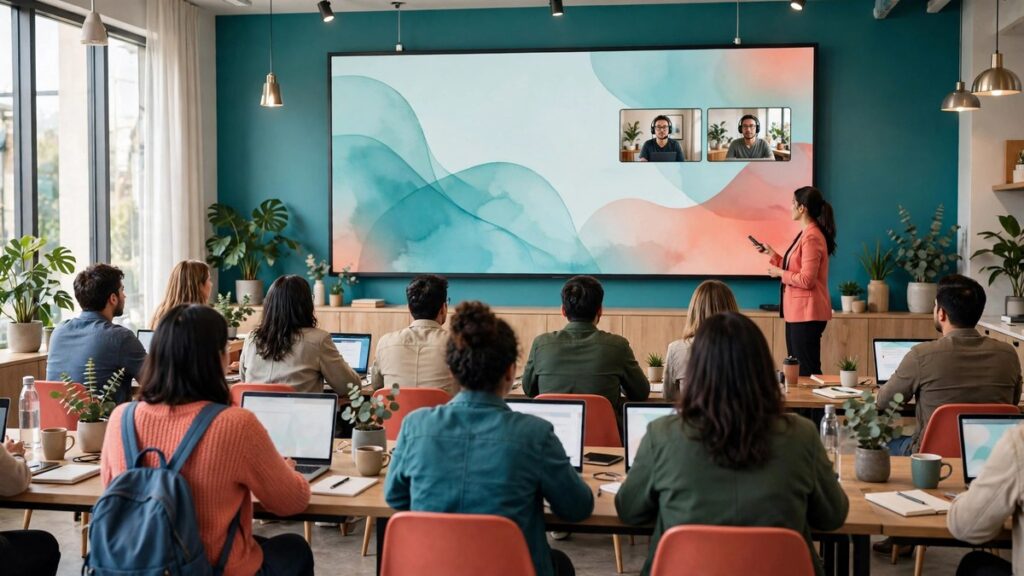
Event marketing is the practice of promoting a brand, product or service through live experiences such as conferences, workshops, trade shows, product launches and webinars. Instead of talking at people through an ad, a business puts its team and its product in front of an audience, and people can ask questions, try things and meet real humans.
If you searched for what is event marketing in business, the short answer is this: it is a way to earn attention and trust through audience participation, then turn that interaction into leads, sales or loyalty. This guide explains how it works, how it differs from experiential marketing, which formats suit which goals, and how to tell whether an event was worth the money.
Table of Contents
What Event Marketing Means
An event can be face to face, fully online or a mix of both. What makes it marketing is the purpose. The event exists to support a business goal such as generating leads, launching a product, educating customers or strengthening relationships with existing ones. A well run event with no goal is just a gathering.
People also use the term in two slightly different ways, which causes confusion. Cvent, a large event technology company, describes both: using events as a marketing channel, and the marketing tactics used to promote an event.
| Meaning | What it covers | Example |
|---|---|---|
| Events as a marketing channel | Hosting or joining events to reach a business goal | A software company runs a live workshop to find new customers |
| Marketing an event | Promotion that fills seats for a specific event | Email campaigns, a registration page and social posts |
Most professionals mean the first one. In practice the two overlap, because even a strong event needs a promotion plan to bring the right people into the room.
Event marketing is also different from event management. Event management covers logistics: the venue, schedule, equipment, catering and staffing. Event marketing covers the audience, the message, the promotion and the business result. Small teams often handle both, but the skills are not the same.
How Event Marketing Differs From Experiential Marketing
Experiential marketing is the term most often mixed up with event marketing. It focuses on audience participation: letting people touch, test or take part in a brand experience instead of watching from a distance. Sources do not agree on which idea contains the other. Wikipedia describes event marketing as part of experiential marketing, while some business guides treat experiential marketing as a subset of event marketing.
A simple way to avoid the argument is to think of the event as the container and the experience as what happens inside it. A trade show is an event. A live demo where visitors build something at your booth is the experiential layer inside that event.
| Event marketing | Experiential marketing | |
|---|---|---|
| Main idea | Promoting a brand through a planned event | Promoting a brand through hands on participation |
| Where it happens | Always tied to an event | At an event, in a store, on the street or online |
| Audience role | Can be passive (a keynote) or active (a workshop) | Usually active |
| Example | A conference with talks and exhibitor booths | A popup where visitors try a product |
Most businesses use both. The more your event invites people to do something, the more it behaves like experiential marketing.
Types of Event Marketing and What Each One Suits
The right format depends on your goal and your audience, not on what looks impressive. This table is a general guide, not a benchmark.
| Format | Best for | Typical audience | Effort |
|---|---|---|---|
| Conferences and summits | Thought leadership, relationships | Industry professionals | High |
| Trade shows | Meeting buyers, capturing leads | People already looking for solutions | Medium to high |
| Product launches | Announcing and demonstrating something new | Customers, press, partners | Medium |
| Workshops and training sessions | Educating and building trust | Prospects and customers | Low to medium |
| Webinars and virtual events | Reaching a wide audience at low cost | Remote prospects | Low to medium |
| Hybrid events | Serving local and remote attendees together | Mixed audiences | High |
| Popups and community events | Local awareness and word of mouth | Nearby customers | Low to medium |
Five ways a business can take part
You do not have to host your own event to benefit from event marketing. Businesses usually take one of these roles:
- Host: you run the event and control the audience, format and follow up.
- Exhibitor: you set up a booth at someone else’s event and talk to attendees directly.
- Sponsor: you fund part of an event in exchange for visibility.
- Speaker or panelist: you share expertise on stage or in a webinar, which builds credibility.
- Partner: you co host with another business and share the audience and the cost.
How Event Marketing Works From Start to Finish
Every successful event follows the same arc. The work before and after the event usually decides the result more than the event day itself.
Before the event
Start with one goal, such as qualified leads, trial sign ups or customer renewals. Then decide who you want in the room and what would make attending worth their time. Promote through the channels your audience already uses, such as email, social media, partners and a simple registration page. Keep the date, place, benefit and registration link consistent everywhere, and send reminders to reduce no shows.
During the event
Design for participation. Live demos, small group sessions, polls and open questions work better than a long presentation. Capture leads with context: a note about what the person asked or needed is worth more than a scanned badge. If attendees agree, capture photos, short clips and quotes you can reuse later.
After the event
Follow up quickly. Many event teams aim to reach attendees within 48 hours, while the conversation is still fresh. Send people what you promised, treat attendees and people who did not attend differently, and move contacts into your CRM with notes. Then review what worked.
A useful habit before any event: write the single goal and the single follow up action on one page. Every other decision becomes easier.
A Practical Example for a Technology Company
The scenario below is illustrative, not a real case. A small software company that sells workflow automation tools hosts a 90 minute live workshop for operations managers. The goal is 40 qualified trial sign ups.
- The registration page asks three short questions: team size, current tool and biggest frustration.
- During the session, attendees build a simple automated workflow in a sandbox account while the presenter answers questions.
- The presenter uses the registration answers to choose relevant examples.
- Within 48 hours, attendees receive the recording, a workflow template and an invitation to book a setup call. People who registered but did not attend receive the recording only.
- Each promotion channel uses a tagged link, so the team can see which channel produced sign ups.
The workshop works because attendees do something instead of only watching, and because the follow up matches what each person said they needed. Large technology companies apply the same logic at a bigger scale. HubSpot’s INBOUND conference is one widely cited example of a company event built around education, community and product exposure.
Why Businesses Use Event Marketing
The benefits come from direct contact. Typical advantages include:
- Real conversations and quick feedback. You see reactions and hear objections immediately.
- Trust. People who meet your team in person or on a live call tend to remember you better than a name in an inbox.
- Better signal on interest. Someone who chose to give up an hour of their day is usually more engaged than a random click.
- Reusable content. Talks, clips, questions and testimonials can feed your other channels.
Industry surveys point the same way, with a caveat. Cvent’s 2026 research reports that 68% of marketers rank events as their most effective marketing channel and 83% say events produce a steady flow of revenue. Bizzabo reports that 78% of organizers see live conferences, summits and conventions as their most impactful marketing channel. Both come from event technology companies surveying event professionals, so respondents may lean favorably toward events. Treat the figures as indicators, not guarantees.
Budgets reflect this interest. A forecast from AMEX GBT, cited by Cvent, puts the average share of marketing budgets spent on events at about 14%. Yet measurement remains a weak spot: a 2026 Vendelux survey found that 44% of respondents call events influential for pipeline but hard to measure.
How to Measure Event Marketing Success
Choose metrics that match your goal. Awareness events lean on attendance and reach. Engagement events lean on participation and satisfaction. Sales driven events need lead and revenue numbers. Define what counts as a qualified lead before the event, so everyone counts the same way.
| Metric | How to calculate it | What it tells you |
|---|---|---|
| Registration to attendance rate | Attendees divided by registrants | How relevant and well timed the event was |
| Qualified lead rate | Qualified leads divided by all leads | Quality of the audience and lead capture |
| Cost per qualified lead | Total event cost divided by qualified leads | Efficiency of the spend |
| Conversion rate | Converted leads divided by qualified leads | Sales impact after follow up |
| Event ROI | (Attributed gross profit minus total event cost) divided by total event cost, times 100 | Overall financial return |
Here is a worked example with made up numbers. An event costs $10,000 and produces 40 qualified leads, so the cost per qualified lead is $250. Six of those leads become customers and generate $18,000 in gross profit. ROI is (18,000 minus 10,000) divided by 10,000, which equals 80%.
For longer B2B sales cycles, separate sourced pipeline from influenced pipeline. Sourced pipeline is opportunities that began because of the event. Influenced pipeline is opportunities already in progress where a contact attended or engaged. Report them separately, avoid counting the same sale twice, and pick a measurement window that fits your sales cycle, which may be several months.
Common Mistakes to Avoid
- Running an event without one clear goal.
- Counting every badge scan or business card as a qualified lead.
- Treating the event day as the finish line instead of the start of follow up.
- Filling the room with the wrong audience because the topic was too broad.
- Packing the agenda with talks and leaving little room for audience participation.
- Measuring only attendance, which says little about business impact.
- Skipping practical planning such as accessibility details, captions for online sessions and a backup internet connection.
If you are starting small, one workshop with a clear follow up plan will teach you more than a large event you cannot measure.
Event Marketing for B2B Teams and Small Businesses
The goal and the measurement change depending on who you sell to.
| B2B | B2C | |
|---|---|---|
| Typical goal | Qualified meetings and pipeline | Sales, awareness and loyalty |
| Sales cycle | Long, with several decision makers | Short |
| Common formats | Conferences, webinars, executive dinners, workshops | Popups, launches, community events |
| Key measures | Influenced pipeline, cost per qualified lead | Sales, redemptions, sign ups, social reach |
Small businesses can use the same ideas with smaller budgets: a local workshop, a tasting, a product demo day or a short webinar. A registration form, an email tool and a spreadsheet are enough to start.
Tools That Support Event Marketing
Most event programs rely on a few types of tools: registration and ticketing, email or marketing automation, check in and lead capture, a CRM and basic analytics. Event platforms such as Eventbrite, Cvent and Bizzabo bundle several of these. AI features can help with drafting invitations or grouping audiences, but a person should review the messages before they go out.
Before choosing software, list what you actually need: registration, reminders, check in, follow up and reporting. Then compare options against that list rather than against feature lists.
Frequently Asked Questions
What is event marketing in simple words?
It is promoting a business by creating live experiences, in person or online, where people can meet your team, learn about your product and take part.
What is the purpose of event marketing in business?
The purpose depends on the goal. Common ones are generating leads, launching products, educating customers, building trust and keeping existing customers engaged.
Is event marketing the same as experiential marketing?
No, though they overlap. Event marketing is tied to a planned event. Experiential marketing focuses on hands on audience participation and can happen inside or outside an event.
How far ahead should you promote an event?
There is no single rule. Common guidance is a few weeks for a webinar or small workshop and several months for a major conference. For a small business event, a plan of about 90 days from goal setting to follow up gives enough room.
Can small businesses use event marketing?
Yes. Local workshops, demos and community events need little budget and create personal contact that online ads cannot.
Is event marketing still effective?
Surveys from event industry companies suggest many marketers rate it highly, but results depend on the goal, the audience and the follow up. It is also harder to attribute than a click based channel, so clear measurement rules matter.
Conclusion
Event marketing is about promoting a brand through live experiences that invite audience participation, then following through so the interaction leads somewhere. The format matters less than a clear goal, the right audience and a prompt, relevant follow up. A good next step is to pick one format from the table above, define one goal and plan the follow up before you plan the agenda.