
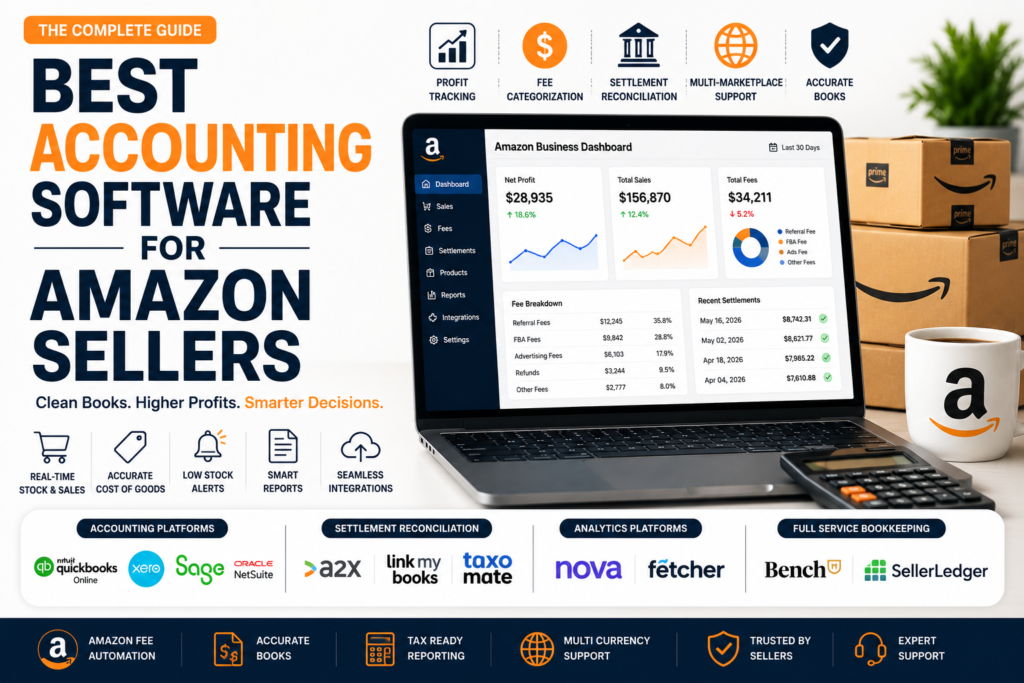
Amazon deposits a net settlement into your bank account every couple of weeks, not your actual gross sales, and that single fact is why generic bookkeeping breaks down for sellers faster than almost any other business type. The best accounting software for Amazon sellers has to separate sales, refunds, advertising fees, storage fees, and reserves before any of it means anything on a profit and loss statement. This guide sorts out something most comparisons blur together, the difference between an accounting platform, a settlement connector, an analytics tool, and a bookkeeping service, since search results mix all four under one ranked list constantly. You will also get real combined pricing, since the connector tools rarely work alone, and a straight look at which AI features are actually usable today versus still on a roadmap. Let us start with the distinction that causes the most confusion.
Table of Contents
What the Best Accounting Software for Amazon Sellers Actually Needs to Do
Before comparing tools by name, it helps to know what the underlying job actually requires, since a lot of generic bookkeeping software quietly skips one or two of these.
- Separate gross sales from net settlement deposits, since Amazon pays out net of fees and refunds, not your actual revenue
- Categorize all nine Amazon fee types correctly rather than dumping them into one generic expense line
- Track cost of goods sold accurately across FBA and FBM operations, including landed costs for imported inventory
- Reconcile each settlement against the actual bank deposit so nothing silently falls through the cracks
- Support multi marketplace and multi currency reporting if you sell beyond a single country
A tool or stack that covers these five solidly matters more than one with a long feature list but weak execution on the basics.
Four Different Tools, One Confusing Search Term
Searching for accounting software for Amazon sellers returns a mix of products that are not actually competing with each other, they solve different pieces of the same problem. Knowing which piece you are missing matters more than picking a single winner from a ranked list.
Accounting platforms. QuickBooks Online, Xero, Sage, and NetSuite are your actual general ledger, where your books live, your taxes get prepared from, and your accountant works. You need one of these regardless of what else you add.
Settlement reconciliation connectors. A2X, Link My Books, and Taxomate sit on top of your accounting platform and translate Amazon’s messy settlement data into clean, categorized entries. These do not replace your accounting platform, they feed it.
Operational analytics platforms. Tools like Nova and Fetcher go further, tracking product level profitability, advertising spend by ASIN, and contribution margins. These answer different questions than your books do, more about which products to promote than what to report to the IRS.
Full service bookkeeping. Services like Bench or SellerLedger pair software with an actual human bookkeeper managing your books for you. This is a genuinely different purchase decision than buying software, since you are paying for expertise and time, not just a tool.
Once you know which of these you are actually missing, comparing options within that category gets a lot more useful than comparing across all four at once.
The Real Combined Cost of a Reconciliation Connector
This is the math that almost never appears in a best accounting software for Amazon sellers roundup. A2X, Link My Books, and Taxomate all publish their own starting price, but none of them replace your QuickBooks Online or Xero subscription, you need both running together.
| Connector | Connector Price | Required Accounting Platform | Real Combined Monthly Cost |
| A2X | From $19 | QuickBooks Online, around $35 and up | Roughly $54 and up |
| Link My Books | From $9 | QuickBooks Online or Xero, around $29 to $35 | Roughly $38 and up |
| Taxomate | From $20 | Xero, around $29 and up | Roughly $49 and up |
Checking both the connector’s pricing page and your accounting platform’s current plans together, rather than looking at either number alone, gives you the real monthly cost before you commit to either one.
Choosing an Accounting Platform
QuickBooks Online is the most common starting point for US based Amazon sellers, largely because most ecommerce accountants and bookkeepers already know it well, and its Amazon Seller Connector can import orders, refunds, and fees directly, though a dedicated connector like A2X still does a more thorough job of separating fee types.
Xero tends to be the stronger choice for international sellers, since its multi currency handling is genuinely well built for anyone selling into the US market from another country. Sage suits UK based sellers who want an all in one accounting solution, while NetSuite is built for sellers who have outgrown a simple general ledger entirely and need inventory, purchasing, and operations managed inside one ERP system. NetSuite’s pricing is rarely published outright, generally running into several thousand dollars a year and requiring a direct sales conversation, which is worth expecting going in rather than being surprised by.
Choosing a Settlement Reconciliation Connector
A2X is the most established option here, with strong daily reconciliation accuracy and wide accountant adoption, making it a safe default if you are working with an ecommerce bookkeeper who already has a preference. Link My Books tends to appeal to sellers on a tighter budget who still want automatic categorization without paying A2X’s slightly higher price. Taxomate leans toward Xero specific workflows and is popular among UK and Australian sellers whose accounting setup already favors Xero’s chart of accounts structure.
Do You Need Analytics on Top of Clean Books
This is the question a lot of sellers do not realize they are actually asking. If your goal is simply accurate books for tax season, a connector plus your accounting platform covers that fully. If you are managing ten or more ASINs and need to know which specific products are actually profitable after advertising and fees, not just which ones sell the most, an analytics platform is answering a genuinely different question your general ledger was never built to answer.
The practical difference shows up clearly in data refresh speed. Reconciliation connectors typically sync on a 24 to 48 hour delay, which is fine for bookkeeping purposes since your books do not need to be current to the hour. Analytics platforms built for daily decision making often refresh hourly instead, which matters if you are adjusting pricing or advertising spend based on same day performance rather than reviewing numbers weekly.
What About Full Service Bookkeeping
Software works well if you or someone on your team is willing to review the numbers regularly and knows what to look for. Full service options exist specifically for sellers who would rather hand this off entirely, and they typically cost more than software alone since a real person is doing the categorization, review, and monthly close. This is worth treating as a genuinely separate decision from picking software, since the question is not which tool is best, it is whether you want to do this yourself at all.
Sales Tax Is Not Fully Handled by Amazon
Amazon collects and remits sales tax automatically in most states under marketplace facilitator laws, which leads a lot of sellers to assume sales tax is fully handled for them. It generally is not. Depending on where you have economic nexus, meaning enough sales activity in a state to trigger a filing requirement, you may still owe your own state level filings even though Amazon already collected the tax on your behalf. Tools like TaxJar and Avalara exist specifically to track nexus thresholds and handle these filings, and are worth budgeting for separately from your core accounting stack rather than assuming your connector or accounting platform covers this automatically.
Are the AI Features Actually Usable Yet
Several platforms in this space now advertise AI features prominently, and it is worth being clear about what is actually available versus what is still a roadmap promise. Some accounting platforms mention AI assistants in their broader marketing without those features being specifically built for Amazon seller workflows. Some analytics platforms list AI powered agents as coming soon rather than shipped. The features that are genuinely useful today tend to be narrower and less flashy, automatic fee categorization and anomaly flagging, rather than anything resembling autonomous financial management. Ask directly during any trial whether a specific AI feature is live today or planned for a future release before it factors into your decision.
The best accounting software for Amazon sellers is rarely a single tool, it is usually a small stack matched to what you are actually missing. Start with a real accounting platform, since that is non negotiable regardless of scale. Add a reconciliation connector once manual settlement entry starts costing you real hours. Consider an analytics platform only once you are managing enough ASINs that product level profitability actually changes your decisions. And be honest about whether you want software at all or would rather hand the whole thing to a bookkeeper. Get that sequence right, and accounting software for Amazon sellers stops feeling like a confusing pile of options and starts looking like a straightforward checklist.